
Anselm Kiefer|深入研究
Germany
1. Artist Profile
安塞尔姆·基弗1945年生于德国多瑙埃兴根,出生时已近第二次世界大战结束;战后德国社会对纳粹历史的沉默、废墟经验与文化记忆的断裂,构成其艺术最深层的历史背景。他先学习法律,1966年转向绘画,后在弗赖堡、卡尔斯鲁厄接受艺术训练,并于20世纪70年代初与约瑟夫·博伊斯在杜塞尔多夫形成重要的师生关系。博伊斯使他理解艺术可以扩展至社会、神话、精神性与材料能量,但基弗并未沿袭行动艺术的轻盈姿态,而是把绘画推向沉重、粗粝且近乎考古现场的物质形态。 1969年的《占领》摄影行动是其重要转折:他身着父辈遗留的军服,在欧洲多地作出纳粹敬礼姿势,以高度冒犯性的图像迫使观看者面对德国尚未被处理的历史。这并非对权力符号的赞美,而是以扮演、挪用和不适感揭开集体记忆中的压抑。此后,他从德国浪漫主义风景、瓦格纳歌剧、北欧神话、诗歌与哲学中提取母题,将民族文化的崇高传统与法西斯主义对其的篡用并置,使宏阔田野、森林、建筑与焦土同时具有纪念碑、舞台和墓地的意味。 20世纪70年代中后期起,基弗逐步以稻草、灰烬、泥土、铅、乳胶、虫胶、枯萎植物等介入画面;材料不只是肌理装饰,而是直接承担观念。稻草易燃,令土地与历史显出毁灭后的脆弱;灰烬保留燃烧的残余;铅因其重量、黯淡与可变性,连接炼金术、记忆、死亡和转化。颜料、沉积物与实物彼此覆盖、龟裂、坠落,使绘画表面获得浮雕般厚度,也使时间不再被描绘,而像沉积层一样被实际制造出来。1980年代表德国参加威尼斯双年展后,他的国际影响力确立;其后创作进一步延展至铅书、雕塑、木刻、摄影、建筑性空间与大型场域装置,并将犹太神秘主义、古代文明、宇宙学与战争记忆纳入更广阔的文明循环。 基弗在战后德国绘画及新表现主义语境中占据关键位置,但其价值不止于“历史绘画”的复兴。他以材料的重量、腐蚀性和不稳定性抵抗图像的单一叙事,证明综合材料能够成为思考历史创伤、知识遗迹与精神重建的方法。对综合材料艺术研究而言,他尤其重要:材料选择、制作过程、画面结构与历史观念在其作品中不可分割,物质的燃烧、堆积、下坠与裂变,本身就是作品的叙事与批判力量。
2. Artistic Concepts
基弗的艺术观念始终围绕“历史如何以废墟、神话和物质残骸的形式继续存在”展开。他出生于第二次世界大战结束之年,成长于战后德国;对他而言,历史并不是可以被整齐归档的过去,而是渗入语言、建筑、土地、民族传说与集体记忆的未决创伤。其早期以身体行动和摄影触及纳粹符号,采用带有挑衅性的姿态,并非重演权力崇拜,而是逼视战后社会对罪责、记忆和文化传统的回避。他由此提出一个关键问题:一个民族能否在压抑自身历史的条件下重建文化身份?这种观念使他的作品从一开始便带有矛盾性——既调用德国浪漫主义、英雄传说和古典建筑,又不断揭示这些文化资源如何曾被意识形态挪用。 进入二十世纪七十至八十年代后,基弗逐步将个人姿态转化为宏大的绘画性场域。荒地、田野、森林、厅堂、书架和废墟般的建筑不只是叙事背景,而是历史沉积的视觉结构:透视线常被拉向遥远而封闭的中心,造成纪念碑式的崇高感,同时也使观看者感到被空旷、沉重与失序所压迫。他把诗歌、神话、圣经故事、犹太神秘主义以及炼金术观念并置,拒绝以单一民族史解释灾难,而是将德国问题扩展为文明如何在创造、毁灭、遗忘与救赎之间循环的问题。尤其在与保罗·策兰诗歌相关的思考中,金色麦秆、焦黑颜料、灰烬般的表面形成脆弱与毁灭的对照,使文化记忆不再停留于文字说明,而成为可被直觉感知的伤痕。 材料在基弗那里不是绘画之后的装饰,而是观念生成的核心。铅的沉重、柔软和易氧化,使其既像档案、墓碑,也像承载知识而难以翻阅的书页;稻草、种子、泥土、枯枝等有机物指向生长、收获、腐败和再生;灰烬、焦木、沙土与厚重颜料则把燃烧和侵蚀直接留在画面中。通过堆积、覆盖、焚烧、刮削、拼贴和让材料自然老化,他使作品表面呈现地层般的时间厚度。裂缝、结块与脱落并非制作中的缺陷,而是反对光洁、稳定和封闭意义的方式:历史正是在不断破碎中显形。 其后期观念进一步由德国的创伤记忆延伸至宇宙、古代文明、宗教图像、植物生命与知识系统。绘画、铅书、雕塑、装置乃至建筑性空间相互连通,表明他不再将作品理解为单幅图像,而视为可供行走、阅读、想象和迷失的精神地景。基弗并不提供历史和解的简单答案;他以巨大尺度、低沉色域和近乎考古的材料劳动,使观看成为一次面对文明残余的经验,并在毁灭性的物质之中保留微弱而顽强的生成可能。
3. Main Materials, Manufacturing Processes, and Technologies
基弗的材料选择首先建立在物质自身的重量、脆弱性、可燃性与时间性之上。铅是其最具标识性的媒介:它质地沉重而柔软,可被压延、折叠、切割和覆盖,表面又会因氧化呈现灰白、暗黑的沉积感。基弗常将铅板制成书页、衣物、建筑性构件或覆盖于图像之上,使金属既像档案与碑铭,也像被历史压迫后的残骸。铅的物理重量转化为观看中的心理重力,令知识、记忆与文明不再是抽象概念,而成为难以搬动、难以翻阅的实体。稻草、枯枝、植物、泥土、沙粒与灰烬则具有相反的属性:轻、干、易碎,并直接携带生长、燃烧、腐朽和死亡的过程。它们常被嵌入厚重的油彩、丙烯、乳液或虫胶层中,通过堆积、粘附、刮削、覆盖和局部灼烧,形成龟裂、焦化、隆起或剥落的表面。虫胶的黏结性和暗褐色光泽,使颜料与杂质般的颗粒凝结为近似地层的皮肤;泥土、灰烬和砂砾则削弱绘画的纯净色彩,使画面转向土黄、灰黑、铅白、焦褐等沉积性色域。由此,绘画不再是描绘风景的平面,而像被开掘的废墟、烧灼过的田野或不断风化的墙面。基弗也将摄影图像、文字、书籍和现成物纳入绘画与雕塑,使拼贴、覆盖和物质侵蚀共同改变图像的可读性。其技术核心并非装饰性混用,而是让材料彼此冲突:金属的持久与植物的凋零、厚涂的凝固与裂缝的失控、书本的知识性与铅页的封闭性相互并置。这种近乎炼金术式的材料语言,使历史、神话、战争创伤与宇宙性想象获得可触的物质形态,并将“记忆如何被保存、掩埋与再度显现”的观念落实为作品自身的生成过程。
4. A Detailed Examination and Analysis of 10 Representative Works
Work 01
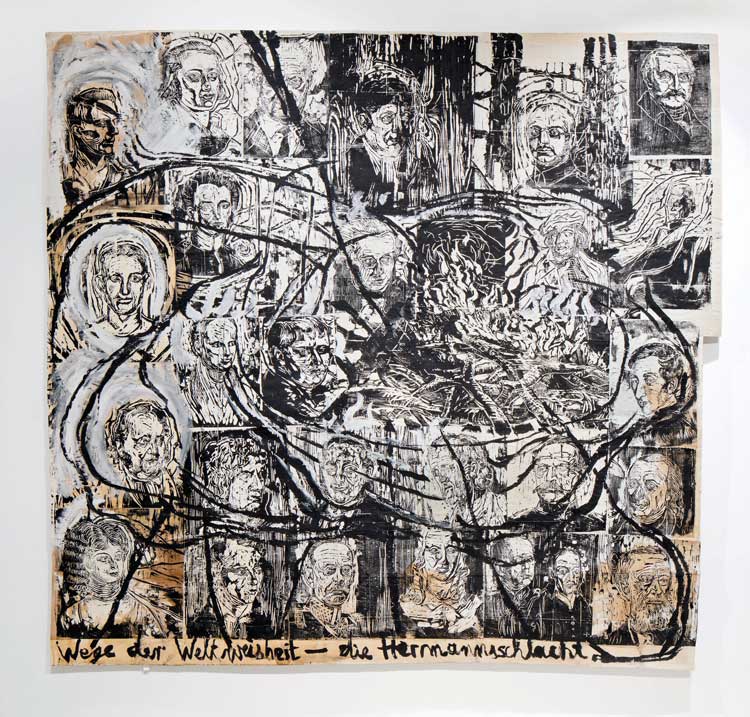
The image unfolds on a nearly square paper plane, with dense black lines running horizontally across the entire surface, scratching marks and cutouts of human figures pressed against each other. The composition lacks a stable central perspective; instead, several heavy, curved, and repeatedly crossed black arcs run through the entire width; they are like roads, vines, wire, or remnants of action left after being wiped over, forcibly binding different human faces into the same visual network. The center-right position features a mass of light-colored flames rolling upward; the lines surrounding them are more tangled, forming the focal point of the image. Most of the figures appear in frontal, side, or half-length portraits, with facial contours drawn rapidly and sharply; the eye sockets, nasal bones, and lips are often compressed into gloomy black-and-white relationships; they are both like fragments of historical portraits and like ghosts that emerge from the surface of the material and are always about to disappear. Color is strictly limited to black, white, gray, and muddy yellow-brown, with black taking on the function of contouring while also exerting oppressive spatial depth through large patches of ink, vertical brushstrokes, and residues of erased tissue; light brown emerges from the local underlayer, making the stark black-and-white image appear with the time-lapse effect of paper aging, smoke, or soil deposits. The edges of the image are not neat; the paper has folds, wear, and irregular margins, indicating that the artist did not pursue an enclosed and flawless image; instead, he preserved the friction, overlapping, and damage inherent in the production process. From visible traces, the artist juxtaposes painting, writing, carving, and collage techniques: some figures appear to have been scraped out from the dark underlayer, while others are covered by rapid black lines; the partial vertical brushstrokes resemble rain clouds or fences, blocking the view. The bottom shows a line of handwritten German text; the text does not serve as a descriptive title; instead, it enters the image in a sloppy, disjointed handwriting, reinforcing the unstable state of language and historical memory. This treatment is consistent with Kiefer’s ongoing path: he does not view history as a narrative that can be reconstructed completely; he transforms it into a surface filled with ruins, conflict, and material resistance. The figures, flames, writing, and tangled lines form a collective memory that is recalled but cannot be placed.
Work 02
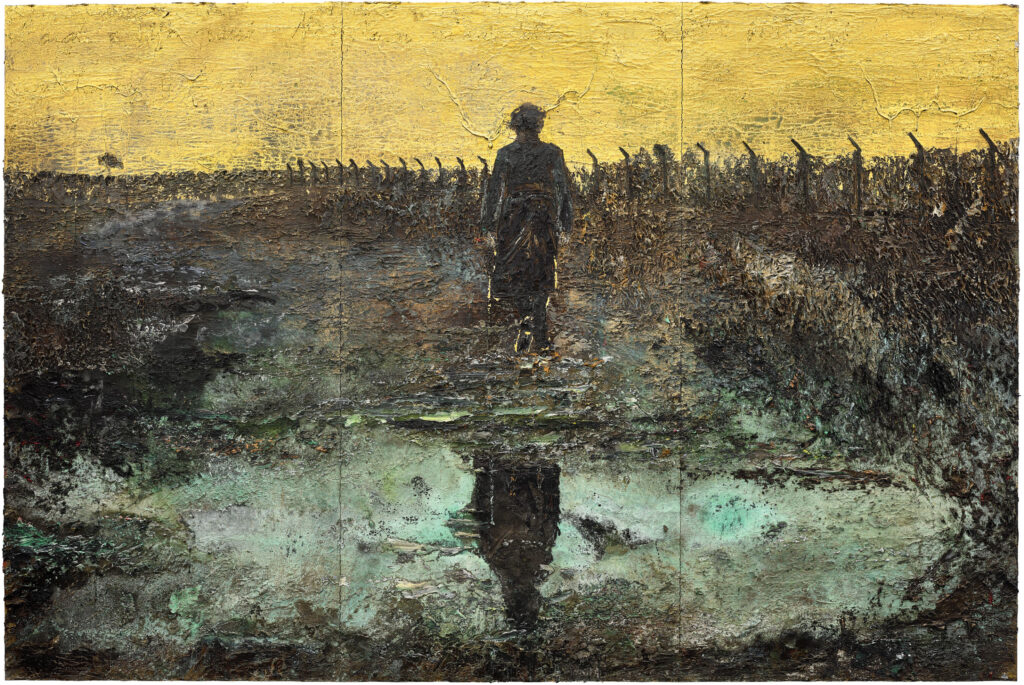
The image builds up a suppressed and enclosed landscape with almost symmetrical horizontal planes: the large, golden-yellow sky above is like a layer of heavy metallic curtain wall; the dense, sloping rods in the horizon form a continuous line of obstruction, simultaneously constituting a barrier-like separation and compressing the distant landscape into an inaccessible boundary. In the center, a dark-skinned figure stands facing the viewer; he stands in front of a desolate wetland; his vertical body forms a dark axis that runs through the image, separating the distant landscape into three interconnected layers: land, water surface, and the reflection. The central figure is not a narrative protagonist; rather, it is a unit of scale held together by the land, the barriers, and the canopy. The foreground water is a murky green, grey-white, and black-brown color, with the horizontal accumulation of mud forming a spatial division between the land, the water surface, and the reflection. The core conflict of the color scheme comes from the bright, unwarm gold above, contrasted with the dark, brown, copper-rust, and cold-green tones below. The golden color does not bring about transcendent lightness; instead, it appears old and damaged due to its widespread cracks, scratches, and stains; the cold green water surface is not a transparent natural color, but rather a layer of sediment generated by oxidation, mold, or deposition. The figures are sculpted from dense black, dark brown, and a small amount of gray-bright brushstrokes; the edges are constantly engulfed by the surrounding mud, making the body, clothing, and surface share the same wear-and-tear state of matter. Visible are repeated layers of production marks covering, scraping, piling, and pressing down. The vertical and horizontal lines of light and shadow across the sky create a tactile surface that approximates a wall skin or metallic oxide layer; the ground consists of granular, thick layers of mud, bound together by sticky dark masses and short scratches; it mimics the mud, but also directly presents the real changes of material affected by gravity, drying, and friction. The fence is not drawn with precise perspective, but is composed of rough vertical and oblique lines that reinforce the sense of confinement. This way of creating images from material loss corresponds to Giefer’s long-standing interest in historical memory, ruins, mythological symbols, and spiritual weight. The work does not treat the land as a landscape for viewing; it is instead treated as a surface carrying trauma, time, and the remnants of the spirit. The figures, reflections, barriers, and the cracked golden canopy together cancel out the stable sense of reality: the gaze forward is blocked, and the downward reflection leads the subject into an uncertain self-reflection. Thus, the material’s heaviness and the corrosion of color and composition work together to make the landscape an entity of historical psychology.
Work 03
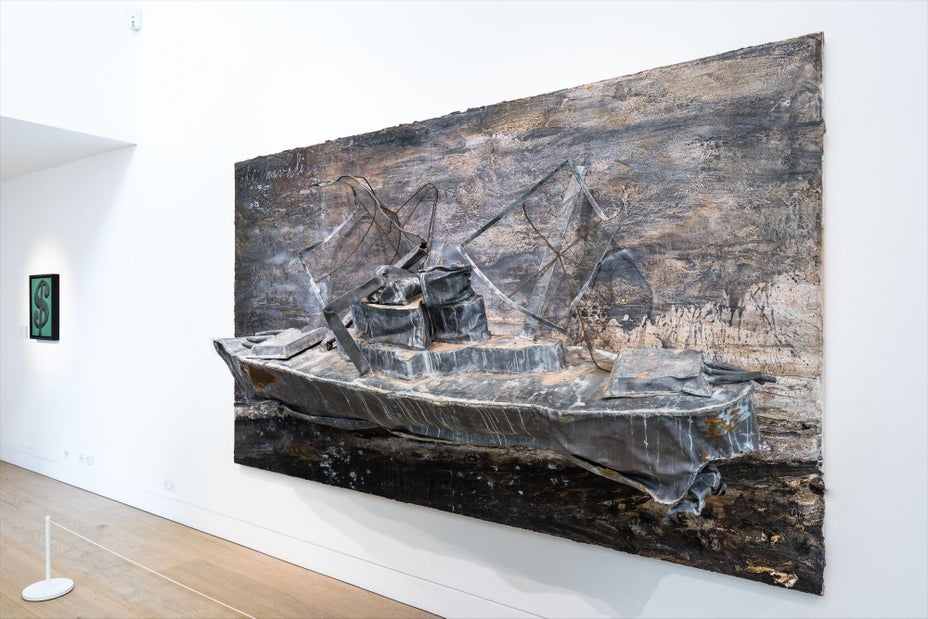
The image occupies the main part of a horizontally stretched hull, with the immense dark rectangular baseplate resembling both a sea surface and a sky, and also a wall that has been eroded by time repeatedly. The bow is slightly raised to the left, and the stern sinks and is damaged at the right end, forming an unstable oblique dynamic. The protruding reliefs on the hull previously detached from the background; the cockpit, deck, and deckboard are compressed into rough geometric forms; numerous slender curved elements extend upward from the deck, resembling broken masts, cables, or cluttered writing marks. They connect the solid hull with the flat surface behind, while at the same time destroying the clear perspective order, transforming the sense of direction into a lingering, tangled state. The overall color is strictly confined to lead gray, charcoal black, brown rust, and gray-white. The upper layers of the background, with their cooler grays and near-black browns, form a heavy layering that distorts the clear perspective order, making the sense of direction in the navigation become a lingering, tangled state. The overall color is strictly restrained between lead gray, charcoal black, brown rust, and gray-white. The upper layers of the background, with their colder grays and near-black browns, form a heavy layering that distorts the clear perspective order, making the sense of direction in the navigation become a lingering, tangled state. The color does not serve to document the realistic representation of the ship’s appearance; rather, through its dark, low-luminance relationships, it approaches the wreckage, relics, or fragmented historical fragments that have been sealed away. The surface treatment clearly emphasizes the accumulation, wrinkling, embossing, and scratching. The hull can be seen with wrinkled layers and longitudinal flows; the edges are not smooth, with some areas resembling torn, bent, or melted seams; the background also retains thick coatings, shellac, and granular textures. The metallic gray material and the rough bottomplate create a stark contrast: the former reflects weak light, revealing a cold, hard, oppressive weight; the latter absorbs light, as if accumulating dust, mud, and burnt sediment. The thinness and thickness of the wire material and the blocky mass of the hull interact to create a tension between the plane painting, the relief, and the installation. This approach to combining the ship with a background of ruins and sedimentary material fits Giefer’s ongoing creative path of focusing on historical memory, mythical symbolism, and material deformation. The ship here is not a romantic image of a voyage, but rather a vessel that carries and loses: it seems able to cross over, and at the same time, it is trapped in the weight, corrosion, and cable-like lines. The value of the work lies in allowing the loss of material, the weight, and the surface damage to participate in the narrative, making the history not appear as a single story but rather as a series of difficult-to-remove traces of matter.
Work 04
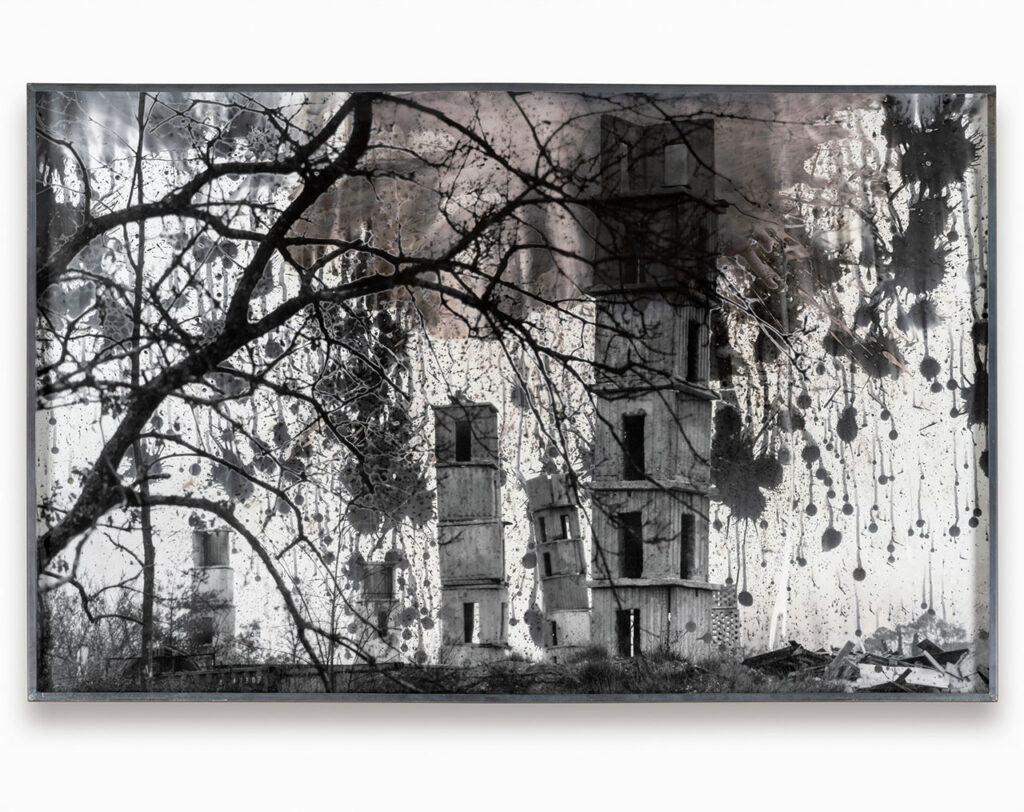
The image is compressed into a narrow metal border, like a sealed-off archaeological site. The foreground is traversed by heavy, distorted bare branches that cross from left to center in a tortuous, twisted pattern. The black silhouette of the branches constantly forks, constituting a barrier to the view and also resembling a net covering the building and the sky. The mid- and rear scenes are erected with several gray-white tower-like structures: they are stacked in layers of varying sizes and angles, with some slightly inclined and featuring dark, narrow rectangular holes. The tallest tower is located in the center of the left side, and its unstable verticality and the expansion of the branches horizontally and obliquely form a strong contrast. The bottom of the image is barren with grass and shrubs and scattered debris at the right corner. These structures do not present a complete monument-like image; instead, they approach the state of ruins, models, and unfinished buildings. The colors are almost compressed to black, gray, and brownish gray. The pale background is not clean; it is dotted with splashes, drips, rubbing, and smudges of dust; the right side is particularly marked by a series of deep, dark drops that fall from the top, reinforcing the sense of time as gravity, seepage, and deposition. The black branches and the dirt are not merely depictions of objects; they are a strong linear structure, repeatedly cutting through the grey-white space; the tower is positioned in the center of the image, yet it is constantly covered by shadows, crack lines, and smudges of dirt; it is difficult to obtain a stable, clear outline. From a visual perspective, the work presents a photographic landscape image, a building-like montage of architectural fragments or a mass of constructed elements, and a powerful linear structure that repeatedly cuts through the grey-white space; the tower is located in the center of the image, yet it is constantly covered by shadows, crack lines, and smudges of dirt, making it difficult to obtain a stable, clear outline. The chromatic compression is almost limited to black, grey, grey-brown, and murky white. The pale background is not clean; it is dotted with splashes, drips, and smears of dirt; the right side is particularly marked by a series of deep, dark drops that fall from the top, reinforcing the sense of time as gravity, seepage, and deposition. The black branches and the dirt are not merely depictions of objects; they are a strong linear structure, repeatedly cutting through the grey-white space; the tower is positioned in the center of the image, yet it is constantly covered by shadows, crack lines, and smudges of dirt, making it difficult to obtain a stable, clear outline. From a visual evidence perspective, the work presents a photographic landscape image, a building-like montage of architectural fragments or a mass of constructed elements, and a powerful linear structure that repeatedly cuts through the grey-white space; the tower is positioned in the center of the image, yet it is constantly covered by shadows, crack lines, and smudges of dirt, making it difficult to obtain a stable, clear outline. From a visual evidence perspective, the work presents a photographic landscape image, a building-like montage of architectural fragments or a mass of constructed elements, and a powerful linear structure that repeatedly cuts through the grey-white space; the tower is positioned in the center of the image, yet it is constantly covered by shadows, crack lines, and smudges of dirt, making it difficult to obtain a stable, clear outline. From a visual evidence perspective, the work presents a photographic landscape image, a building-like montage of architectural fragments or a mass of constructed elements, and a powerful linear structure that repeatedly cuts through the grey-white space; the tower is positioned in the center of the image, yet it is constantly covered by shadows, crack lines, and smudges of dirt, making it difficult to obtain a stable, clear outline.
Work 05
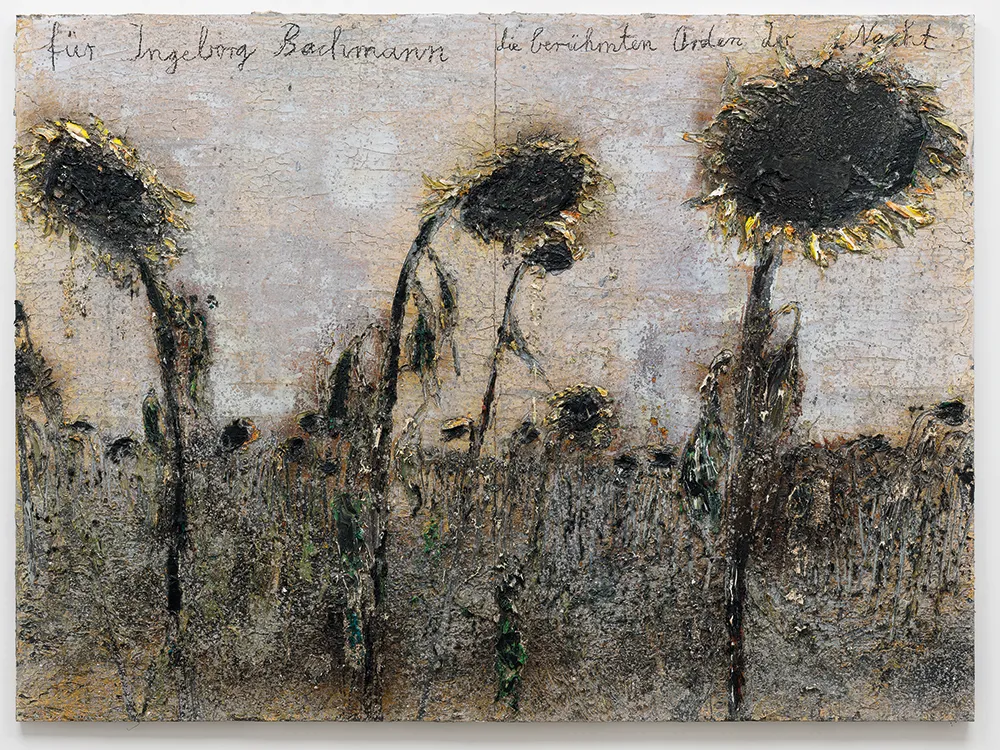
画面以低矮而浑浊的地平线展开,三株高大的向日葵状植物占据前、中、右三处支点:左、右两株近乎直立,中间一株则明显弯折、下垂。它们并不构成明朗的植物写生,而像在一片灰黑色残留物中勉强竖起的碑柱或焦枯遗骸。上方大面积灰白、淡褐与微粉色的天空相对平静,底部却被密集、粗粝的暗色肌理覆盖;横向的空阔与纵向的茎秆彼此牵制,使画面具有压抑而不稳定的空间张力。 色彩被严格收束于泥灰、炭黑、褐黑和铅白般的冷暗范围,只有花盘边缘及茎叶间散见的枯黄、金黄和微弱绿色,像未被完全熄灭的余烬。这些暖色并未带来生机,反而因被黑色团块包围而凸显衰败、灼烧或腐殖后的状态。三枚花盘均以厚重的黑色堆积形成,其轮廓不规则,边缘插入或附着大量尖锐的黄褐色碎片;花朵的“开合”由材料的突起、断裂和投影决定,而非由传统明暗塑造。 表面显然经过反复覆盖、刮擦、堆砌与滴落。背景保留龟裂、剥蚀、擦除后的浅层痕迹,前景则呈现颗粒状、泥浆般的沉积感;细长茎秆被黑色线性物质反复拉拽,局部夹杂暗绿与褐黄的附着物,既像颜料被拖行,也像植物纤维、碎屑或燃烧后的残片嵌入基底。画面顶部的一行手写体文字横贯天空,将图像从单纯风景转化为带有档案、题记或悼念意味的场域;文字轻薄易逝,与下方沉重的物质堆积形成鲜明对照。 这种以真实材料的阻力替代再现性描绘的方法,与基弗长期将历史记忆、诗性语言、土地意象和毁坏性的物质过程并置的观念相呼应。此处植物不是自然的装饰符号,而是承受时间、暴力与沉积的形体。综合色层、粗糙颗粒、焦暗团块和脆弱金黄共同制造出一种介于生长与毁灭之间的状态:图像仿佛从废墟中生成,同时又在自身表面持续瓦解。
Work 06
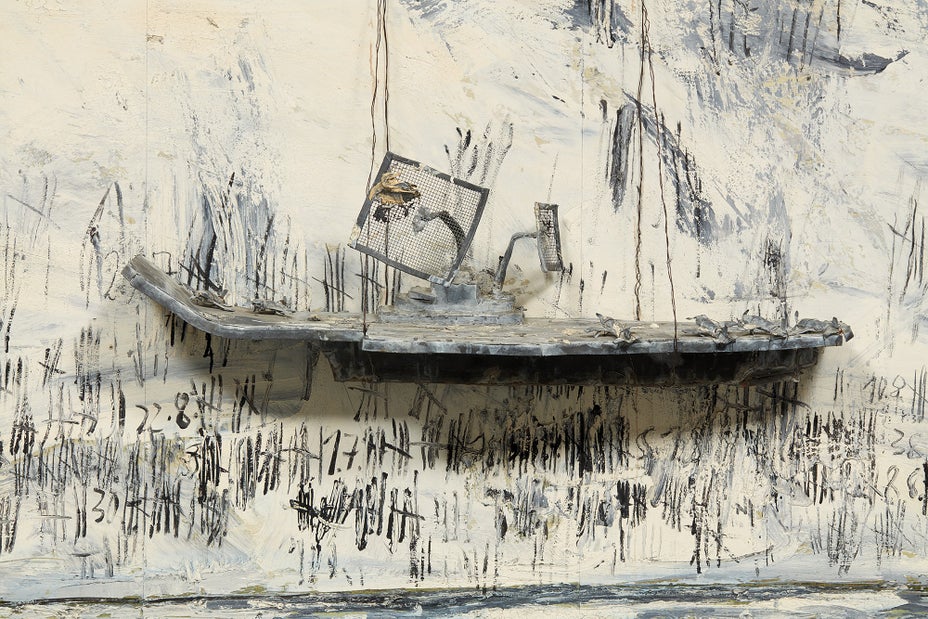
画面以一艘横贯中央的舟形实体建立了强烈的水平轴线。船体略向左上方翘起,右端收束于尖锐的船首,既像停泊在浅滩,也像从画面内部缓慢穿出的残骸。其上竖立着一块倾斜的网格状板件、一段弯曲的金属构件及零散碎片;细长的垂直线又从上缘垂下,使船的重量与悬吊感同时存在。背景并非稳定的风景,而是由纵横擦痕、滴痕、涂抹和近似书写的线条构成的浑浊场域。下方大量黑色竖线向上刺入船底,像芦苇、焦灼的笔迹或被压抑的阴影,令水平的航行意象陷入密集而不安定的地层。 整体色彩近乎被限制在灰白、铅灰、炭黑和局部褐黄之间。大面积泛黄的白并不洁净,表面保留了刮擦、堆积、冲刷后的不均质感;灰蓝色痕迹在上部游移,像冷雾、旧墙面或被抹除的图像。黑色线条既承担空间分割,也作为情绪的沉积:它们有时细如潦草书写,有时被拖成黏重的竖向痕迹,与船体下方深暗的投影互相呼应。因而,画面并非以透视制造深度,而是通过浅色基底、隆起船体和垂直笔触的密度差,形成介于壁面、地表与水面之间的暧昧空间。 船体表面可见厚重、粗粝的附着物,边缘呈现压弯、褶皱、磨损和氧化般的综合色泽。它似乎不是被绘出的船,而是由具有实际重量的板状材料、碎屑与涂层构成,再嵌入绘画性背景之中。网格板和弯曲构件的加入,使其具有临时拼装、修补失败或考古残存的意味;悬垂细线则把制作过程的牵引、固定和下坠感暴露出来。材料的沉重与线条的脆弱形成对照:前者提供历史遗物般的物证性,后者则像记忆在表面反复留下又难以辨认的记录。 这种将绘画、拼贴、浮雕和废墟式建构并置的方法,呼应了艺术家长期对历史记忆、神话性象征、毁坏与再生的关注。图中的舟并未被处理成叙事插图,而更像一具承载与搁浅同时发生的容器;它既指向迁徙、渡越和救赎的古老意象,也因其破损、沉积和难以前行的状态,转化为关于历史重量的视觉结构。作品的价值正在于让材料的真实磨耗、绘画的抹除痕迹与象征性形象彼此牵制,使“历史”不作为完整故事出现,而以残片、阴影和未被修复的表面持续显现。
Work 07
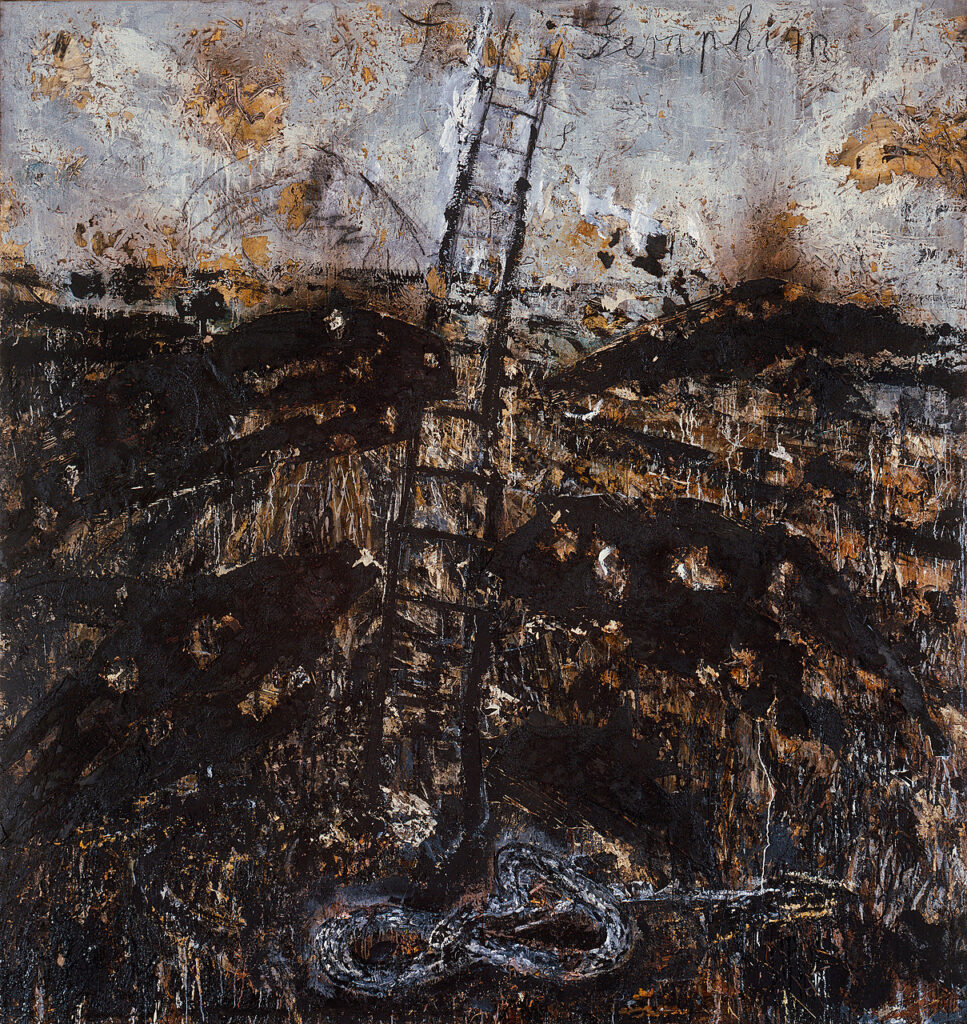
画面以近乎垂直的中轴结构统摄全局:一架细长、深色的梯形构架自下方水面般的椭圆涡旋处竖起,穿过横向展开的黑色土丘,指向上部灰白而浑浊的天空。它既像可攀登的梯子,也像被拉长的树干、残骸或测量尺度;其断续的横档和倾斜轮廓并不提供稳定的上升路径,反而使空间带有摇晃、坍塌的危险感。中景的深黑色带状形体以左右对冲的弧线压过画面,形成沉重的地貌屏障;前景则由密集的竖向、斜向刮痕和黏厚暗层组成,仿佛泥土、焦痕与积水共同沉积而成。 色彩被严格压缩在灰白、铅黑、褐赭和零星土黄之间。上部冷灰并非平整背景,而是由覆盖、擦除、划刻和颗粒化堆积反复生成;褐黄色碎片散布其间,像从表层露出的锈蚀矿物,也使灰白不至于成为纯粹的空无。下部大面积黑褐色吸收光线,局部却因厚涂边缘、刮刀拉痕和浅色残留而闪现湿润或金属般的反光。明暗在此不是再现自然光,而是用来区分表层结壳、裂口、渗漏与覆盖的物质状态。 可见表面具有强烈的建造性:颜料或混合性媒材被堆起、压抹、刮削,再以线性刻划和泼溅痕迹打断。中央构架似由深色涂层反复描出,周边白色和褐色的附着物使它看似从画面底层被艰难地挖掘出来。底部的椭圆形旋涡以较亮的环状笔触围合暗核,像水坑、孔洞或地层开口,将垂直中轴的终点转化为不确定的下沉之处。 这种让风景、建筑性骨架与受损表皮相互嵌合的方法,契合基弗创作中以材料承受历史重量的倾向。图像没有把大地处理为可供观赏的田园,而将其转化为记忆沉积、毁坏痕迹与精神性追问的场域。梯子的向上意象与泥沼般的向下拉力并置:超越的愿望始终必须穿过沉重、破碎且难以清理的现实。作品的力量正在于它不以完整叙事封闭意义,而让粗粝材料、受阻结构和黯淡色域持续制造观看上的抵抗。
Work 08
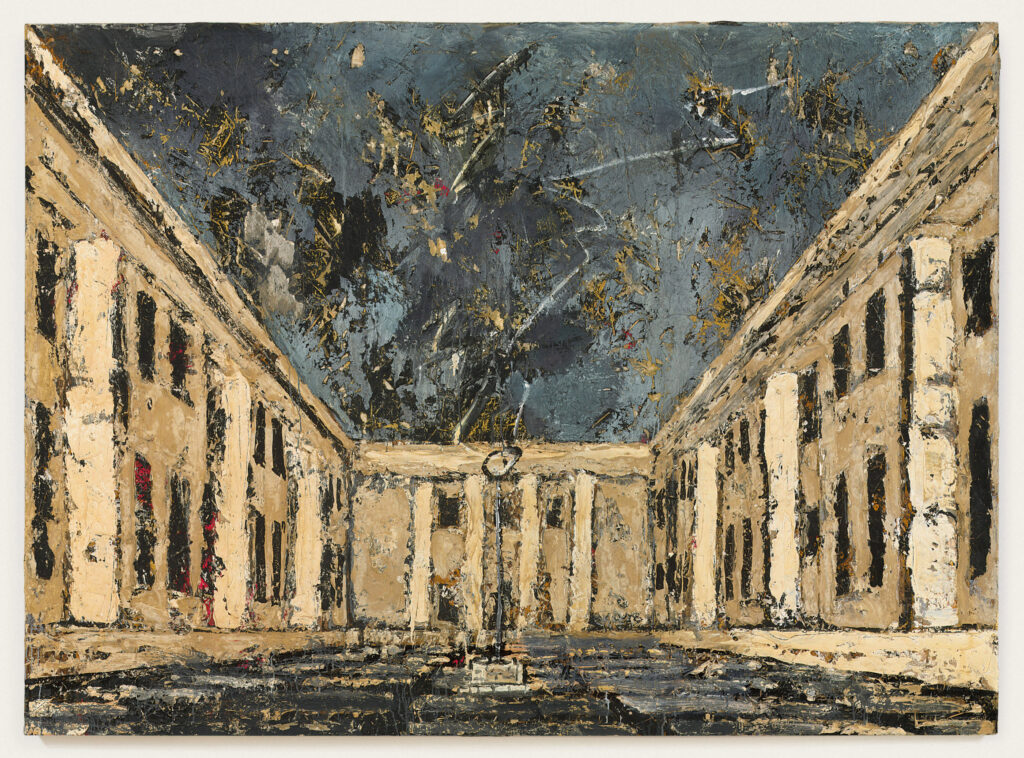
画面以强烈的单点透视组织出一条向内收束的街道或庭院式空间。左右两排建筑由厚重的斜向屋檐和竖直墙体构成,彼此向画面中央挤压;底部横向铺开的深色地面又像一道沉积层,封住了空间的前景。中央尽端的低矮建筑、其前方近似柱状或人形的黑色痕迹,以及上方一片难以辨认的暗色团块,共同形成视觉的重心。透视本应带来可进入的纵深,但两侧建筑过分厚实、天空过于压低,反而使空间呈现出封闭、窒塞而不稳定的舞台感。 色彩建立在冷暖和明暗的尖锐对抗上。蓝灰、黑灰与深褐色构成上半部阴沉的天幕,其间散布土黄、赭黄及少量鲜红色碎点;下半部建筑则以灰白、乳黄和泥土色为主,却不断被垂直的黑色裂隙切断。红色并未扩展为明确形象,而像从厚层中偶然渗出的伤口或余烬。左右墙面的浅色使建筑轮廓得以显现,却因黑色污迹和斑驳覆盖而失去洁净性,建筑不再是稳定的几何实体,而像正在风化、受损或被历史沉积侵蚀的外壳。 表面处理是作品意义的重要部分。颜料显然并非平整涂布:大面积堆积、刮擦、拖抹与局部剥落并存,墙体的浅色膏状层形成近似灰泥或旧墙皮的触感;天空中的暗色层则被反复搅动,显出粗粝的笔触、裂开的边缘和颗粒状杂质。画面中可见零散的黄褐色纤维性痕迹,它们穿插于颜料表层,既增强了材料的物质阻力,也使画面像被植物残屑、尘土或废墟碎片侵入。中轴处的线性黑痕尤其具有手工拼接、悬挂或刮划后的偶发感。 这种以建筑透视为骨架、以破坏性肌理瓦解秩序的方法,契合基弗长期对记忆、废墟、神话性空间与历史创伤的关注。图像并不通过叙事细节说明事件,而让材料本身承担时间的证词:厚重意味着沉积,裂隙意味着断裂,污渍与纤维意味着现实世界对绘画表面的侵入。严密而近乎古典的构图,因此被转化为一处既真实又幻象化的心理场域。
Work 09
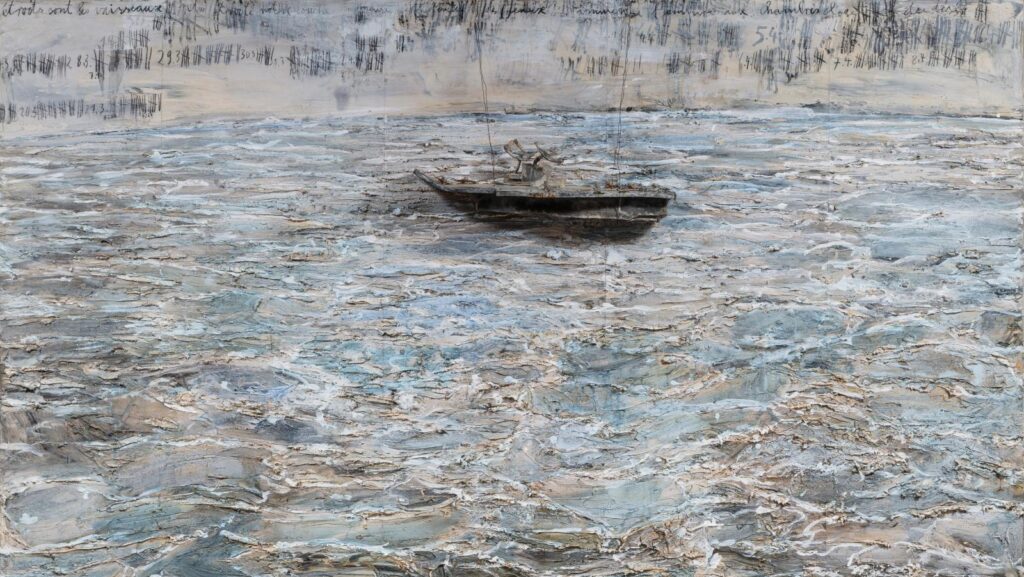
画面以一道近乎水平的岸线或冰层分界展开:上部是被灰白、土黄与冷蓝覆盖的浅空,底部则被处理成广阔、沉重而不断起伏的水面。中央偏上的一只小船以深褐至黑色的实体浮现,船身横向停泊,却因边缘的断裂、翘起和投下的阴影而呈现出残骸般的脆弱状态。它既是视觉重心,也被周围无边的横向肌理压缩,形成个体尺度与荒寒场域之间的悬殊关系。画面上缘可见连续的手写文字、数字、短线与近似计数的密集刻画;这些痕迹并不构成易读叙述,而像被反复记录又遭覆盖的档案残片。其下方较为平缓的淡色带与下部汹涌的厚层表面形成明确对照,使图像同时具有地平线、书写页和物质沉积层三种空间感。 色彩严格收束于铅灰、冰蓝、乳白、褐灰和局部暗黑之间。冷色并非制造透明的水景,而在浑浊的白、泥质褐和黑色裂隙中获得重量;明暗关系亦不依赖传统光源,而由堆积材料的高低、断面与阴影生成。下半部可见大面积刮抹、堆叠、拖曳和撕裂般的纹路,厚重的覆盖层在局部隆起、龟裂或露出底层,令水面更接近冰层、淤泥、灰烬或受损墙皮。横向笔触模拟波浪的运动,但材料凝结后的阻滞感又否定了流动,使“水”成为时间冻结后的地质性表皮。 小船并非仅由绘画轮廓表示,而像被直接嵌入或以厚实构件塑成;其粗粝、烧灼般的暗色表面,与四周苍白而多层的基底形成触觉上的冲突。细小的垂直线从上方落向船体附近,既可能是线性绘制,也像悬挂、测量或牵引的痕迹,进一步加强了图像的不安定。对基弗而言,绘画常不是对景物的再现,而是让历史、神话、文字与物质损耗共同进入表面的方法。此处船、书写和沉积性的“水域”并置,使航行不再指向明确目的地,而成为在记忆废墟、不可辨认的记录与巨大自然力量之间艰难存留的形象。
Work 10
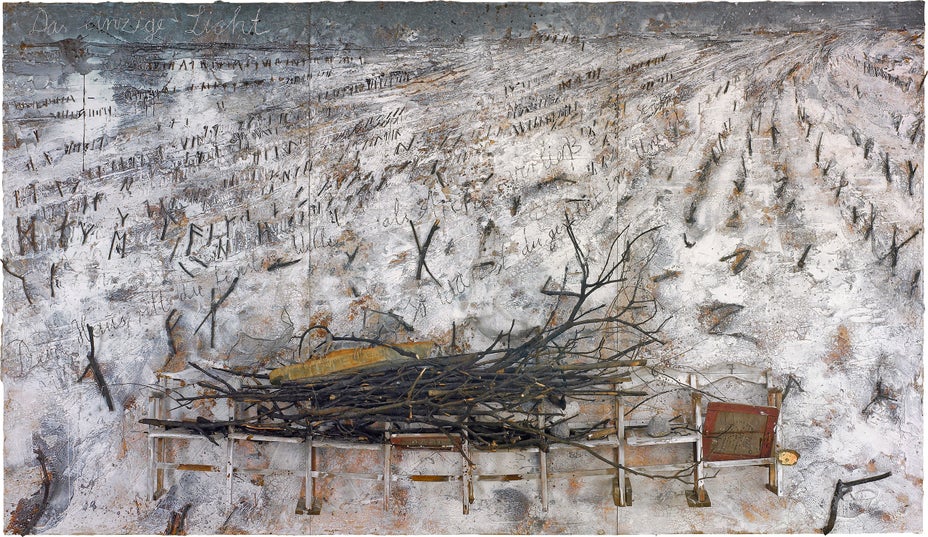
画面以横向、近似壁面或田野剖面的结构展开。上部由灰蓝、铅白与泥褐色交织成辽阔而低沉的背景,斜向延伸的深色短线和密集刻痕构成类似垄沟、枯草或行列的节奏;右上方的线条向远处汇聚,使平面获得微弱却明确的纵深。表层散布潦草的手写字迹,它们并不承担可直接阅读的叙述功能,而像被埋入地层的残余语言,与划痕、裂隙和污渍共同形成时间积累的痕迹。 画面下方突起一组由细木条、金属丝、枝桠及零散构件搭成的低矮结构,既像临时支架、残破栅栏,也像承载遗物的祭坛。黑褐色枝条以缠结、交叉、折断的方式横卧其上,尖锐的斜线与背景中规整而遥远的线性秩序相冲突。右侧嵌入的红褐色矩形部件,在大面积冷灰中形成唯一相对浓重的色彩节点;其锈蚀般的暗红并非鲜明装饰,而更接近受损物件内部尚未消散的热度。 底层可见粗粝的厚涂、堆积颗粒、擦刮和局部龟裂,白色不呈现洁净的光,而带有粉化、灰烬化及风霜侵蚀后的浑浊感。材料表面与真实枝条的干枯质地彼此呼应:前者模拟土地、墙皮或雪后泥土的脆弱覆盖,后者则以实际体积刺破绘画平面。由此,绘画不再是再现景观的窗口,而成为一个容纳沉积物、残片与记忆的物质场。 这类处理契合基弗一贯将历史、神话、语言与土地意象置于同一残骸结构中的方法。图中没有稳定、完整的叙事,只有被覆盖又重新露出的书写、如战后废墟般的构架,以及仿佛经历寒冷季节的地表。结构的脆弱、色彩的压抑与材料的伤痕相互强化,使“风景”转化为历史记忆难以修复、却不断要求被观看和辨认的现场。