Jeremy Gardiner | In-Depth Research
United Kingdom
1. Artist Profile
Jeremy Gardiner was born in 1957, grew up in London, and spent many summers on the southwest coast of England;This juxtaposition of urban life and coastal experiences later shaped his dual perspective on landscape: he is concerned with the macro-structure of the terrain while also being sensitive to the concrete traces left by navigation, industrial relics, and everyday walks. He studied Fine Art at Newcastle University and Painting at the Royal College of Art in London.While living in the United States during the 1980s and 1990s, his practice encompassed printmaking, photography, digital imagery, and computer art, and he gained experience in art education and new media. This period led him to understand technical media early on as tools for reconfiguring visual experience, rather than as mere appendages to landscape representation. Around 1992, he returned to the Dorset coast on multiple occasions to conduct field studies of the Jurassic Coast, which led to a series centered on locations such as Point Ballard; after returning to the UK in 1999, he gradually established a mature artistic direction.Since then, he has continued to explore the coasts, harbors, lighthouses, cliffs, and strata of southern England, translating his on-site walks, boat trips, aerial perspectives, cartographic data, and geological research into paintings that convey a sense of bird’s-eye view and cross-section.His significant shift lies not in a transition from representational landscape to abstraction, but in advancing the concept of “landscape” from visible scenery to a material surface shaped by the combined forces of time, erosion, sedimentation, and human activity. Gardiner’s place in art history can be situated within the contemporary extension of the British modern landscape tradition: he draws on the explorations of Ben Nicholson, Peter Lannian, and others regarding composition, space, and a sense of topography, yet renews this tradition through a consciousness of digital surveying and a perspective rooted in environmental history.He often layers, pours, polishes, scrapes, cuts, chisels, and repaints on wood panels or paper, giving the surface of the painting a relief-like quality reminiscent of rock strata, tidal erosion, and cliffs; the material processes do more than simply create texture—they directly simulate the slow accumulation and sudden fractures of geological changes.Colors are often derived from seawater, limestone, soil, vegetation, and light, tending toward condensation rather than naturalistic depiction; thus, the color field and the undulating structure jointly contribute to the construction of space.In the context of interdisciplinary art research on mixed media, his work is significant for demonstrating how painting—through additive and subtractive techniques and the interplay between physical substrates and visual information—transforms the behavior of materials into a visual discourse on geologic time, the memory of place, and ecological fragility.
2. Artistic Concepts
Jeremy Gardiner’s artistic vision goes beyond merely reproducing the outward appearance of a landscape; rather, he understands the landscape as a “chronological archive” that is constantly being generated and continuously interpreted.For him, coastlines, cliffs, harbors, waterfalls, and hills are not static images of nature, but rather complex surfaces shaped by the combined forces of geological movements, marine erosion and weathering, climate change, industrial activity, and human habitation.Consequently, his paintings consistently establish connections between the visible landscape and invisible history: what is presented on the canvas is not a sketch-like impression of a single moment, but rather a mental map formed through walking, sailing, looking down from above, consulting topographical data, and repeatedly returning to the same location over the long term. The Dorset coast, in particular, constitutes the baseline of his conceptual framework.His repeated exposure to the southwest coast of England during childhood has made the region both a repository of personal memories and a cultural site connecting deep-time geology with the British landscape tradition. His early works already revealed an interest in shifting the scale of observation.Satellite imagery and the Nazca Lines prompted him to move away from traditional eye-level landscapes, organizing the earth’s surface through bird’s-eye views, fragmentation, and symbolization; the landscape thus transformed from a natural object into a schematic, two-dimensional structure.His subsequent experience living in the United States and engaging in environmental art practice broadened his focus to the relationships between cities, industrial traces, and the ecological environment. Returning to the UK in the late 1990s, he resumed his research on the Jurassic Coast, and his conceptual approach gradually shifted from visual topographical generalizations to an exploration of stratigraphy, erosion, and paleontological time.The landscape is no longer merely “nature to be viewed,” but becomes an entity that attests to the existence of time through material change. This line of thought directly shapes his visual composition and creative process. He often interweaves high vantage points, distant vistas, and close-ups, compressing the depth of traditional perspective so that coastal contours, rock strata, tide lines, roads, and architectural remnants are juxtaposed like layers of information on a map.Lighthouses, ships, or houses—often minuscule in scale against the vast landscape—are not the subjects of the narrative but rather serve to suggest the transience of human existence.The colors in the paintings do not aim for naturalistic reproduction but serve the overall atmosphere created by light, seasons, sea fog, and rock strata; the restrained relationship between warm and cool tones, light and dark, and color planes gives the landscape a sense of time that is both real and refined. Gardiner’s particularly significant contribution lies in establishing a structural correspondence between material processes and geological processes.He builds up layers using pigments, collage, printmaking, and digital imagery, then repeatedly disrupts and reconstructs them through sanding, scraping, cutting, and erosion, making the paintings resemble both compressed strata and cliff faces eroded by ocean waves.His later works draw on research resources such as geomorphology, 3D imaging, digital cartography, and images of fossils—not to create visual spectacles through technology, but to deepen the cognitive capacity of painting by drawing on different knowledge systems.Consequently, the textures in his works are not merely decorative “rough effects,” but become vessels for memories of time, touch, and place; his landscape paintings thus shift from a lyrical observation of nature to a meditation on the scale of the Earth, the scale of humanity, and the asymmetrical relationship between the two.
3. Main Materials, Manufacturing Processes, and Technologies
Jeremy Gardiner’s choice of materials consistently serves his exploration of coastal landscapes, geological time, and the memory of place.He frequently uses handmade cotton paper and poplar panels as his bases: the former possesses fibrous malleability and absorbency, capable of withstanding overpainting, layering, scraping, and selective removal; the latter is smooth and sturdy, suitable for supporting more stable layers of accumulation and incised marks.Paper and board are not passive carriers of the image, but rather correspond, respectively, to the flexible stratification of sediment and the rigid cross-sections of rock layers. The creative process typically begins with hand-drawn linear structures based on field observations, transforming the contours of the terrain, coastlines, cliff fissures, and man-made paths into abstract frameworks resembling maps.The artist then cuts the paper forms—trimmed according to the line drawings—and layers them on the surface of the cotton paper, allowing subtle variations in height to emerge before color is applied; building upon this foundation, transparent washes and thick layers of acrylic are applied, using two different concentrations of pigment to create visual contrasts in movement between water vapor, the sea surface, soil layers, and rock. One of her key materials is Jesmonite, a polymer-modified plaster. When wet, it can be scraped thinly and seeps into crevices; once dry, it forms a hard surface that can be sanded and carved.Gardiner applies it over existing layers of color, then grinds and carves away the surface; this “cover-reveal” process prevents the underlying colors from appearing uniformly, making them resemble sedimentary strata exposed by erosion.The water-based marbling technique further simulates sedimentary textures through the flow and overlapping of opaque and transparent layers; subsequently, the surface layer of the paper is scraped away with precisely controlled depth, and watercolors are applied to the recesses. Gum arabic slows the drying of the watercolors, giving the pigments greater transparency and luster.Colors such as steel blue, earth yellow, and chalk white are thus not direct representations of natural landscapes, but rather geological hues generated through the processes of material permeation, masking, erosion, and revelation. The core of this technique lies not in creating a realistic three-dimensional topography, but in organizing the viewer’s path through low relief, incisions, layers of color, and texture: from a distance, the composition maintains a map-like two-dimensional order; up close, the surface reveals cracks, granules, edges, and “slices of time” of varying depths.The language of materials thus juxtaposes painting, cartography, sculpture, and sedimentary processes, transforming the landscape from a mere object of contemplation into a field where natural forces, historical traces, and personal perceptions continuously overlap.
4. A Detailed Examination and Analysis of 10 Representative Works
Work 01
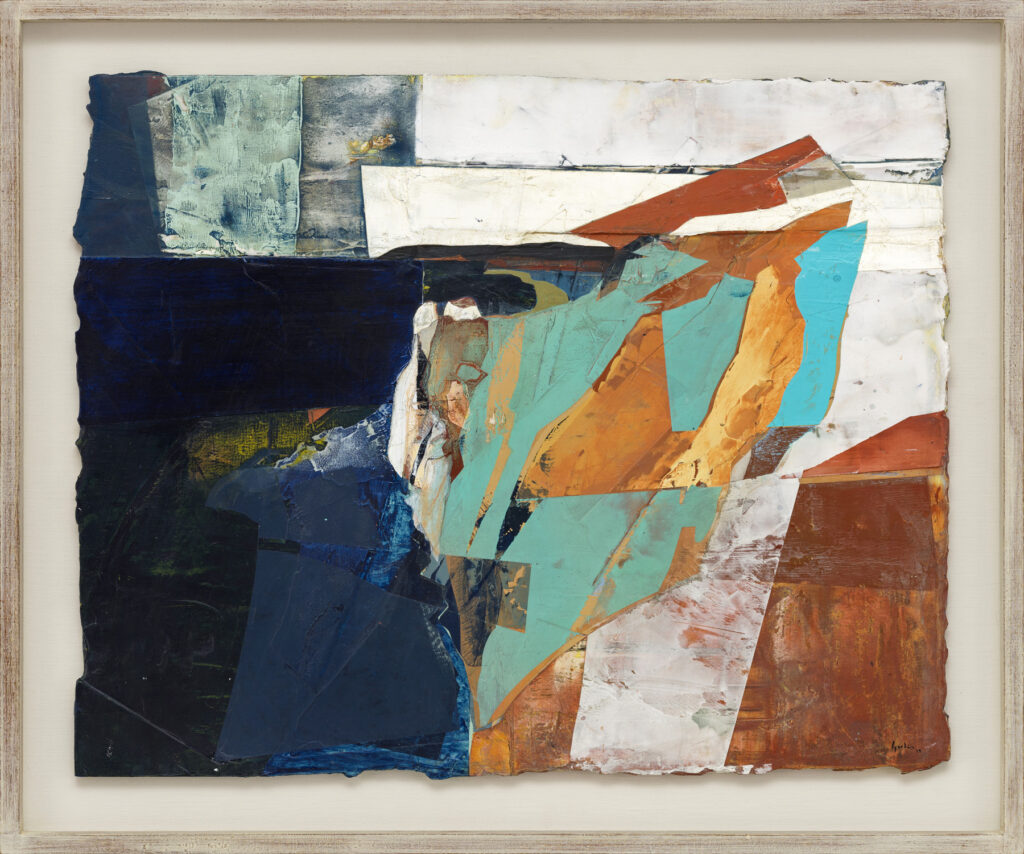
The composition unfolds in a nearly square, collage-like structure. Rather than seeking to reproduce a landscape from a single vantage point, the artist juxtaposes horizontally divided distant views, vertically stacked blocks of color, and sharp diagonal slices, creating a space that is compressed, folded, and reorganized.On the left, large areas of deep blue and jet black form a heavy, inward-turning shadow, reminiscent of shadows, deep water, or geological strata; the horizontal bands of gray-blue and gray-white at the top, meanwhile, open up a more distant, tranquil space.In the right half, turquoise, lake blue, orange-yellow, and sienna intertwine in continuous diagonal angles; the clear directional progression of the color blocks causes the composition to shift gradually from the sinking sensation in the lower left to the rising and expanding sensation in the upper right. Color is not a smoothly applied decoration but serves the functions of structural division and spatial tension.The cool-toned areas mostly present deep, subdued, or semi-transparent layers, while the warm tones form prominent cross-sections with orange, vermilion, and earthy brown; high-purity blue-green is placed between the two, resembling both the refraction of light as it penetrates the dark areas and serving as a “seam” connecting different color fields.White is not a blank background, but a material area bearing scuffs, cracks, stains, and traces of overpainting; it not only provides a pause for the intense color blocks but also reveals the history of the painting’s repeated manipulations. Visible on the surface are torn edges, layered sheets of paper, scrapes, smudges, and areas of thick impasto; some shapes retain irregular frayed edges and a curled texture, keeping the image perpetually suspended between painting and collage, between flatness and bas-relief.The edges of the diagonal elements are sometimes as sharp as if cut, and at other times blurred by a layer of paint, indicating that the composition was not created by first establishing a complete pattern and then filling it with color, but rather gradually emerged through the processes of covering, peeling away, and revising the material.Its structure thus possesses a stratified quality reminiscent of a geological cross-section: the different color layers serve not only as visual planes but also as remnants of time and the artistic process. In the context of Jeremy Gardiner’s ongoing exploration of site-specific experience, topographical structure, and painting materials, this work can be understood as a “topographical” approach that does not rely on realistic landscapes.The work transforms recognizable horizons, rock-like horizontal bands, and stress-induced slopes into abstract relationships, so that the site no longer appears as a panoramic image but is perceived through its intrinsic color density, surface wear, and structural rhythm.The sense of material deterioration is balanced by the precise organization of color blocks, allowing the work to retain both the spontaneity of natural erosion and a meticulously orchestrated order.
Work 02
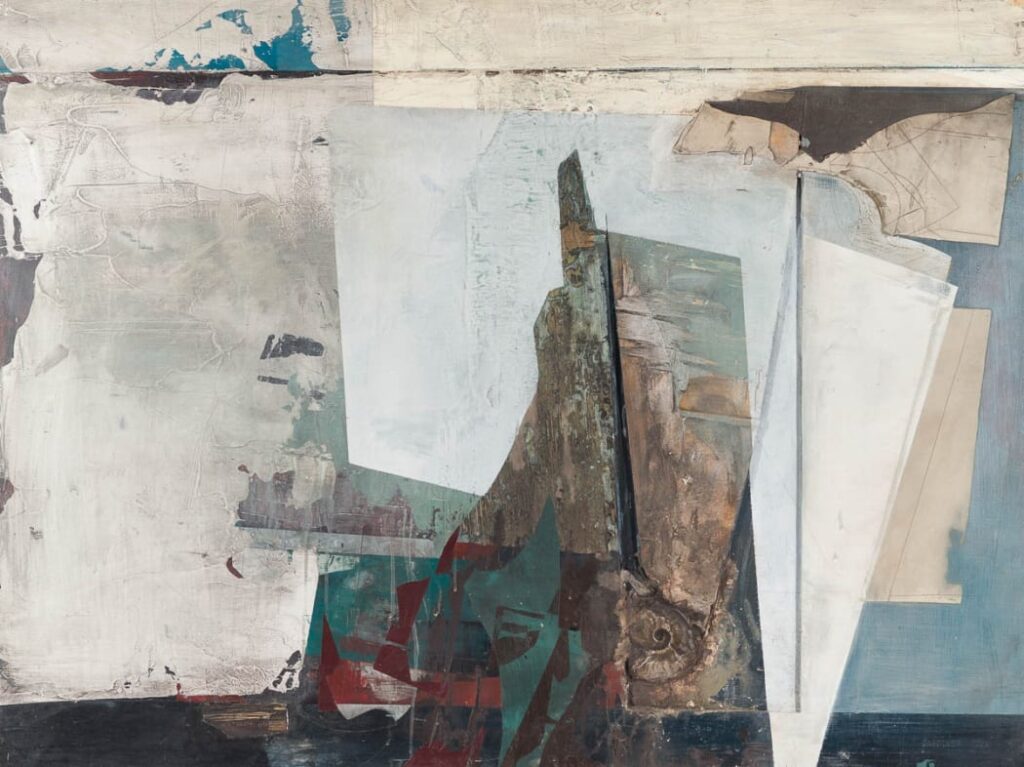
The composition takes a nearly square plane as its setting; rather than depicting a complete landscape, the main subject consists of a fragment of space formed by multiple layers of overlay, cutting, and splicing. A thin, dark line runs horizontally across the top, resembling a horizon, a seam, or a compressed boundary;On the left, a large expanse of gray-white background unfolds toward the center, retaining traces of wiping, scraping, and bas-relief-like textures. Slightly to the right of center stands a group of overlapping forms in dark brown, black-green, and gray-blue; their sharp upper ends and heavy lower sections form the composition’s vertical axis;On the right, several slanted, plate-like areas of white and beige fold outward, resembling pages of paper, rock strata, or load-bearing surfaces in an architectural cross-section. The color palette is restricted to low-saturation shades of grayish-white, bluish-gray, jet black, earthy brown, and dark green; localized touches of blue-green and dark red are concentrated primarily in the lower section, creating a density of color reminiscent of sedimentary deposits or rust stains.The white is not a void background: it possesses material thickness due to its translucent overlay, curled edges, and underlying line drawings; the dark areas, meanwhile, appear rough and heavy because of their grain, fissures, accumulations, and wear.Visible in the painting are the boundaries of collage materials, residual layers left by repeated applications of pigment, and fine lines resembling incisions, impressions, or transfers. These traces serve no decorative purpose but transform the surface into a record of the accumulation of time. The tension in the composition stems from the juxtaposition of “covering” and “exposure”: the smooth white sloping surface obscures the central form, yet its sharp contours serve to highlight the fragmentation of the underlying material;vertical black, fissure-like lines bind multiple layers together, lending the image the feel of a sliced-open surface or a page turned in an archive. Here, color serves to stratify space, while the texture of the materials provides a sense of tactility and history; techniques such as cutting, layering, and erasing collectively transform the two-dimensional image into a surface structure reminiscent of a geological cross-section. In light of Gardiner’s ongoing focus on place, topography, memory, and the accumulation of time in his creative practice, this image can be understood as a form of “topographical construction” that does not rely on realistic landscapes.It does not depict a recognizable location, yet through layers of material residues, boundary lines, and color blocks resembling geological strata, it conveys to the viewer that the environment is not a static visual scene, but rather a complex entity composed of erosion, overburden, fractures, and human traces.
Work 03
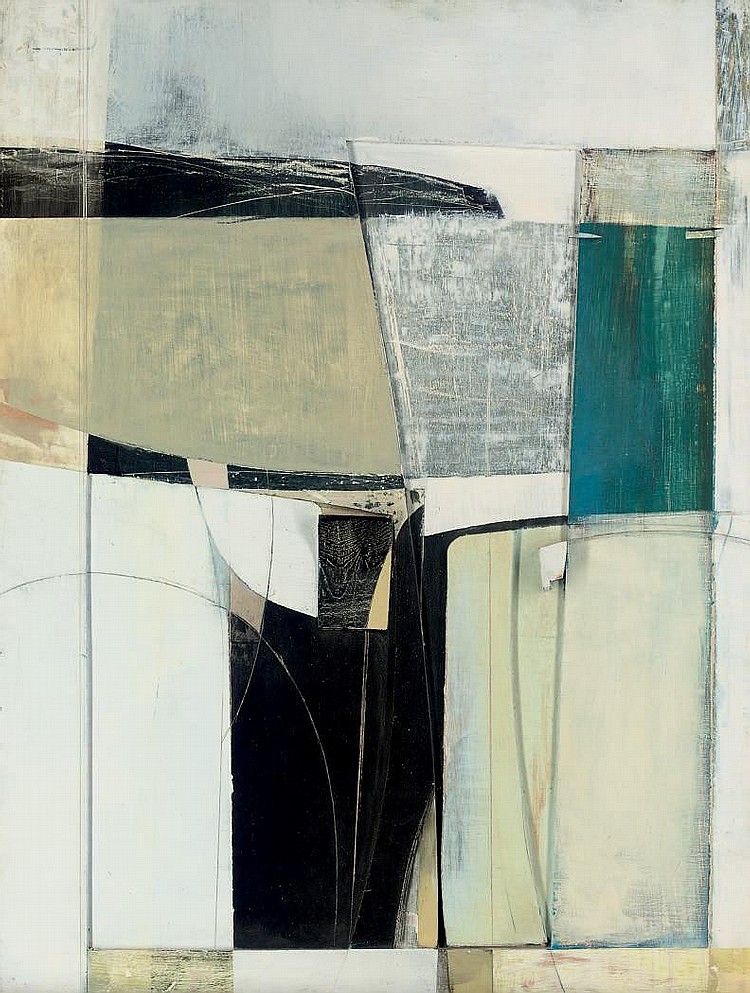
The composition is organized around vertical rectangles, yet is constantly disrupted by diagonal lines, arcs, and irregular edges.The upper portion is a cool, grayish-white expanse, resembling a sky or wall shrouded in mist; below it runs a deep black band. The black is not a uniform, flat application but is formed through repeated layering, wiping, and diagonal scraping, evoking an oppressive sense reminiscent of geological strata, shadows, or distant landmasses.A large gray-brown rectangle slightly to the left of center tilts slightly downward to the right, interlocking with the vertical blue-green block on the right and the light gray area below, giving the division of the plane a structural quality reminiscent of architectural elements supporting one another. The color palette is strictly limited to shades of gray-white, beige, black, gray-brown, and low-saturation blue-green. The large expanses of light color do not appear insubstantial; visible vertical and horizontal brushstrokes, translucent layers, and localized wear transform the white into a textured surface rather than a blank background.Black bears the weight of the composition, concentrated in the upper horizontal band and the lower center; the former pulls the composition outward to the left and right, while the latter sinks downward as a nearly vertical, deep, dark mass.The blue-green block on the right forms the only relatively distinct accent of cool color in the composition; its edges are not completely sealed off, and the surrounding layers of gray-white appear to obscure, erode, or recalibrate it. Visible traces of the painting process indicate that the work was not completed in a single session: thin layers reveal a sense of underlying color seeping through, while unevenly applied coverage creates blurred boundaries;local lines appear to have been created through scratching, dragging, or erasing—particularly at the junction of white and black in the lower half, where fine arcs and straight lines lend the geometric divisions a sense of hesitation as if measured by hand.Certain edges also present a layered visual effect reminiscent of paper, collaged fragments, or overlay layers, though the specific medium cannot be determined from the image itself. It is precisely these imperfectly smooth surfaces that prevent the rational composition from devolving into a cold, rigid geometric design. In light of Jeremy Gardiner’s long-standing artistic focus on place, topography, traces of time, and the experience of viewing, this image can be understood as a method of compressing the sense of landscape into structural relationships: natural objects are not directly reproduced but are transformed into horizontal lines, sedimentary textures, stressed color blocks, and unstable boundaries.The work’s value lies in the fact that it transforms the “landscape” from a mere recognizable external image into a perceptual site jointly generated by material surfaces, spatial divisions, and visual memory.
Work 04
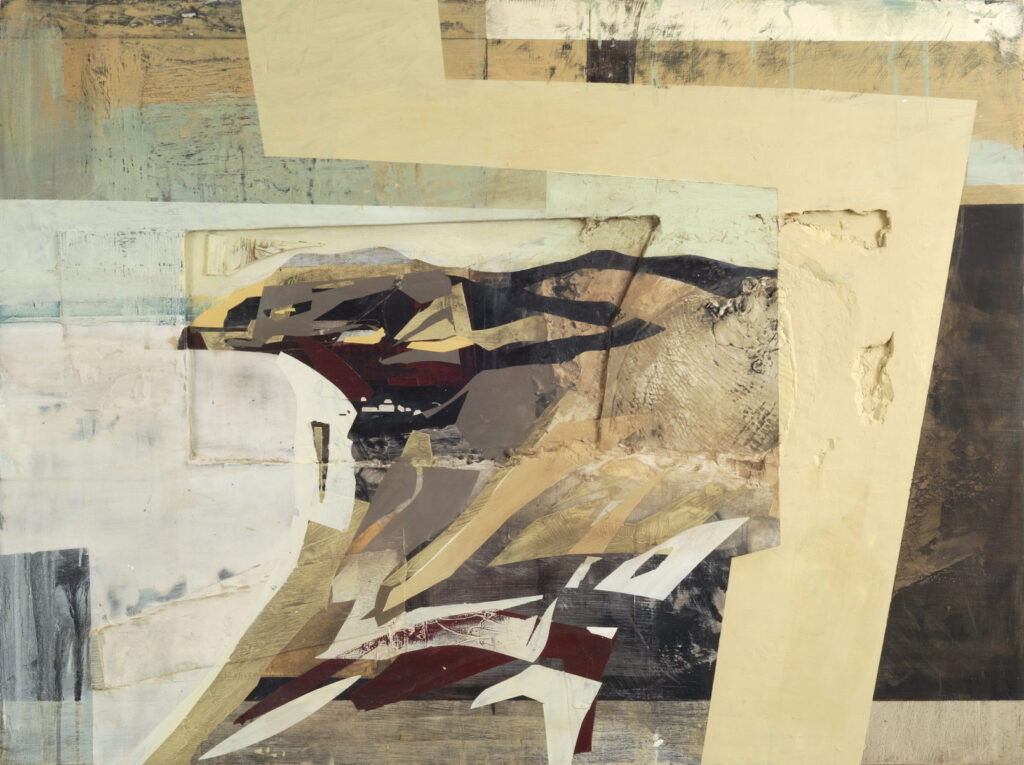
The composition is based on a horizontally extending rectangular frame, yet its stability is disrupted by numerous tilted, misaligned, and overlapping sections.The upper portion consists of large, flat planes of gray-brown, light khaki, and near-white, resembling a slice of the sky, a wall, or geological strata; the dark vertical area on the right forms a heavy boundary, drawing greater focus to the central-lower image core.At the center is a group of sharp-angled fragments in deep gray, black, ochre, burgundy, and off-white, which interweave diagonally, creating a sense of compression reminiscent of fractured rock layers while vaguely evoking associations with mountain ridges, coastlines, or architectural ruins.The work does not rely on one-point perspective; instead, it uses overlapping relationships, the weight of light and shadow, and color blocks of varying scales to organize a space that is both accessible and constantly obstructed. The overall color palette is subdued: gray-green, earthy yellow, brown, and ivory white form a tone reminiscent of a weathered surface, while localized burgundy seeps through the black-and-gray structure, infusing the subdued composition with an internal warmth.White is not merely negative space; rather, it participates in the construction of space through layers of varying thickness, cut-out shapes, and smudged traces;black functions both as shadow and as a skeletal framework holding the fragments together. Large swaths of pale yellow span the upper and right sides; their translucent, jagged edges soften the rigidity of the geometric forms, lending the composition a sense of temporality marked by deposition, flaking, and re-coating. The surface is clearly not a homogeneous painting: visible are scrapes, impressions, erasures, crack-like textures, localized accumulations, and a sense of discontinuity reminiscent of the edges of collage materials.The central brown-gray area features a net-like or scaly texture, while the adjacent planes retain the directionality of fibers, abrasion marks, and drag marks; these variations transform the material from a mere substrate for the image into a source of topographical generation.The sharp, dark forms appear to have been created by cutting or masking, forming a stark contrast with the surrounding, more substantial and weathered underlayers. This juxtaposition of painting, collage-like composition, and eroded surfaces echoes Jeremy Gardiner’s ongoing artistic focus on site-specific experience, geological time, and human modes of perception.Rather than treating the landscape as an object to be faithfully reproduced, the images transform it into a stratification of memory, matter, and structure: hard-edged fragments suggest the intervention of observation and construction, while the rough underlying layer retains traces of natural deposition and wear. Thus, the value of the work lies in allowing abstract forms to embody the tactile quality and temporal density of a specific place.
Work 05
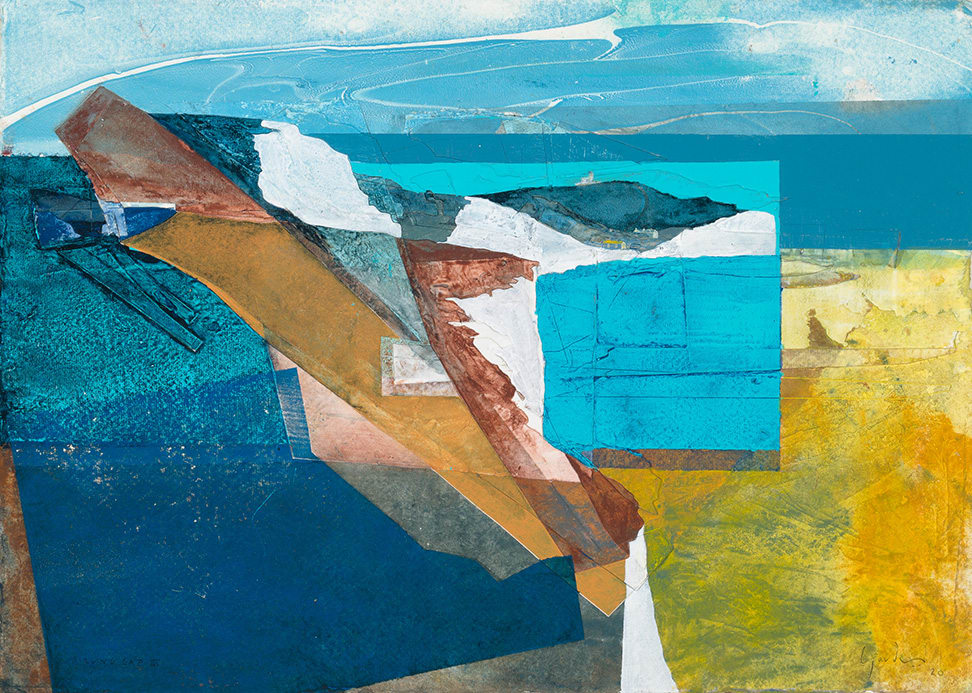
The composition is organized as a horizontally unfolding, landscape-like structure; however, it does not depict a specific, recognizable location, but rather compresses bird’s-eye, eye-level, and cross-sectional perspectives onto a single plane.The large expanse of pale blue and off-white bands at the top suggests both the sky and the sea surface or tidal marks; the central section, composed of fragmented forms in deep cyan, lake blue, white, and brown, forms the primary visual fault line; while the lower regions of deep blue, gray-green, and yellowish-brown create a heavy and stable foundation.The dominant element is the diagonal band of brownish-gold stretching from the upper left to the lower right; it resembles a cut-away slope, geological strata, or an artificial embankment, as well as a structural axis stitching together the different color fields.An irregular white band sandwiched between the dark and warm colors creates a luminance transition reminiscent of light or wave foam, while also reinforcing the sense that the surface has been eroded, covered, and re-exposed. The work’s spatiality is not achieved through perspective receding in layers, but rather generated through the overlapping of color blocks, the superimposition of transparent layers, and the discontinuity of edges.The highly saturated blue-green rectangle on the right bears a distinct sense of artificial cutting, with faint linear scratches, grids, and smudges visible within; it contrasts with the surrounding surfaces, which are more granular and fluid, as if survey maps, architectural plans, or man-made boundaries have intruded into the natural landscape.The yellow-green area in the lower right is more murky; the dragging, bleeding, and semi-transparent overlay of pigments give it an ambiguous texture reminiscent of dampness, siltation, or vegetation cover. Judging from the visible surface, the painting employs a combination of techniques such as brushing, scraping, glazing, collage, and overlay.Certain brown and grayish-white forms retain distinct boundaries, resembling the layering of paper, thin panels, or rigid materials; in the deep blue areas, particles of varying sizes, scratches, and localized deposits are visible, indicating that the material has not been treated as a uniform, smooth painterly surface.Here, the technique does not serve a decorative purpose, but rather interprets the landscape as a surface shaped by the convergence of multiple times: covering, wear, fracture, deposition, and measurement occur simultaneously. This approach resonates with the artist’s ongoing focus on the British coastline, topography, and traces of human activity.Rather than reducing the landscape to a lyrical vista, the image translates it into a material system that can be read, dissected, and reassembled. The juxtaposition of warm and cool colors, geometric structures, and traces of manual labor gives concrete visual form to the tension between the natural environment and human planning.
Work 06
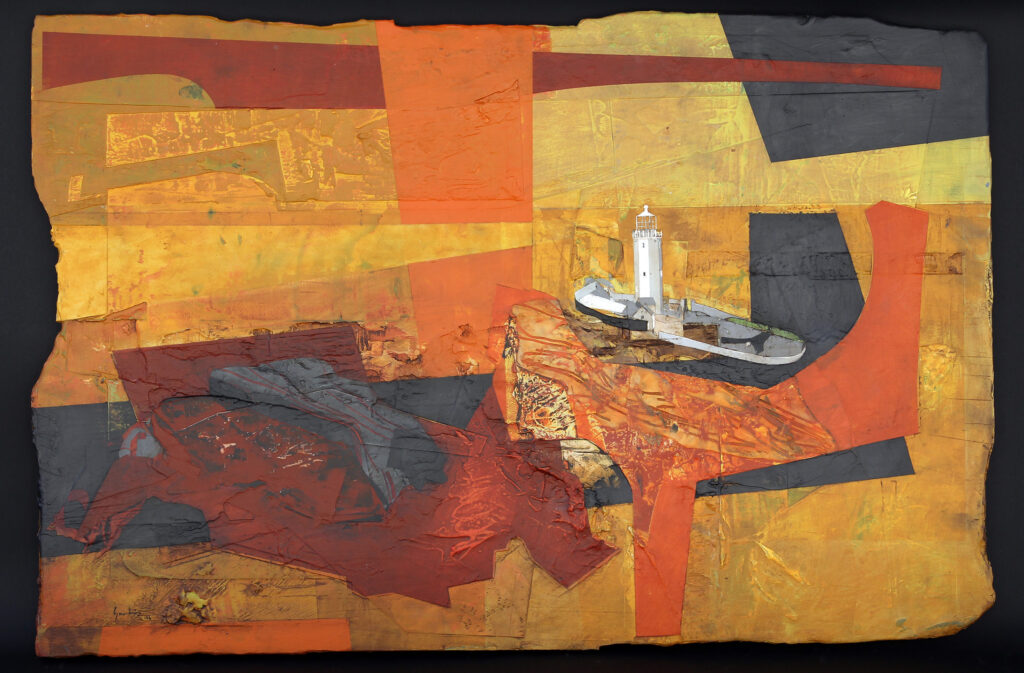
The composition unfolds with irregular, almost hand-torn rectangular edges, giving the overall impression of a fragment peeled away from a landscape or an old wall. Large swaths of yellowish-brown, earthy yellow, and ochre form the base layer, laying out a subdued spatial tone horizontally;while blocks of brick red, orange-red, and deep gray-black disrupt this continuity by overlapping, interweaving, and shifting. The small white lighthouse, situated slightly to the right of center, along with its ancillary structures and the silhouette of a ship, possesses relatively distinct contours, making it one of the few recognizable references to reality in the composition.They are not placed within a harbor space rendered with accurate perspective, but are embedded within tilted, overlapping blocks of color and texture, as if emerging from the interplay of geographical layers, fragments of memory, and material deposits. The movement in the composition stems primarily from the horizontal band-like structure and the diagonal lines in the lower section. A long, deep-red strip spans the upper part of the composition, resembling stretched strata, embankments, or waterways; on the right, a large, dark-gray, arched color field presses inward, forming a pincer-like effect with the orange-red vertical and diagonal blocks.Below, fragments of dark red, gray-black, and orange-yellow overlap, creating a sense of foreground weight; though small, the lighthouse gains a stable visual axis through the verticality of its white form.The colors do not seek to reproduce nature: the golden yellow evokes associations with weathering, salt corrosion, and sunlight; the rust-like reddish-orange intensifies the heat of coastal structures, ship hulls, and eroded land; while the grayish-black resembles shadows on the sea’s surface, rock strata, or the remnants of industrial structures. The surface reveals distinct layers of accumulation, scraping, imprints, cracks, and undulating edges. Some areas feature thin, translucent layers where the underlying color shines through; others possess a thicker, raised texture resembling mud or plaster.Consequently, the image is not simply “painted” on a flat surface, but resembles a bas-relief formed through cutting, collage, layering, and repainting. The resistance and unevenness of the material’s surface counteract the sense of design that geometric color blocks might otherwise convey, keeping the structure in a constant state of formation, erosion, and repair. This approach resonates with Jeremy Gardiner’s long-standing focus on the British coastline, topographical experience, and site-specific memory: recognizable architectural or nautical imagery serves not as the narrative protagonist in a landscape painting, but as markers for measuring scale, time, and human intervention.The works juxtapose cartographic divisions, geological-like deposits, and fragmented visual memories, transforming the site from a landscape to be gazed upon into a complex surface constituted by materiality, historical traces, and the act of viewing.
Work 07
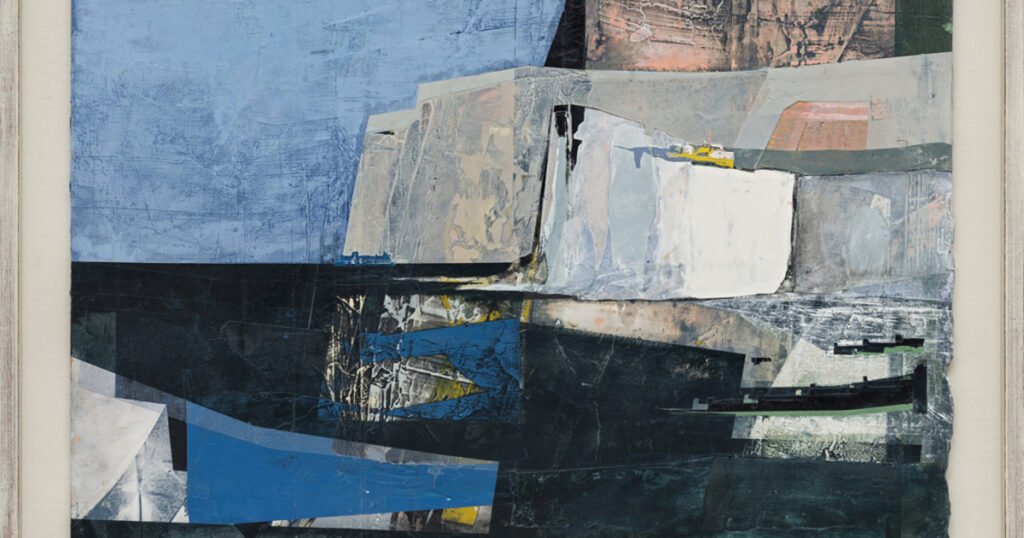
The composition unfolds as a horizontally expansive, topographic structure. The upper half consists of a cool blue plane, worn down into layered strata, resembling the sky, the sea, or the background of a topographic map; the lower half forms a heavy foundation composed of blocks of deep black, dark green, and blue-black.Between the two is not a clear, natural horizon, but rather a dark band that has been repeatedly overlaid, fractured, and extends to the left and right, evoking associations with a coastal cross-section, industrial structures, and a map section.The large gray-white mass slightly to the right of center protrudes forward with irregular folds, resembling an eroded rock formation or topographic data that has been spliced, overlaid, and recalibrated; the long gray band above it, together with the ochre-red textured area in the upper right corner, forms another, more distant spatial plane. The color composition is built upon localized clashes between warm and cool tones, as well as light and dark. The large expanse of blue is not smooth; it retains crisscrossing horizontal and vertical scuff marks, light-colored smudges, and fine grains, lending the color field a density born of the passage of time.The black areas absorb most of the light, yet reveal localized bluish-green reflections, scraped lines, and translucent glazes, preventing them from becoming mere silhouettes.The low saturation of the gray-white blocks lends the center a hardness reminiscent of a rock strata cross-section; small amounts of bright yellow, cobalt blue, and orange-red are compressed into fissure-like areas. Because these areas are so tiny, they resemble beacons, artificial markers, or mineral glints in the landscape, reinforcing the uncertainty of scale. The key to the work lies not in reproducing a complete landscape, but in constructing the viewing experience through overlapping, obscuring, cutting, and erasing. The jagged visible edges, the interplay of paint layers, the locally collage-like breaks, and the surfaces that have been repeatedly scraped smooth and repainted suggest that the image underwent a process of continuous revision during its creation.Dark horizontal bands press down upon the blue, arched areas beneath them, while grayish-white forms cover the dark bands, creating a nested relationship reminiscent of geological strata, embankments, ship hulls, or cartographic symbols.The sense of structural discontinuity arises directly from the manipulation of materials: layers of varying thickness, underlying colors revealed in worn areas, and textured surfaces bearing traces of the brush—all transform the landscape from a distant visual object into a material surface that can be touched, explored, and interpreted. This resonates with Gardiner’s long-standing practice of interweaving geographical experience, coastal environments, and painterly experimentation.Rather than treating the site as a static panorama, the image compresses memory, observation, geological time, and human intervention into a two-dimensional plane imbued with a sense of structure. It allows abstract structures to function as landscapes, while also making the resistance, traces, and layers of the material key means of understanding the site.
Work 08
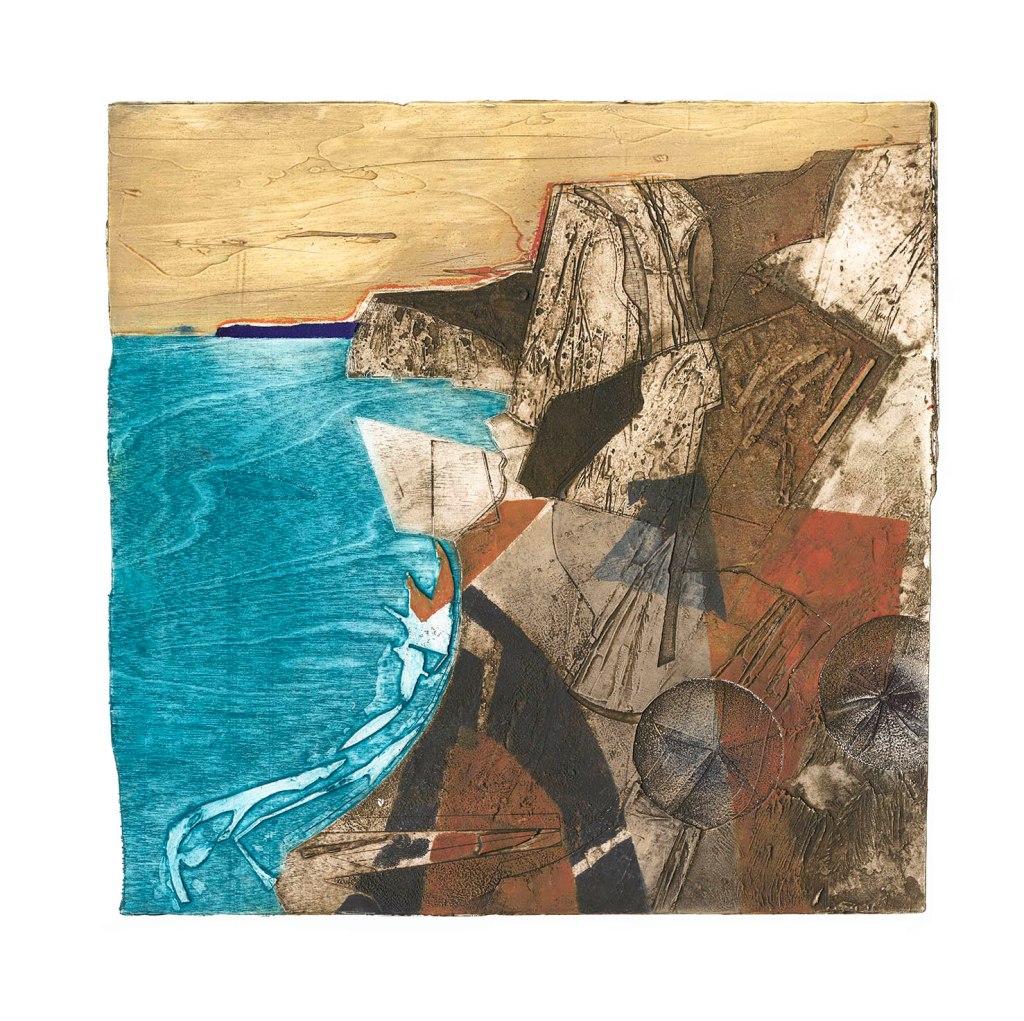
While the painting takes coastal cliffs as its central motif, it does not rely on a single perspective to depict the natural landscape; instead, it compresses the sea surface, cliff faces, headlands, and the foreground terrain into interlocking block-like structures.On the left, a vast expanse of blue-green water forms a wide and tranquil visual entry point; the coastline curves inward from the upper left toward the center, then plunges sharply downward along a jagged, light-colored edge. The right side is immediately dominated by towering, dense, and jagged rock formations.The composition derives its fundamental tension from the horizontal expanse of the horizon and the vertically soaring cliffs; the former suggests distance, tranquility, and a vantage point from which to observe, while the latter creates a sense of oppressive closeness through its fractured, overlapping, and tilted forms. The colors do not seek naturalistic, seamless transitions. The sea is rendered in a cool, vivid cyan-blue, with fine horizontal smudges and flowing lines visible beneath the surface, giving the water both depth and the flat, imprinted quality of a print.The sky is rendered as a low-saturation layer of ochre-yellow and off-gray, creating a contrast of warm and cool tones with the sea; the rocky shore, meanwhile, is rendered in shades ranging from dark brown to gray-white, earthy yellow, and rust-red.In particular, the reddish-brown diagonal blocks extending from the lower right to the center—resembling geological strata, weathered surfaces, or traces of human intervention—push the originally stable rock tones toward a more cautionary energy. Consequently, the cool-toned sea is not merely a background, nor is the warm, dark-toned land merely a foreground; together, they orchestrate the conflict at the coastal boundary. The surface reveals distinct characteristics of a composite technique: flat application, scraping, embossing, line engraving, and granular textures are juxtaposed. The light-colored sections of the cliff face are covered with crack-like black lines, spots, and vertical drag marks, as if the rock’s internal stratification had been sliced open;the dark areas, by contrast, are more compact, resembling shadows or sedimentary layers covering the surface. Local contours are defined by stiffer lines, while some color planes exhibit slight misalignments, overlaps, and residual edges, transforming the landscape from a continuous natural surface into one reassembled from fragments of different times and textures.The circular, radiating patterns in the lower right particularly reinforce associations with geological cross-sections or traces of erosion. This approach aligns with Jeremy Gardiner’s long-standing artistic practice centered on the British coastal landscape: he does not view the landscape merely as a subject to be depicted, but focuses instead on how stratigraphy, sea erosion, climate, traces of historical use, and the experience of viewing collectively shape a place.The material surfaces in the image serve as “evidence of the landscape”: the grooves correspond to erosion, the accumulations to sedimentation, and the patchwork-like composition to the process by which the coastline is constantly being cut away and reconstructed.The work thus establishes a connection between landscape imagery and material studies: while retaining the recognizable contours of the coastline, it also reveals the natural space as a constantly shifting temporal structure through an unstable, rugged, and multi-layered visual language.
Work 09
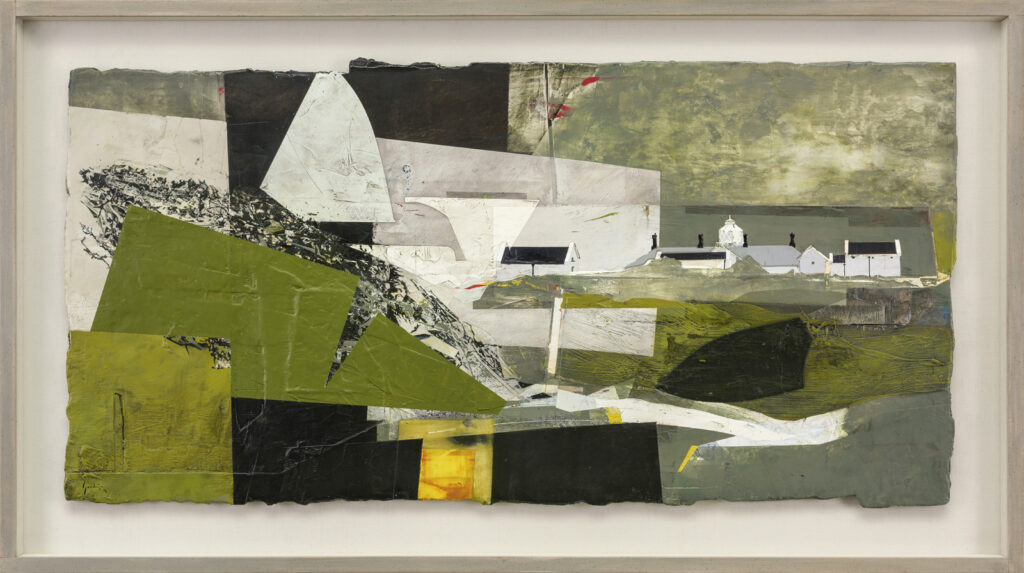
The composition features a low, horizontally elongated rectangle that frames a coastal or rural settlement that has been deconstructed and reassembled.The expansive gray-green sky in the upper portion, combined with a dark horizontal band, forms a low-slung horizon, while the white cluster of buildings, tower-like roofs, and dark chimneys slightly to the right of center provide recognizable signs of habitation; however, these elements do not follow one-point perspective but are instead placed within layers of misaligned planes.On the left, diagonal bands of black-and-white, debris-like elements create a powerful sense of downward momentum, resembling exposed rock strata, gravel slopes, or an eroded surface;overlaid with several olive-green geometric shapes, transforming the natural landscape into an abstract structure that appears to have been cut, superimposed, and mapped.The deep black elliptical block in the lower right resembles a shadow, a pond, or a depression in the ground; it creates tension with the surrounding dense network of yellow-green hatching lines, lending the tranquil landscape a sense of instability reminiscent of a geological cross-section. The color palette is strictly limited to gray-white, jet black, moss green, earthy yellow, and a small amount of vermilion. The gray-white structures appear fragile and serene against the dark green background, while the black band running horizontally across the bottom dominates the entire composition, transforming the small yellow squares and scattered red brushstrokes into highly alarming visual focal points.The composition does not rely on light and shadow to create volume, but rather establishes space through the boundaries of color blocks, layers of transparency, and reflections on different surfaces: the sky in the background is relatively murky and flat, while the green blocks in the foreground possess a thick, waxy or resinous quality, with visible undulations, creases, and irregular frayed edges.Detailed scraping, incisions, mesh-like indentations, and exposed traces of the underlying layers in certain areas indicate that the surface has undergone repeated layering, covering, scraping, and reworking, rather than being created in a single session. This creative logic transforms the landscape from a complete vista for viewing into a material archive composed of topography, architecture, memory, and human intervention.Jeremy Gardiner continues to explore the interweaving of natural forms and cultural traces in the British landscape; in this image, recognizable coastal settlements are compressed into fragments of topography, architecture, and architectural drawings.The thickness and thinness of the materials, along with their torn edges and incisions, transform the accumulation of time into a tangible tactile experience, while the geometric拼接suggests humanity’s division, occupation, and renaming of the land.The work thus maintains a tension between figurative landscape and abstract composition: it preserves visual clues of the site while making the viewer aware that any “landscape” is, in fact, a cultural image that comes into being only through selection, fragmentation, and reconstruction.
Work 10
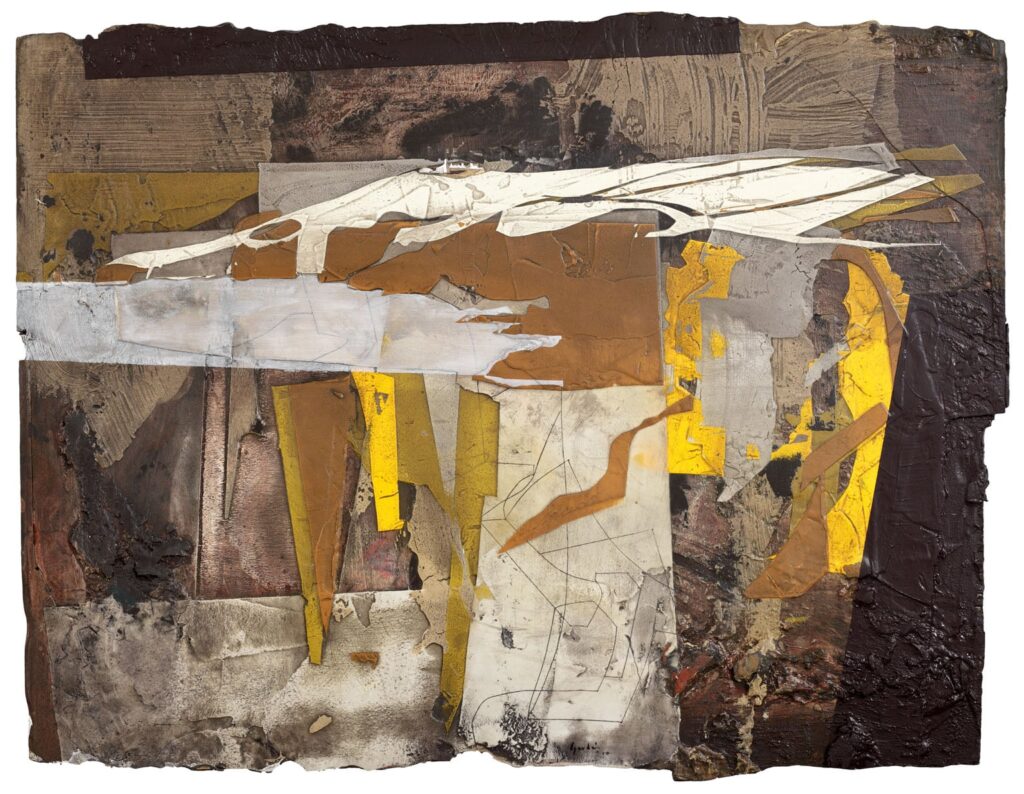
The composition unfolds as an almost horizontal, rectangular, slab-like structure with irregular edges;局部 tears, missing sections, and thick accumulations make it resemble a fragment of earth’s surface or a piece of wall that has been cut away.The composition lacks the single vanishing point found in traditional perspective; instead, it is organized by fragments that overlap horizontally, intrude vertically, and intersect diagonally. The thick, dark brown band at the top resembles a lowered horizon, rock strata, or a covering layer; in the middle section, large, torn white forms extend horizontally, creating the strongest visual rupture;while the lower section features blocks of brown, gray, yellow, and white that interlock, resembling different sedimentary layers exposed by erosion. The deep black vertical border on the right presses down on the composition, providing a frame for the unstable fragments within and reinforcing the sense of weight as material is crammed toward the edges. The color palette ranges from earthy dark browns, rusty reds, gray-blacks, and gray-whites, with small amounts of highly saturated yellow and earth yellow placed in the lower-middle section and on the right, resembling the glinting surfaces of minerals exposed from the sedimentary crust.The white is not a pristine negative space, but rather bears traces of grime, cracks, smudges, and overpainting; it provides a breath of luminosity while also presenting a stripped-away surface due to its fragmented contours.The brown areas are relatively smooth, yet incisions, creases, and residual edges are visible; the thick layers of dark brown exhibit distinct textures created by the pushing, pressing, and undulating movements of the palette knife. The juxtaposition of different surfaces allows the work not only to depict the landscape but also to simulate its formation through its own physical layers. Within the composition, one can discern the interplay of torn and pasted paper fragments, layers of pigment, or similar thin materials; certain areas also bear traces of linear outlines, imprints, and scraping.The materials are torn, layered, obscured, and revealed anew, making the creative process an integral part of the viewing experience: the viewer’s gaze constantly shifts between the surface and the underlying layers, between flat and slightly raised areas, and between what is covered and what is revealed.The white horizontal fragments resemble strips carried by wind or water currents, while the yellow vertical strips resemble supports, fissures, or markers cutting into the strata, suggesting that natural forms are not static landscapes but the result of continuous forces. This resonates with Jeremy Gardiner’s long-standing practice, which focuses on place, topographical memory, and the structure of the natural environment.The value here lies not in reproducing a recognizable landscape, but in transforming the topography into a reading of composite materials: color conveys the sensations of geology and light; collage conveys fault-like spatial relationships; and thickness, thinness, and damage serve as evidence of time and erosion.The work thus transforms the landscape from a viewable external object into a material experience that can be touched, traced, and reassembled.