
Alexis Peskine|深入研究
France
1. Artist Profile
Alexis Peskine生于1979年巴黎,父亲具法俄背景,母亲来自巴西非裔社群;跨越法国、巴西与美国的成长经验,使身份、迁徙、黑人民族志与离散文化成为其创作的深层坐标。他少年时期接受平面设计训练,后因篮球赴美,在霍华德大学取得艺术学士学位,并于马里兰艺术学院完成硕士学习。美国历史性黑人大学的知识环境,尤其对哈莱姆文艺复兴、黑人现代主义与非洲侨民历史的接触,使他从早期绘画、摄影、丝网印刷及数字图像实践,转向更具身体性和文化记忆密度的综合材料语言。约在研究生阶段,他开始以不同长度的钉子锤入木板,并逐渐形成其标志性的浮雕式人物图像;这一转折并非单纯的媒介创新,而是以敲击、穿刺、覆盖和镀金等劳动过程,将肖像转化为关于创伤、能量、尊严与修复的视觉结构。 Peskine常以咖啡、泥土等处理木材表面,再以钉帽的疏密、高低和金箔反光组织明暗、肤色与体积。于是,远观时作品具有绘画和摄影般的面孔辨识度,近看则显露为木、金属、颜料与手工节奏构成的物质场域。钉子既关联刚果盆地钉饰力量物,也可引出疼痛、宗教献祭及精神疗愈等多重意涵;但他并未将非洲传统简化为装饰性符号,而是借其结构重新讨论当代非裔主体如何面对历史暴力与自我塑造。其后围绕“力量”“火焰”“森林”等意象展开的系列,显示出创作由身份申诉逐步扩展至祖先性、自然、仪式与集体疗愈。除钉饰木板作品外,他也涉及摄影、影像及装置。就欧洲当代艺术而言,Peskine处于肖像传统、后殖民视觉政治与材料雕塑的交汇处;其价值尤其在于证明综合材料并非绘画的附属技法,而能通过材料来源、手工强度、表面肌理与观看距离,共同生成复杂而具伦理重量的图像。
2. Artistic Concepts
阿列克西斯·佩斯金的艺术观念始终围绕非洲及其离散社群的身份经验展开,但他并不满足于把这一主题处理为社会学意义上的“再现”。出生于巴黎、具有俄裔父系与非裔巴西母系背景,并曾在美国学习与生活的经历,使他较早意识到身份并非固定的血缘标签,而是在迁徙、语言、历史记忆与被观看的过程中不断生成的关系。他笔下的人物常源于具体摄影形象,却并非传统意义上意在记录某个人生经历的肖像;它们更像汇聚多重经验的精神性形象,是关于尊严、脆弱、意志与集体力量的视觉容器。因此,正面凝视、侧身轮廓、仰首或闭目的姿态并不服务于叙事细节,而是将个体身体提升为具有纪念碑感的存在。 其早期至“力量形象”阶段,重点在于回应黑人身体在现代视觉文化中被简化、规训或消隐的处境。佩斯金以木板承受钉子的穿刺,让身体形象从平面表面向浮雕式结构转化:钉入、凸起、覆盖金属箔的过程,一方面保留暴力、劳动与创伤的触感,另一方面又把伤痕般的重复动作转译为光的生成。钉子既是工业化、日常化的物件,也令人联想到刚果盆地具有守护、疗愈和精神效力的钉饰力量物。艺术家并非复制仪式器物,而是借其结构逻辑,重新思考材料如何储存历史,以及观看如何成为一种召唤力量的行动。木材上经常出现的泥土、咖啡、水、颜料等,进一步把作品从中性的绘画底面拉回土地、种植、贸易和离散历史所交织的物质现实。 约自2010年代起,佩斯金多次前往非洲大陆,并在巴西、欧洲与美国之间持续移动,其观念逐渐由个人身份的不稳定感扩展至泛非语境中的迁徙、奴役遗产、剥夺与抵抗。此时,画面常以深色剪影组织大面积负形,再由不同长度、密度和反光度的钉子塑造面部与身体的明暗。黑色在这里不是空缺,而是视觉的起点;金色、银色或氧化金属光泽也不是装饰,而是从暗部内部浮现的能量。严整而近乎图标化的构图,使人物既具有现实身体的重量,又带有超越具体时空的象征性。 在“火焰形象”及其后的“森林形象”中,他的关注重心进一步从抵抗的历史转向修复、祖先知识与人与自然的互依。火、植物、花瓣、矿物性泥土及不同地域取得的天然染色材料,使背景不再只是承载人物的表皮,而成为具备生命循环与疗愈含义的场域。钉子的攻击性因此被重新理解:它既指向痛苦,也指向穿越痛苦后仍能建立联系的力量。佩斯金将缓慢、重复且高度体力化的敲击,转化为一种近似编织、祈祷或集体劳动的制作过程;由此,他的综合材料实践不是对身份政治的图解,而是在木、土、金属、光与身体之间,为非洲离散经验建立一种兼具历史重量、精神维度与未来想象的视觉语言。
3. Main Materials, Manufacturing Processes, and Technologies
Peskine的核心材料是木板、铁钉与金属箔,并辅以泥土、咖啡、水、颜料、植物性染色材料及清漆等。木材具有纤维、纹理与可被穿刺的阻力,既是温暖而有生命感的有机基底,也能承受反复锤击;铁钉则坚硬、尖锐,兼具工业性、伤害性与建造功能。正是两者之间“金属进入木质”的物理冲突,使他选择钉子而非单纯笔触:钉入既像创伤的留下,也像支撑、连接与修复的动作。艺术家通常从摄影肖像出发,经数字处理将人物的明暗和轮廓转译为可执行的疏密结构,再以胶带或遮挡方法建立清晰的剪影边界,在经咖啡、泥土等染色处理的木面上逐点锤入不同规格、不同高度的钉子。钉头的直径、排列密度和凸出深度共同替代传统绘画中的网点、笔触与灰阶:近看是密集而具攻击性的金属阵列,远观则汇聚为面部、皮肤、目光与光影。覆于钉头的金箔、银色金属箔或局部色层,会随观看角度和环境光发生闪烁,使深色人物剪影不再被吸入背景,而从暗部中生成具有浮雕感的光。泥土、咖啡和植物色素保留了渗透、沉积、斑驳和不均质的表面时间性,削弱了数字图像的平滑感,并把肖像置入近似土壤、皮肤、旧墙或仪式性器物的质地之中。于是,他的作品介于绘画、浅浮雕、拼贴和雕塑之间:平面的肖像因钉子获得真实阴影和观看距离的变化,材料的粗粝与金箔的庄严亦形成张力。这种材料语言关联刚果盆地钉饰力量雕像所承载的保护与赋能观念,但并非对传统器物外形的复制;钉子的穿刺性被转化为关于黑人民族离散经验中伤痛、抵抗、尊严与自我建构的视觉隐喻。
4. A Detailed Examination and Analysis of 10 Representative Works
Work 01
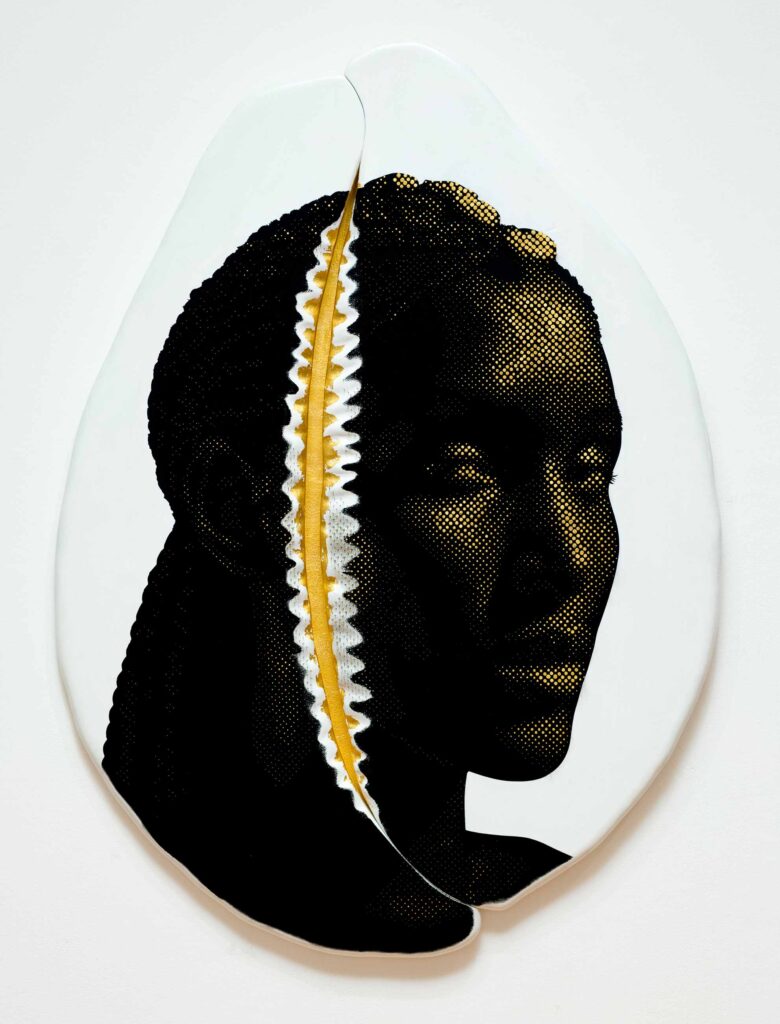
The composition features an irregular white outline that forms the outer edge of what resembles a portrait; inside, a black side-view portrait gazes to the right, with the head, bridge of the nose, lips, and neck all defined by continuous yet restrained silhouette lines.The outer contour is not a neutral border: the two white areas at the top overlap, while the bottom forms a slight fork, making the portrait appear as if emerging from a container that has been opened, folded, or deformed under pressure. The integrity of the figure’s face is severed by a vertical fissure running from the top of the forehead to the lower edge;though slightly offset to the left, this fissure becomes the true visual axis of the entire work due to the strong verticality of the golden central axis. The color palette is reduced to three hues: white, deep black, and golden yellow. White serves both as the background and the supporting structure, as well as the negative space surrounding the fissure; black forms the large, light-absorbing body, lending the portrait a monumental tranquility;The gold appears as dense dots and a central band of light. On the right side of the face, the golden dots gradually cluster and disperse across the forehead, cheekbones, bridge of the nose, around the eyes, and on the lips—resembling the shading of halftone printing, yet retaining their individual granularity upon close inspection.Consequently, the image is not rendered with smooth tones but is “forged” through the density, clustering, and fading of the dots. The contrast between black and gold suggests that the light does not come from external illumination but seems to emerge slowly from within the material itself. The edges of the central crack are irregularly jagged, with white fraying surrounding a golden band; the folds, reflections, and short, outward-protruding golden marks on either side of the band reinforce its visual quality as a patch, a suture, or a scabbed wound.Here, the fracture is not concealed but rather transformed into the brightest and most tactile part of the work. Subtle shadows visible on the white surface indicate that the work is not a purely two-dimensional image; the curled edges, overlapping layers, and variations in height along the fissure position the portrait somewhere between a bas-relief and an object. This resonates with Alexis Peskine’s long-standing approach to addressing Black subjectivity through dense hammering, the accumulation of granules, and the construction of portraits.The face depicted here possesses recognizable individual emotions while refusing to represent the subject through a singular, smooth surface: the dot matrix renders identity as a density composed of countless minute actions, while the cracks place fragility, trauma, and repair within the same structure.The hardness of the material, the rhythm of repetitive manual labor, and the symbolic luster of gold collectively transform the portrait from a representation of a subject into a surface that speaks to dignity, memory, and self-reconstruction.
Work 02
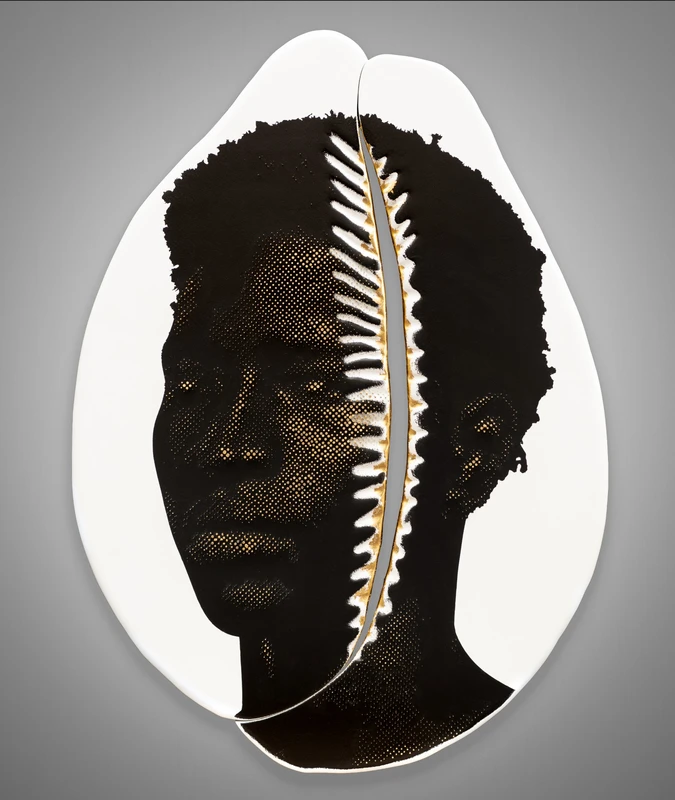
The composition unfolds against a white, nearly oval-shaped background with undulating edges. A black side portrait occupies most of the interior space; the head is turned slightly to the left, and the face, neck, and voluminous hair together form a serene yet resilient silhouette.The white outer edge is not merely a background but resembles a shell that both supports and isolates the figure; the black figure expands outward within it, with the coarse edges of the hair forming an irregular interlocking pattern with the white background, creating a contrast between the smooth outer contour and the dynamic inner edges.A vertical fissure runs through the center of the portrait, extending from the top across the forehead and bridge of the nose to the junction of the chest and neck, nearly dividing the face in half.On either side of the fissure are rows of interlacing, outward-extending white, jagged marks—resembling sutures, bone spurs, or torn paper fibers; the narrow golden lines exposed between them ensure that the fracture signifies not merely damage, but also serves as a source of light imbued with energy and dignity. The color palette is strictly limited to black, white, and gold. Black conveys the figure’s volume, the shadows of the skin, and the density of the spirit; white serves as the background while also intruding into the black with a sharp, jagged rhythm alongside the fissure, intensifying the sense of division; the gold, though minimal in area, gains decisive visual weight due to its position on the work’s central axis.The figures are not shaped by continuous shading but are composed of extremely dense, dot-like pinholes or grain-like particles resembling metal nail heads.The density and direction of these granules vary across the forehead, eye sockets, nostrils, lips, and neck, causing the face to appear as a solid, dark mass from a distance, yet reveal itself upon closer inspection as a multitude of discrete, hammered units.Warm-colored specks that flicker in certain areas pierce through the black layer, preventing the skin from becoming a closed silhouette and instead endowing it with a breathing-like inner luster. This method of creating portraits through repetitive striking, piercing, or embedding transforms the bodily image into a sedimentation of time and labor: each minute unit serves both as a pictorial pixel and as physical evidence of the force applied.Cracks, granules, and the golden inner layer collectively reject the notion of identity as an intact, undamaged surface, instead presenting it as visible fractures, repairs, and重组. In light of the artist’s ongoing focus on the subjectivity, memory, and dignity of the African diaspora, this work in particular demonstrates a significant approach:rather than creating heroic portraits through a singular, polished representation, the work uses the resistance of materials, traces of craftsmanship, and structural breaches to transform the individual’s face into a space where historical pressures and self-reconstruction coexist.
Work 03
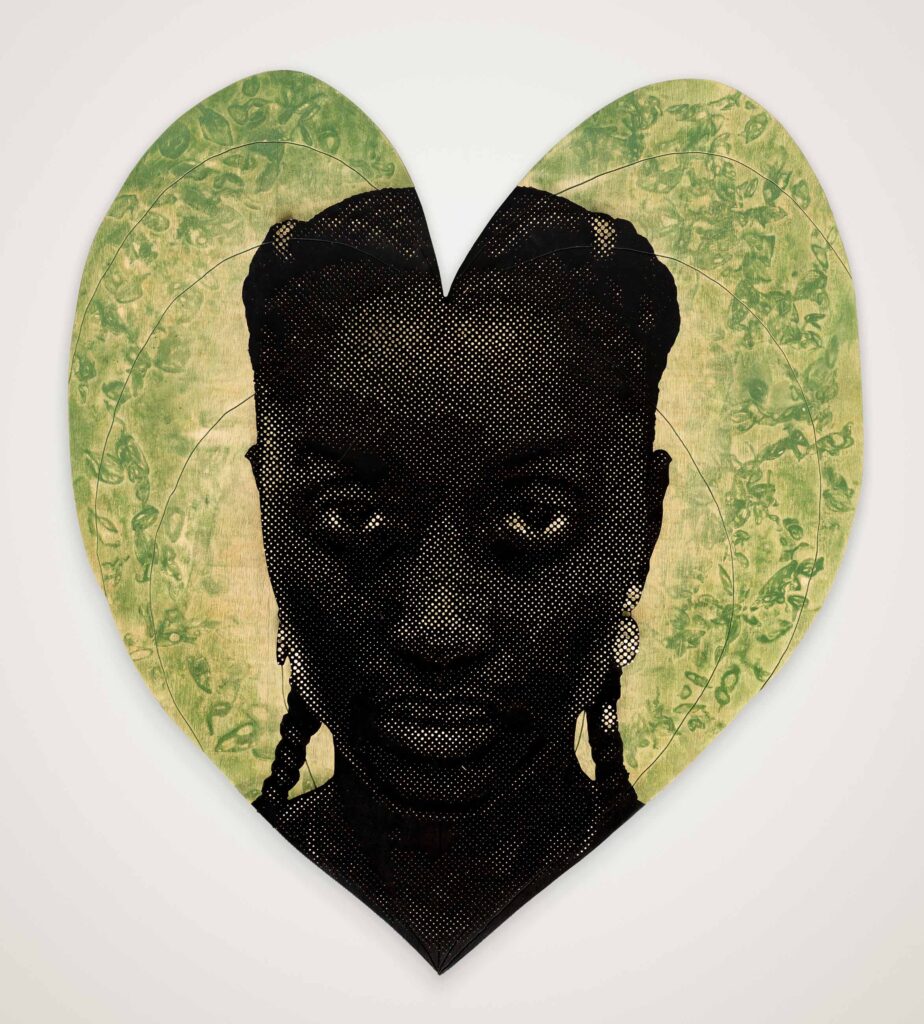
The composition unfolds in a nearly vertically symmetrical, shield-shaped outline: the upper portion splits into two rounded, blunt arcs at the shoulders; the middle tapers inward; and the lower edge drops sharply downward. As a whole, it resembles both an elongated human face and the front view of a ceremonial mask, emblem, or artifact.The central black portrait occupies the vast majority of the space; the forehead, eyes, bridge of the nose, lips, ears, neck, and the braids hanging down on both sides all appear as highly abstracted silhouettes. The facial features are not shaped by light and shadow but gradually emerge through the density, undulations, and localized highlights of a dense dot matrix.The viewer must navigate the overall black surface with their eyes to discern the drooping eyelids, the contours of the nostrils, and the volume of the mouth; thus, the portrait appears simultaneously as a visible face and as a shadow that resists immediate interpretation. The yellow-green underlayer along the outer edges bears distinct wood grain and mottled traces resembling wiping or brushing; the pale golden undertone, covered by a translucent green layer, creates a weathered yet warm luster.Visible beneath the surface are continuous curved incisions or linear indentations that encircle the head, resembling topographic contour lines, sound waves, or protective bands; their imperfectly regular trajectories mitigate the sense of stillness that a symmetrical composition might otherwise convey.A stark contrast in luminosity exists between the black portrait and the light-colored background, while small metallic dots introduce the background’s brightness into the black surface, preventing it from appearing as a closed plane. Judging from the visual evidence, the surface of the portrait consists of a multitude of tiny, reflective, nail-like dots; these appear in varying densities on the forehead, cheeks, and neck, serving both as pixel-like modulations of light and shadow and preserving the labor time spent hammering, positioning, and accumulating each dot.The black areas along the edges appear thicker, with局部 contours retaining the irregularities resulting from hand-cutting or application. Here, the material’s hardness, penetrability, and reflectivity do not serve realistic representation; rather, they cause the portrait to disintegrate into countless independent metallic units when viewed up close, only to coalesce once more into a personified image when viewed from a distance. This approach resonates with the artist’s ongoing practice of constructing the visibility of Black subjects through nails, wooden substrates, and portraiture. The work does not treat the face as a passively displayed object but, through piercing, inlaying, and layering, endows it with a monumental weight.The shield-like structure, mask-like frontality, and braided hair details collectively evoke identity, heritage, and self-representation; at the same time, the shimmer created by the dot matrix refuses to reduce identity to a single label, transforming the act of viewing into a process of constant adjustment between distance, light, and the resistance of the material.
Work 04
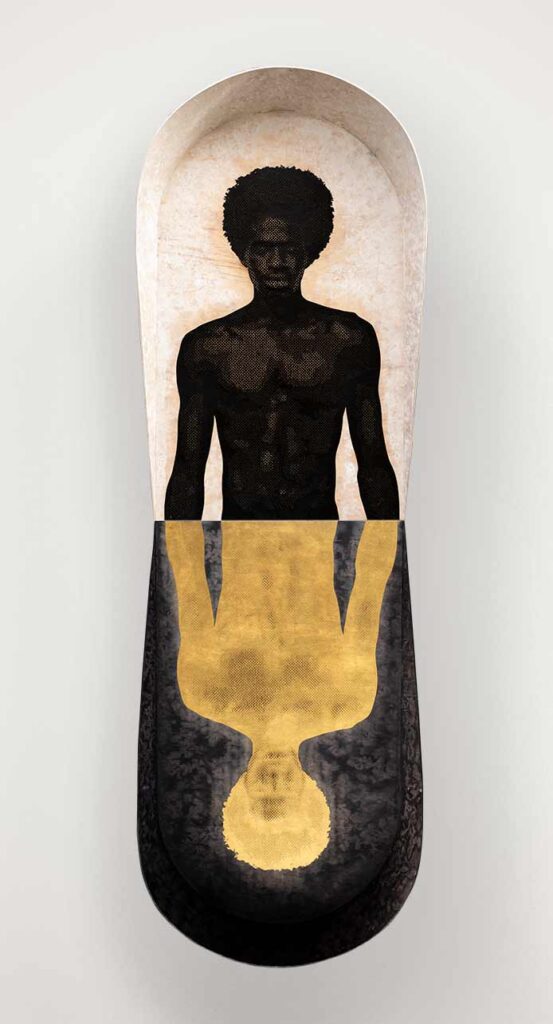
The work consists of a plate-like structure that extends vertically, tapering into arcs at both ends, resembling a superimposed combination of a niche, a shield, and a vessel.A horizontal dividing line in the center splits the composition into two distinct fields: the upper half is a recessed arched space interwoven with light gray, off-white, and pale brown tones, with a frontal male bust standing at its center;the lower half transitions into a dense background of deep black and dark gray, from which an inverted golden human figure emerges. The contrast between upright and inverted, black and gold, and the light-colored foreground and the dark background creates a structure of strong axial symmetry that is nonetheless internally contradictory. The head, shoulder line, chest, and arms of the figure above are rendered with dark, almost silhouette-like outlines,but the face, collarbones, pectoral muscles, and abdomen are not rendered as smooth chiaroscuro forms; instead, they are woven from extremely fine dots, grains, or repetitive puncture marks. Consequently, the figure possesses the recognizability of a portrait while simultaneously revealing itself as a surface composed of countless minute units.Black is not a single solid color: subtle variations in local density, reflections, and underlying hues cause the body to float gently in the shadows, causing the viewer’s perception to oscillate between “seeing a person” and “seeing a labor-intensive surface.” The golden inverted human figure is likewise composed of fine, dense particles, yet possesses a stronger symbolic quality due to the high contrast of its warm yellow hue.Its legs spread upward, its torso tapers downward, and its round head rests at the black base; this inverted body is not a mirror image of the figure above, but rather resembles another layer of existence pressed deep within.The horizontal seam precisely severs the connection between the two sets of bodies, making them appear as if they share a single container yet exist in different times, gravitational states, and mental states. The visible granular order on the material’s surface, the local irregularities, and the roughness of the edges lend the image a texture created by hand, point by point.The abrasion and smoky mottling in the light areas, combined with the muted texture of the dark background, prevent the background from becoming a mere backdrop, instead endowing it with the depth of a wall, a layer of earth, or historical sediment.This method of constructing portraits through repetitive actions resonates with the artist’s ongoing practice focused on the Black body, ancestral memory, visibility, and dignity: here, the body is not a passive object of the gaze, but rather a space re-empowered by material, patience, and density.
Work 05
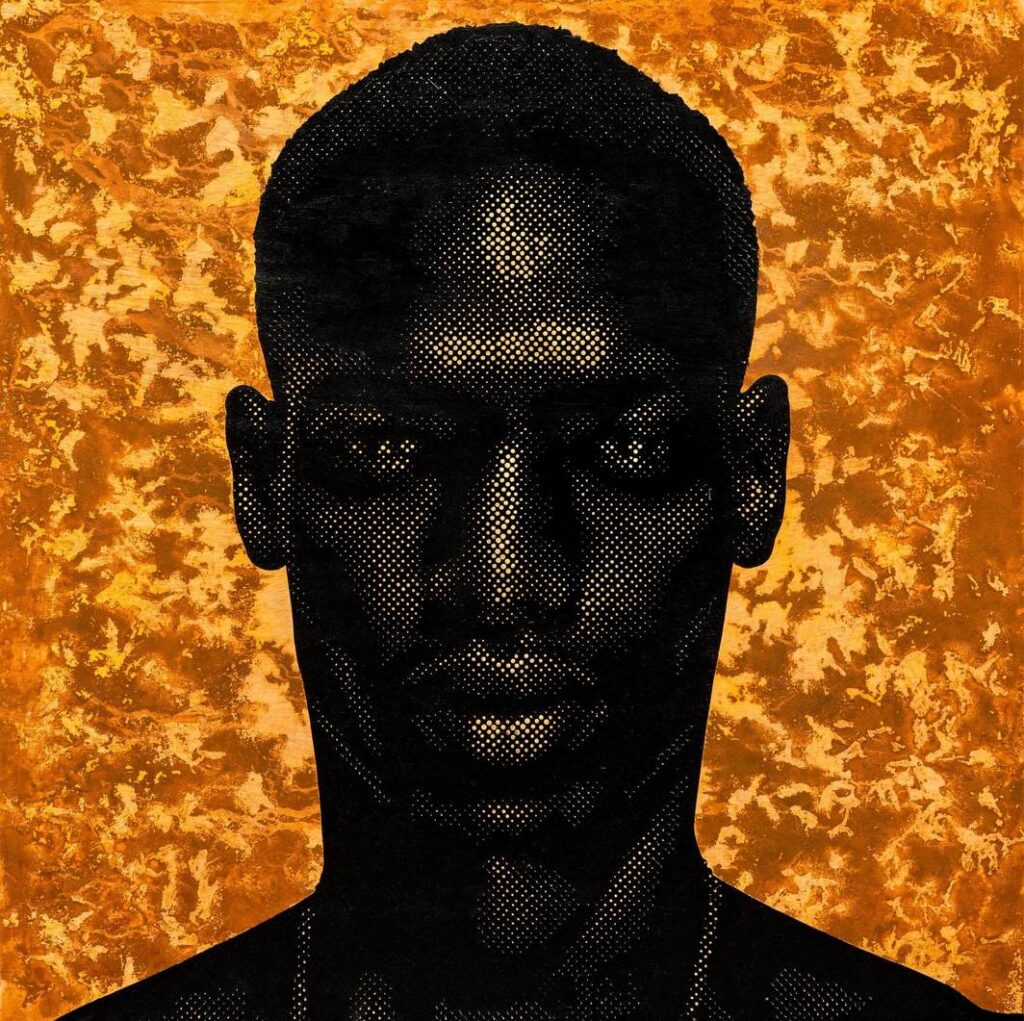
画面以正面肖像构成近乎碑刻式的中心结构:头部占据画幅大部,双耳、颈部与肩线被裁切至边缘,人物直视前方,神情克制而坚决。背景没有透视空间,而是一片高饱和的赭黄、橙金与浅黄交织的斑驳场域;其剥落、堆积和擦拭般的痕迹,与人物轮廓的稳定、封闭形成强烈对照。黑色头部如剪影般从暖色底中凸显,但它并非单纯的平涂暗面:脸部、额头、鼻梁、眼周、嘴唇与颈部均由极为密集的细小圆点组织而成。圆点的疏密、显隐及其所透出的金色底层,承担了明暗塑形的功能,使面孔在接近与远观之间不断转换:远看是具有体积、光源和表情的肖像,近看则是重复单元构成的网格与表面。 这种点状结构尤其改变了黑色的意义。黑并未将人物压缩为不可辨认的轮廓,反而因暖色孔隙的穿透而获得内部光泽;额部、鼻梁、颧部和下唇处较多的金色显露,形成类似反光的亮区,眼眶、发际及面部阴影则由更密的黑色覆盖加深。色彩因此不是附加的装饰,而是由底层暖色与表层黑色的相互争夺生成:金色既像背景,也像从人物肌理内部浮出的能量。 从图像可见的规则点阵及局部厚重、近似压印或嵌入的暗色表面推断,作品强调了反复施作的劳动过程。每一个点既是微小的制作痕迹,也是整体面孔不可缺少的结构单位;肖像的可读性依赖于大量离散标记的精确聚合。背景的偶发性肌理与人物点阵的纪律性并置,使个体形象同时具有历史沉积与当下显影的双重质感。结合艺术家持续关注黑人主体、记忆与尊严的创作取向,这一图像并不把肖像处理为单一、光滑的身份符号,而是通过材料性、重复性和光线穿透,提示主体性由无数痕迹、关系与时间层层构成。
Work 06
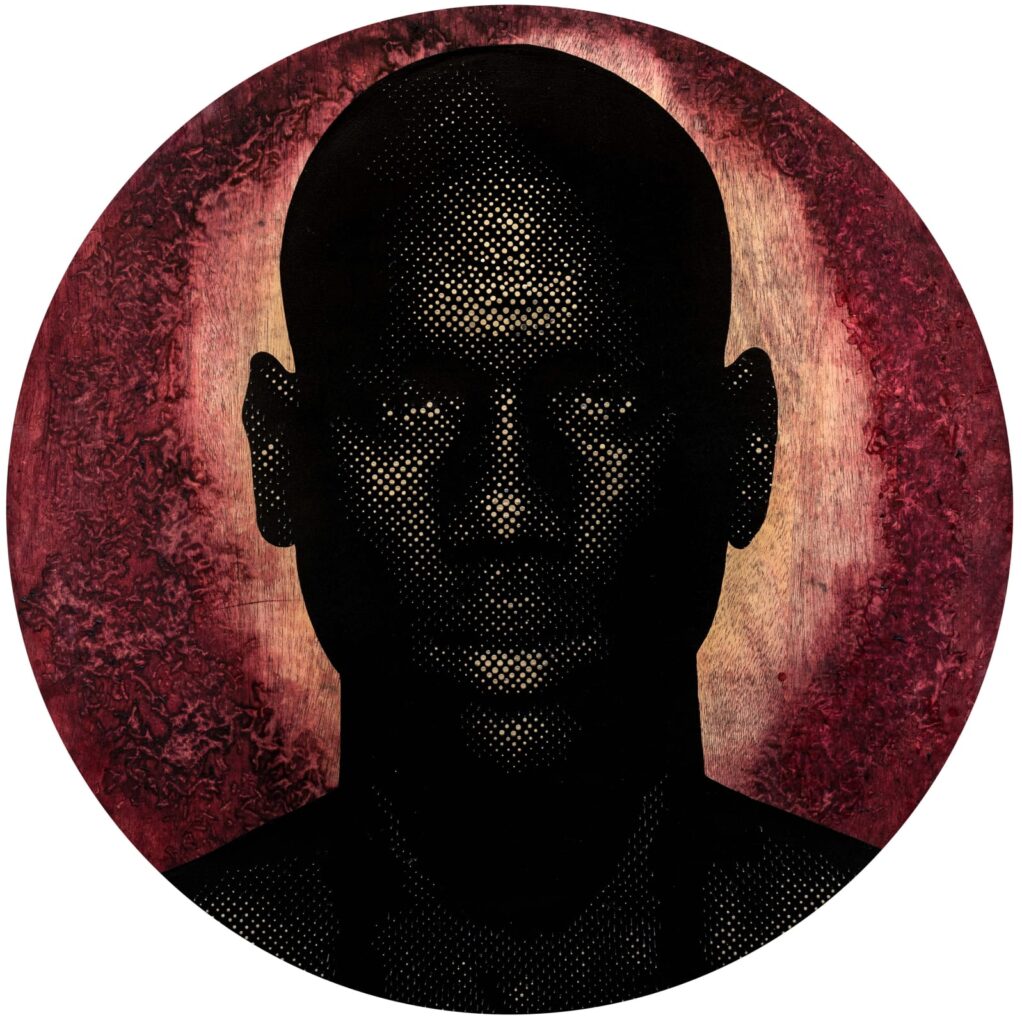
画面被严格收束于近乎完整的圆形之内:正面人物以头肩像占据中央,头部、双耳、颈部和肩线均由深黑色的大面积剪影构成,轮廓平稳而庄重。人物并未依靠明暗涂绘获得体积,而是由密集的浅金色圆点在黑暗中逐步显影:额头、眉弓、眼眶、鼻梁、颧骨、嘴唇与下颌处的点位疏密、大小和聚散差异,建立了面部的起伏。因而,肖像既呈现为一个可辨认的个体,又始终保持着由无数离散单位构成的图像状态。圆形背景如同光环或容器,人物的黑色剪影与其发生强烈的正负形关系;头部周围较亮的赭金区域形成逆光,使人物从酒红色外圈中被推出,同时也令黑色主体显得沉静、内敛。 色彩关系高度节制。外缘的暗红、紫褐与斑驳的赭色木质底调并非均匀铺陈,而呈现纵向纹理、磨擦痕和不规则的深浅沉积。它带来近似旧墙面、皮肤、土壤或被时间浸染表层的复杂感受。中央黑色吸收了大部分视觉信息,金色点阵遂成为唯一明确的发光因素;暖金与暗红彼此呼应,却因黑底阻隔而不流于装饰。金属般的亮点越在高光区域集中,面部越具雕塑性的凸出感;点位向边缘稀释时,轮廓又重新沉入暗部。 从图像证据看,这些圆点具有明显的逐点施作特征,其排列并不完全机械:局部沿面部结构形成斜向、弧向的力线,点径和间距也随形体转换。它们可能是嵌入、敲击或固定于基底表面的金属构件,其物理反光使肖像随观看距离而转换:远观时,点阵融合为明暗与表情;近看时,脸部又分解为可计数的材料单元。背景中保留的木纹或纤维性肌理,与黑色区域较为封闭的表面形成对照,使“承载痕迹的底”与“由击打累积的像”同时可见。 这类方法契合Alexis Peskine持续以肖像、身体与材料劳动讨论黑人主体可见性的实践。此处,身份并非被平滑再现,而是在暗色、反光、遮蔽与显现之间被缓慢建构。重复的手工点位既具有绘画的调子功能,也将时间、力度和身体动作留在表面;肖像的尊严由此不来自理想化修饰,而来自材料抵抗、耐心劳动与凝视关系共同生成的存在感。
Work 07
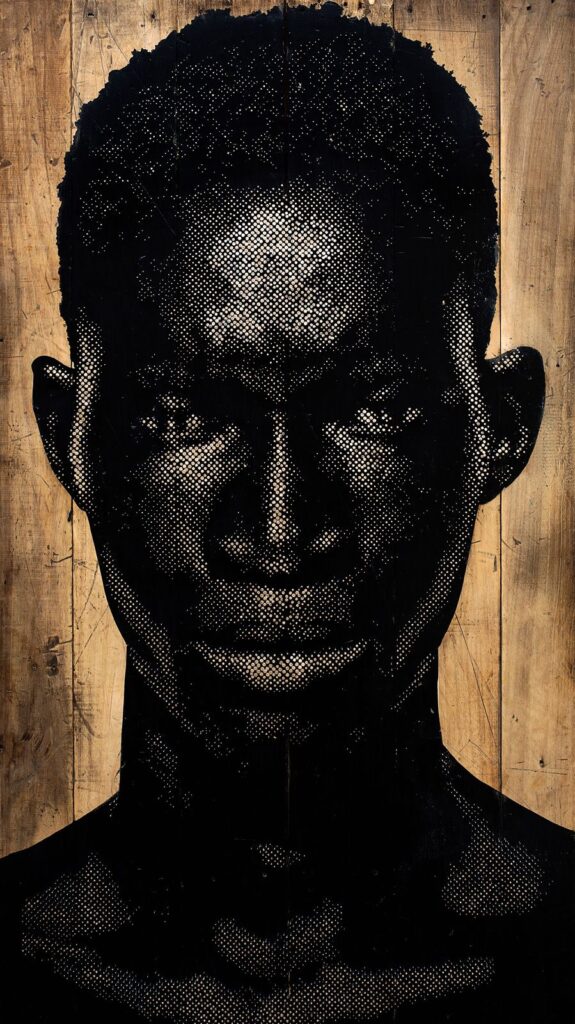
画面以一块纵向拼接的木板为基底,人物正面肖像被压缩为近乎等身的巨大头肩轮廓。构图极端居中,头部占据画面上方的大部分面积,双耳、颈部与肩线将形象稳定地锚定在木材表面;正视的凝望并不依靠写实细节,而由额头、眉弓、眼窝、鼻梁、唇部和颧骨之间的明暗关系逐层显现。黑色覆盖形成沉重而近于剪影的外壳,暖褐色木板则从密集点状孔隙或钉状痕迹间透出,使面孔仿佛由光点在暗部中缓慢凝聚。 色彩被严格限制在炭黑与原木的黄褐之间。这样的高反差并非单纯的黑白摄影效果:木材本身的温度、纹理和旧痕使亮部带有肉身感,也令肖像脱离平滑图像的中性。点状单元在额头中央、鼻梁、双颊、上唇与下巴处尤为密集,承担了受光面和体积转折;眼眶、发际、面颊边缘及颈部则由大面积黑色吞没。观看距离因而成为作品结构的一部分:远看,离散圆点汇合为坚实的面部塑性;近看,形象又分解为重复而彼此有间距的微小行动痕迹。 木板上的纵向接缝、划痕、孔洞、污渍及边缘粗粝的黑色涂覆均未被遮蔽。它们打断肖像的完美性,并把人物图像置回一块具有时间感和使用痕迹的物质表面。黑色层既像涂料形成的遮蔽,也像经由反复敲击、穿刺或局部显露而被激活的地层;点阵的疏密、方向与局部重叠,使机械网点式的视觉秩序转化为带有手工节奏的肌理。材料在此不只是承载图像的底板,而直接规定了图像如何出现:木的纤维、接缝和伤痕构成现实重量,黑色覆盖制造历史性沉默,点状亮部则将个体面容重新推向可见。 这与Alexis Peskine持续关注黑人主体、肖像权与物质记忆的方法相呼应。作品没有把人物塑造成可被迅速消费的照片式形象,而是让观看者在“看见一张脸”与“看见木、黑色表层和无数痕迹”之间往返。肖像由累积性的劳动生成,因而身份不再是固定的表象,而成为由身体、历史、表面伤痕与观看距离共同建构的现场。
Work 08
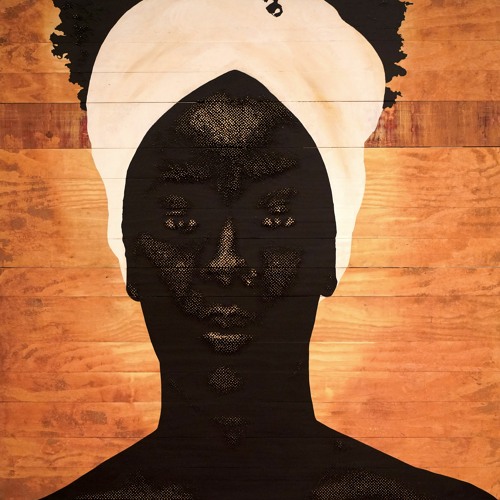
画面以正面肖像的高度凝视建立稳定而直接的观看关系。人物头肩占据画幅中心,下部宽阔的深色肩线向两侧展开,形成近似纪念碑式的三角支撑;头部则被置于浅色包头与上方不规则黑色形体之间。背景由横向拼接的木板构成,板缝清晰地穿过面部、颈部与头饰,使肖像并未脱离其物质基底,而像是从木材内部被逐层显现出来。横向木纹的自然流动与人物垂直、对称的轴线相互牵制,令庄严的正面构图保留了材料自身的不规整与时间感。 色彩关系高度凝练:暖橙褐色木材提供了近似肤温和土地色调的背景,黑色构成头部、颈肩及后方阴影,乳白色包头则形成最强的明度区。黑、白、木色并非单纯勾勒人物轮廓,而是在深浅套叠中塑造身份的可见性:白色头饰将脸部的暗色重量向内聚拢,顶部和两侧的黑色又使白色轮廓更为突出。面部内部并非均质黑面,额头、眼眶、鼻梁、双唇、面颊和下巴由密集的细小点状反光逐渐生成;远看是清晰而沉静的五官,近看则可辨认出颗粒式的覆盖、凹凸与金属般的闪烁。 这种由大量重复性击打或嵌入痕迹形成的明暗,改变了传统肖像依赖颜料铺陈的方式。五官不是被柔和地“画”出来,而是借由密度、方向和表面反射被建构:钉状或点状单元越集中,面部转折越显得厚重;较为疏松的区域则让黑色底面保持沉入暗处。木板的水平接缝同时打断连续的脸部塑形,使肖像带有拼装、修补和承压后的结构感。材料在此既是图像的载体,也是意义的参与者:木材的纹理、深色覆盖层与坚硬颗粒共同抵抗平滑、理想化的肖像传统。 结合艺术家一贯以肖像、记忆、身体与非洲离散经验为核心的实践,这件图像可被理解为一种以劳动性工艺重新赋予主体可见性的方式。观看者必须在整体轮廓与局部颗粒之间来回调整距离,才会意识到这张脸既具有强烈的个体性,也由无数细微、重复而不可忽略的物质动作构成。由此,肖像不只是再现某个人的面容,更成为关于尊严、历史沉积与自我呈现权的结构。
Work 09
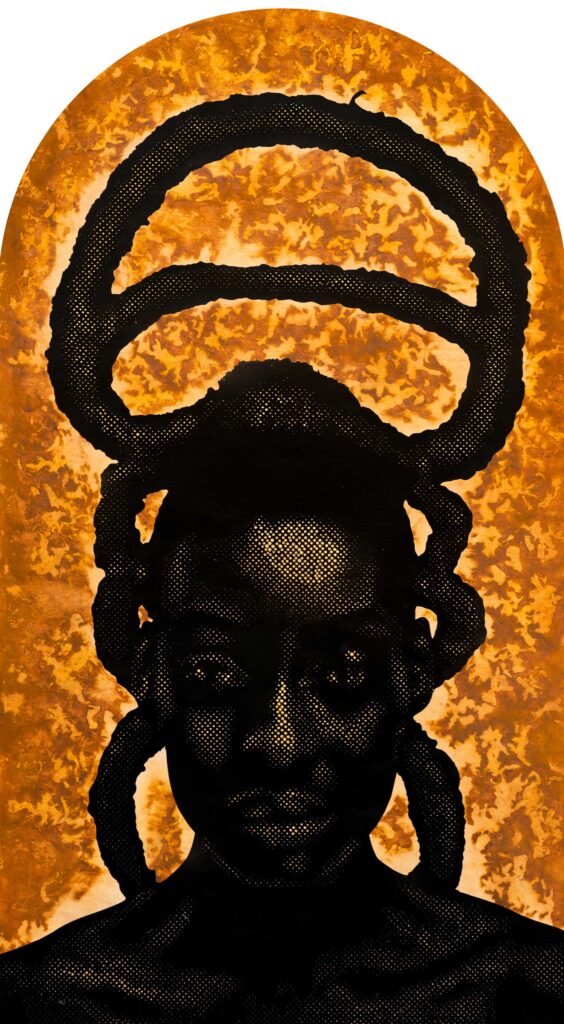
画面以近乎正面的胸像构图展开,人物被置于拱顶般的半圆形边界之中,肩部横向展开,头颈稳定地占据轴线,形成纪念碑式的垂直结构。上方的头饰并非附属于头像的装饰性轮廓,而像一组层层环抱、向外扩张的弧带:宽阔的外圈、中间的弯曲留白与横向压低的内层共同构成冠冕、发辫与光环之间游移的形象。人物的眼神平视,面部虽被深黑覆盖,却因双眼、鼻梁、唇部和颧骨处密集而疏密不同的微小亮点获得清晰体积,观看因此在整体剪影与局部面容之间往复移动。 色彩被高度压缩为焦橙、赭褐、木色与黑色的对置。背景呈现出不规则的斑驳、渗化和烧蚀般纹理,暖色并非均匀铺陈,而在浅木色底上聚集为深浅不一的褐色岛屿;它既制造出类似氧化金属、风化墙面或皮肤痕迹的时间感,也令黑色人物显得不是悬浮于平面之上,而是从带有历史沉积的底层中显影出来。黑色区域边缘保留明显的起伏与毛糙,拒绝了工业制图式的光滑轮廓,使庄严的正面肖像始终带有手工介入后的不稳定性。 最关键的表面语言来自黑色形体内部遍布的细小圆点。它们如穿孔、压印或钉入后形成的密集光孔,在深色基底上以背景的暖光反向勾出脸部、发束、衣褶和头饰的明暗。点并不平均排列:面部结构转折处更为集中,暗部则趋于吞没,因而类似传统素描中的排线,却又将线性的塑形转化为颗粒化的节奏。宏观看,人物首先作为厚重、沉默的黑色剪影出现;近看时,黑色又被无数微小开口穿透,成为一种由缺失、孔隙和反射共同构成的表皮。 这种将肖像建构于穿刺性痕迹、木质或板材感肌理与强烈色场关系中的方法,契合Peskine持续关注的身体、记忆与非洲离散身份经验。图像没有把人物处理为可被轻易归类的社会类型,而是让身份在材料劳动中逐步生成:暖色底层提供时间、土地与能量,黑色覆盖赋予形象重量,密点则使其在遮蔽中重新获得可见性。由此,肖像既具有图标般的凝聚力,也保留了由材料阻力、手工节奏和观看距离共同激活的复杂性。
Work 10
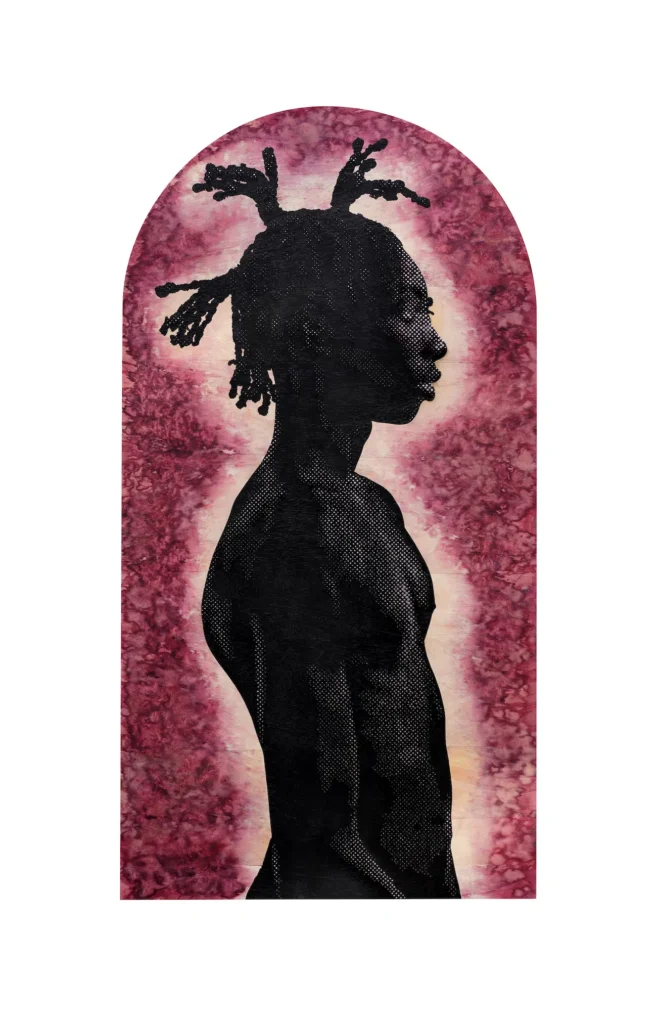
画面被严格收束在拱形边界之内:人物以右侧面半身像占据中心,肩、颈、头部构成由下向上略微前倾的纵轴,发束则向左、向上和向右伸展,使稳定的肖像轮廓获得外溢的动势。拱顶既像建筑中的壁龛,也像为人物设置的纪念性框架;人物周围预留的浅色光晕,将黑色形体从酒红背景中明确地托举出来。侧脸的额头、鼻梁、双唇与下颌以连续而克制的剪影线切出,避免了写实表情的铺陈,却使昂首凝视的姿态具有清醒、坚定的精神强度。 色彩组织建立在黑、玫红、暗紫与暖白之间。背景由边缘浓重、中央渐亮的云雾状色层构成,近似染渍、渗化和反复覆盖后留下的斑驳肌理;深红并不只是装饰性的底色,而像环绕身体的能量场。人物通体近黑,但并非无差别的平面黑色:面部、颈部、肩部及胸前可见疏密不同的细小亮点,局部形成较明晰的灰阶过渡。因而,人物首先以剪影出现,继而又在观看距离拉近时显露体积、皮肤般的起伏与内部结构。 这些点状单位从视觉效果判断,接近被逐一嵌入或敲击于基底上的金属钉头;其反光使黑色轮廓获得颗粒化的明暗。钉点并未平均覆盖,而是顺应颧骨、下颌、锁骨和肩背的转折调整密度,密处压低并凝实形体,疏处则让底层暗色与光线参与塑形。发辫部分呈现更粗粝的团块和分叉边缘,似由线性材料、涂层或密集钉构成的交织笔触,与面部精细的点阵形成工艺节奏上的对照。 这种以重复性手工劳动生成肖像的方式,契合艺术家将黑色身体、记忆与尊严置于物质表面加以重建的总体取向。钉击或嵌置不只是图像再现的技术,它把肖像从可被快速消费的平面图像转化为具有重量、阻力和时间沉积的对象。背景的渗染性与主体的钉构性相互牵制:前者指向流动、情感和历史的扩散,后者则以坚硬、精确而持久的结构,确认人物不可被抹除的在场。