fabian treiber|深入研究
Germany
1. Artist Profile
Fabian Treiber,1986年生于德国路德维希堡,现工作、生活于斯图加特,是德国当代绘画中以室内、静物、建筑与风景为线索,持续重估图像空间的艺术家。他于2007年至2015年间在斯图加特国立美术学院接受基础、绘画及跨媒介创作训练,先后师从Andreas Opiolka、Reto Boller,以及Discoteca Flaming Star的Christina Gómez Barrio与Wolfgang Mayer;其后完成魏森霍夫艺术项目的Meisterschüler阶段。学院训练使他并未将绘画理解为再现现实的窗口,而更重视画面作为材料、痕迹、尺度和观看秩序相互作用的现场。2013年租用独立工作室,是其由学习阶段转向自主实践的重要节点;2016年前后完成学业后,他逐渐通过德国及欧洲多地展览建立起稳定的职业轨迹。 Treiber早期已关注具象物象如何在画面中变得不稳定,之后逐步发展出辨识度极高的“非现实空间”:房间、走廊、窗景、桌面、植物、器物或建筑局部看似可辨,却常被不合逻辑的透视、突兀的尺度转换和断裂的视点重新组织。其重要转折不在于从具象转向抽象,而在于将二者维持在相互牵制的临界状态:物象提供记忆、日常经验与心理投射的入口,抽象性的色面、线条和结构则阻止叙事被轻易固定。烛火、烟雾等反复出现的细节,也令静止的室内含有时间流逝与人迹缺席的意味。 在艺术史位置上,Treiber可被视作欧洲当代绘画复兴语境中重返“绘画问题”的一代艺术家。他不依赖怀旧式的写实传统,而以室内画、静物画和风景画这些历史类型为实验框架,讨论形、色、构图、空间及观看真实如何被建构。其作品常以丙烯、墨、油画棒、粉彩等并置于画布或纸本;不同媒材的覆盖、渗透、颗粒感与线性书写,使平滑色域与手工痕迹彼此抵触,从而直接生成空间的前后关系和心理温度。对综合材料艺术研究而言,他尤其值得关注:材料在这里并非装饰性叠加,而是与图像结构同步工作——墨的流动性削弱边界,粉彩与油画棒强化触觉和停顿,丙烯色层则承担建筑般的构成秩序,由此说明当代绘画如何在有限媒介中获得复杂的复合感知。
2. Artistic Concepts
特赖伯的艺术观念并不以再现某个可被辨认的地点、事件或人物为目标,而是将绘画理解为一种生成独立现实的过程。他反复使用室内、静物、建筑、窗帘、植物、手部及若干日常器物,并非出于叙事性的生活记录;这些母题更像是让色彩、结构、触感与空间关系得以展开的“支架”。在他的画面中,房间既可能来自记忆,也可能仅是由局部印象、视觉残留和绘画过程共同凝结而成的心理场域。因此,错位的透视、断裂的家具轮廓、无法确认内外的空间转换,并非对现实观察的失误,而是有意取消单一视点与稳定尺度,使观看从“识别物”转向感受物与物之间的张力。 其早期及较具代表性的室内与静物绘画,已显示出一种以形式决定内容的立场。室内空间提供了边界、台面、开口和遮挡关系,静物则提供可被切割、压缩或变形的体积;但艺术家并不让它们服从透视学或日常功能,而是借其组织画面的平面分区、视线节奏与色彩重心。粉彩般明亮而彼此接近的色调,常与灰暗、裸露或低饱和的底层并置,形成既亲近又疏离的感受。温和色彩因此不等于抒情,反而由于色层之间的摩擦、冷暖关系的悬置以及空间逻辑的失衡,制造出一种不完全安适的观看经验。这种“似曾相识却无法安放”的气氛,关联着记忆并不可靠、感知总被情绪重写的现代经验。 在近年的发展中,他逐渐将原本以内景为核心的结构延展至风景、户外建筑以及内外互相渗透的场面。风、雨、昼夜、星体等本来难以作为实体把握的现象,被转译为喷涂线、擦洗痕迹、飘移的色块、重复的圆形或流动的笔触。由此,他关心的不只是“画什么”,更是如何让不可见的时间、空气和情绪在绘画中获得形式。画面中偶尔出现的手臂或手势,也不提供完整人物叙事,而像介入空间的片段信号,提示人的存在,却拒绝将意义封闭为单一故事。 这种观念与其材料方法密切相关。特赖伯通常在未经底涂或保留织物感的画布上,以丙烯、墨、水性喷涂、油画棒、粉彩等媒介层层推进;薄而透明的渗染、空气喷枪造成的雾化边缘、厚涂颜料的凝结,以及擦洗、覆盖和保留,分别承担光线、烟雾、风力、物体重量或空间深度的功能。材料不是被动服务于形象的工具,而是主动“提示”图像走向的因素:半干的黏滞颜料、吸收颜料的织物、偶发的痕迹都会改变下一步判断。艺术家因而更像调停者,在预设的视觉记忆与画面自身不断提出的要求之间工作。这一立场也与其在斯图加特学院所经历的跨媒介学习环境有关:他不把绘画、物件、装置或图像观念视为绝对分隔的领域,却始终以绘画内部的精确控制为核心。最终,他的作品将个人记忆、日常空间与当代人不稳定的感知经验,转化为一种既具物质密度又保持开放性的视觉现实。
3. Main Materials, Manufacturing Processes, and Technologies
Treiber的材料选择以织物底材、丙烯颜料与丙烯墨水为核心,并在近年的作品中结合油画棒、粉彩及纸张元素。其画布常采用织纹细密而未作厚重底涂的亚麻或苎麻类织物;这种底材保留纤维孔隙与吸收性,使稀释后、高颜料浓度的色液能够渗入正反两面,而非仅停留于表皮。正因如此,他并不把画面理解为一个等待覆盖的平面,而将其视为能够吸纳、沉积和回返色彩的多孔场域。创作通常从少量彼此关系紧密的基础色开始,以宽笔反复铺陈稀薄色层,并在湿画法中让颜色相互渗化、叠压;随着层数增加,织物逐渐被颜料浸透,透明的染色感与局部浓稠的实体感遂同时存在。 喷枪是其重要工具。雾化的丙烯色能够形成边缘游移、密度不均的色域,避免笔触直接作为个人手势占据表面;由此产生的朦胧、悬浮和轻微失焦,尤其适合处理室内、器物与建筑片段中不稳定的空间关系。相对于喷涂的无接触性,他又以纸质剪形、遮挡和轮廓定位介入画面:先移动纸片以试探形体在构图中的位置,再固定或遮蔽其边界,向内部填入较厚的丙烯颜料,随后继续喷涂、覆盖或以油画棒和粉彩加强局部。纸张因而既是拼贴材料,也是临时的制图工具;厚涂色块则从薄层背景中凸显出来,如同家具、肢体或器皿的残片,却始终保留抽象形状的独立性。 这种由渗透、喷雾、遮蔽、厚涂和干性线痕共同构成的材料语言,使画面同时具有织物般的柔软、空气般的漂浮与沉积物般的重量。色彩并非服务于物象的固有色再现,而是在冷暖近似、明度微差和层层覆盖中制造视觉摩擦;空间也不依赖透视法被稳定建构,而是在透明与不透明、远退与凸起之间不断摇摆。材料工艺因此直接支持其艺术观念:日常物与室内景象不是可被准确辨认的叙事对象,而是感知、记忆和现实经验在绘画过程中暂时凝结的原型。
4. A Detailed Examination and Analysis of 10 Representative Works
Work 01
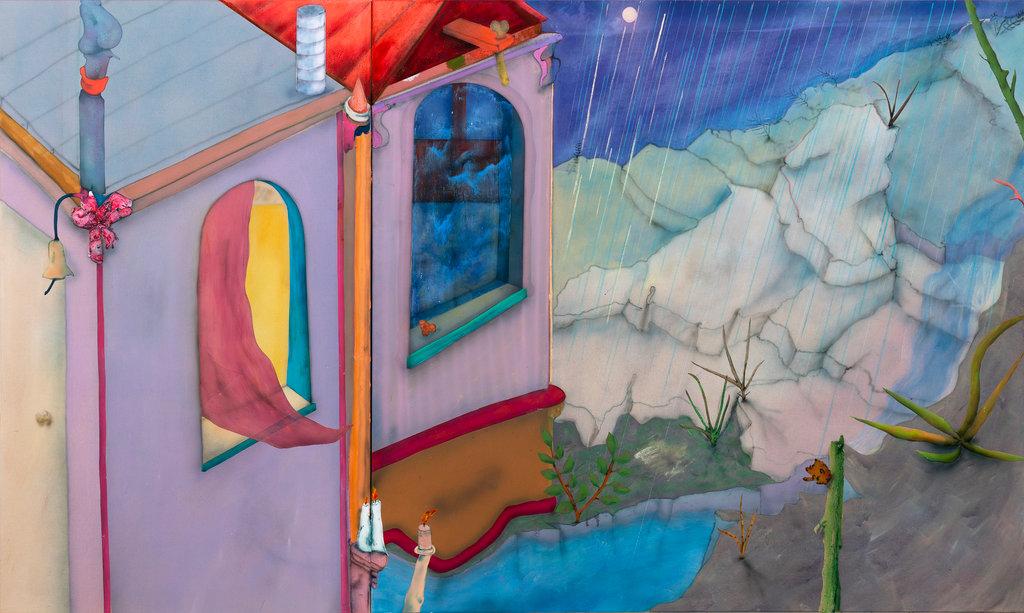
The image centers on a building cut off from view, with the left wall, roof, chimney, and two arched windows forming a stable vertical framework; the right side suddenly unfolds into a band of rock, slopes, water, and plants. The building is not embedded in the environment with traditional perspective, but rather as a stage set for the foreground: orange-yellow tubular elements on the corner, red-red eaves and roof slopes reinforce its flattened profile, also creating a slight but persistent dislocation between the interior and exterior, artificial bodies, and the landscape. The red curtain hanging from the left window conceals the interior colors of yellow and green, while the right window presents a dark blue and black-blue spectrum of subdued space; the two windows do not provide recognizable interior narratives, but rather serve as containers of different densities of color. The relationship between colors is highly structured. The gray-purple and pink-purple walls of the building form a soft, slightly cold base, on which are embedded red, burgundy, orange-yellow, and green lines of high purity, giving the elements a flattened, jagged outline. The vertical lines above the deep blue sky, in contrast, echo the lines on the rock wall. They connect the air, rainfall, rock layers, and the drawing of the painting. The red water surface is located below, both as a continuation of the red-brown base of the building and as a link between the grey ground and the green vegetation on the right. The juxtaposition of different textures in the image is visible: the wall is relatively smooth, with shadows transitioning to transparent and thin layers of color; the rock wall, on the other hand, is like layers of fog that permeate and wipe away, with both a nebulous infiltration and a boundary resembling geological sections. The plants are particularly important: slender branches, leaves, cacti-like upright forms, and the protruding fronds of the right side appear with clear contours that are somewhat cartoonish. They do not fully obey the realistic scale; rather, they act as a rhythmic “seam” between the hard architecture and the loose mountain rock. This method of construction, with its neat edges, flowing curtains, sedimentary layers, and sparse vegetation, creates a sense of both precision and dreamlike wandering. The approach embodied in this image approaches Treiber’s tendency to rearrange the spatial organization of buildings, natural fragments, and visual memories. It does not treat space as a reality that can be directly reproduced; rather, it views walls, windows, roofs, water bodies, rocks, and plants as components with independent color and tactile value. Because the structure is pressed down to a moderate level and the scale relationship is slightly disturbed, the viewer cannot immediately determine whether the space is a dwelling, a ruin, a greenhouse, or an imagined edge zone; the painting thus turns from depicting landscapes to examining how artificial bodies intermingle with natural forms and reconstruct them.
Work 02
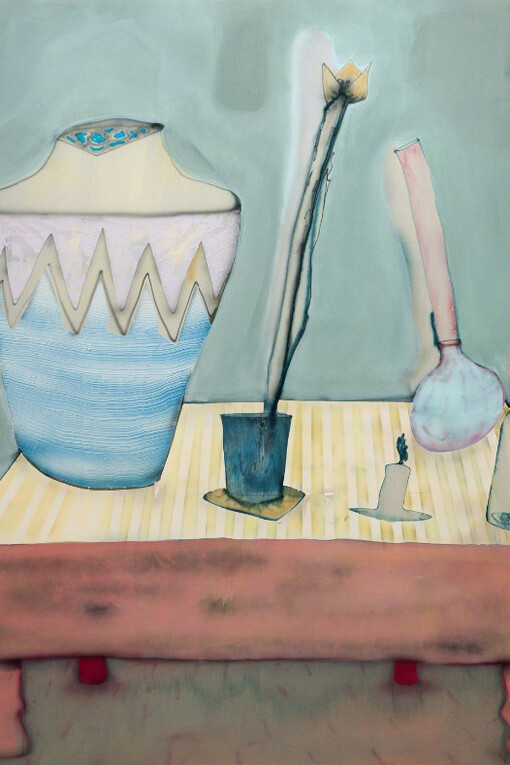
The image unfolds in a near-horizontal still-life arrangement: a tabletop covered with pale yellow stripes occupies the lower half, with a background of large, grey-green walls; to the left are oversized ceramic vessels, with vertical branches of slender, dead branches and dark containers at the center; the tilted, long-necked glass vessels at the right constitute an unstable triangular relationship. The table edge is cut off by a thick, ochre-red horizontal band, making the tabletop both a display stand and a stage backdrop; the faint red table legs and the dark space below it convey a somewhat suspended sense of the stable still-life order. The colors do not pursue saturation; instead, a low-temperature, cloudy composition is established between grey-green, milky-white, pale yellow, blue-grey, and rust-red tones. The blue horizontal lines of the left objects, in contrast to the vertical shadows in the background, the vertical lines of the branches in the center, and the pink edges of the red glass vessels at the right, evoke a kind of suspended sense of the still-life’s stability. The colors here are not decorative; they are structural tools for regulating the distance, temperature, and psychological weight between objects. The surface of the paintings retains the distinct drawing process: the background is a mist-like variation of thin layers and slight rubbing; the contours of the objects are repeatedly defined by deep, slightly shifting lines; the dense parallel patterns of the ceramic vessels are not entirely faithful to the real world’s luminosity; they emphasize their volume by means of intermittent black-and-gray brushstrokes and faint white fill; these treatments keep the objects always between “recognizable” and “completely undetermined”: they come from everyday utensils, yet are magnified, simplified, and misplaced, acquiring a near-humanistic stance in the empty background. In the artist’s usual method of organizing ambiguous narratives through the organization of interiors, objects, and plants, this painting transforms the stability of still-life painting into a psychological theater. The material qualities, faded hues, and slightly clumsy structure resist sophisticated display, making everyday objects a visual container for time, loss, loneliness, and potential events.
Work 03
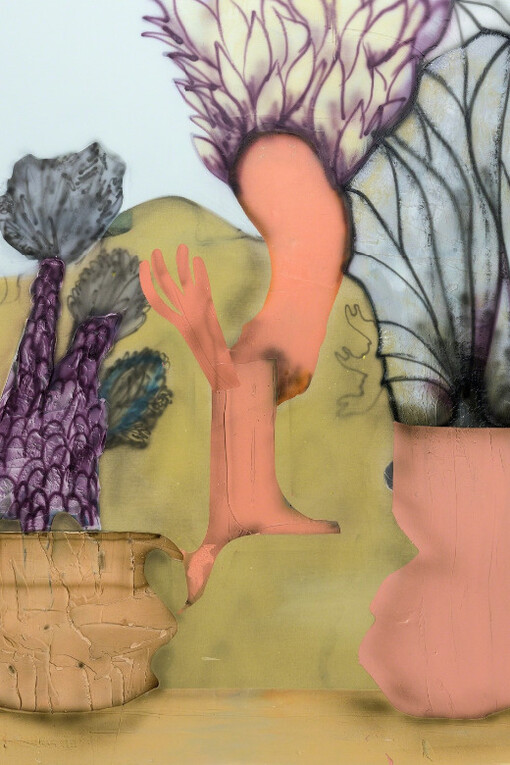
The image unfolds in a nearly stage-setlike compressed composition: the ochre-yellow tabletop supports the left-side vessels and the orange-pink containers in the center, with the undulating forms of olive-green and grey-black in the middle horizontally spread out like hills, fabrics, or enlarged plant stems. Above it, several organic forms of varying proportions stand out: on the left is a purple-spined stem with grey-black flowers; in the center is a curved form of orange-pink, resembling limbs or flower stalks; at the top, a purple-white petal emerges; on the right, a massive leaf and container form a closed, heavy mass. The categories of plant, body, container, and landscape are intentionally confused, so the space thus resembles a still life rather than an inaccessible psychological scene. The colors do not seek to reproduce nature, but rely on the antagonism between low-saturated yellow-green, flesh-pink, grey-black, and deep purple to establish order. The yellow-green takes on the role of background and connection, giving the orange-pink form a striking sense of body. The grey-black lines in the edge of the flower head infiltrate the grey-black of the background, providing both vertical support and a response to the dense texture of the orange-pink; the grey-black lines also repeatedly outline the petals, leaves, and scales, transforming the soft growth form into a structured network of patterns. The grey-white underside of the right leaf is divided by coarse, dark lines, providing both longitudinal support and a response to the dense texture of the orange-pink on the left. Visible are distinct covering, scratching, and partial accumulation marks on the surface of the vessel's exterior wall. The cracks in the vessel's outer surface, the blurred shadows in the background, and the grey-black infiltration of the flower head border make the image not composed of smooth color blocks, but rather a skin that is constantly being modified and eroded. The orange-green tone near the center is divided into horizontal lines of thick, dark lines, providing both vertical support and a response to the dense texture of the orange-pink on the left. The color of the orange-green on the right is similar to the left, with a darker shade of orange-green on the bottom, and the vertical lines on the left are also divided into horizontal lines of thick, dark lines. The color of the right leaf is close to the left, with a darker shade of orange-green on the bottom, and the vertical lines on the left are also divided into horizontal lines of thick, dark lines. The gray-white base of the surface of the right leaf is divided by coarse, dark lines, providing both vertical support and a response to the dense texture of the orange-pink on the left. Visible are distinct covering, scratching, and partial accumulation marks on the surface of the vessel's exterior wall. The cracks in the vessel's outer surface, the blurred shadows in the background, and the grey-black infiltration of the flower head border make the image not composed of smooth color blocks, but rather a skin that is constantly being modified and eroded. The orange-green tone near the center is divided into horizontal lines of thick, dark lines, providing both vertical support and a response to the dense texture of the orange-pink on the left. Visible are distinct covering, scratching, and partial accumulation marks on the surface of the vessel's exterior wall. The cracks in the vessel's outer surface, the blurred shadows in the background, and the grey-black infiltration of the flower head border make the image not composed of smooth color blocks, but rather a skin that is constantly being modified and eroded. The orange-green tone near the center is divided into horizontal lines of thick, dark lines, providing both vertical support and a response to the dense texture of the orange-pink on the left. Visible are distinct covering, scratching, and partial accumulation marks on the surface of the vessel's exterior wall.
Work 04
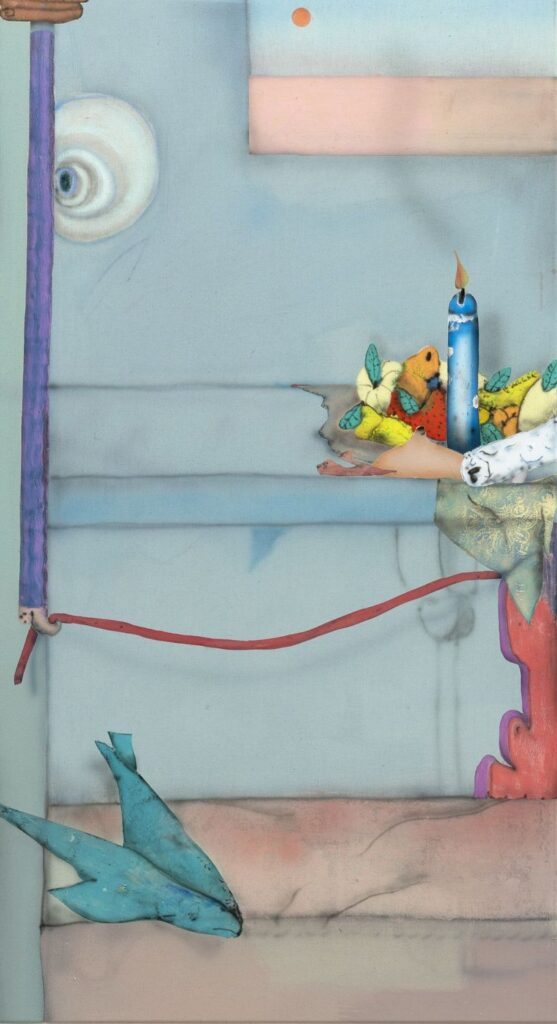
The screen forms a closed space that is almost like a stage set. A vertical purple pillar-like element extends from the top to the bottom on the left side, forming a supporting structure for the red-purple support on the right side; a slender red line stretches horizontally and hangs loosely in the air, connecting the two at the same time. A long red line stretches horizontally and hangs loosely in the air, connecting the two at the same time. The large white space left in the center of the space makes the upper right corner of the fruit, leaves, blue candles, and fabric-like forms appear as props left behind in a silent scene. The vertical rectangular pink and orange dots on the top and the white spiral-shaped objects on the left side, which are suspended at the same level, form visual nodes lacking narrative logic but pulling together in terms of scale and direction. The warm blue-gray colors are based on a low saturation of blue-gray; the warm colors of pink, purple, red, orange, yellow, and green are concentrated only on a few objects, making the picture appear as a detached, abnormal temperature increase in a calm space. The tiny warm yellow flames of the blue candle are echoed by the orange dot above; the red line draws a fragile and clear path across the broad blue-gray background. The colors here are not used to reproduce nature; they serve as structural functions that position, connect, and create psychological instability. The surface of the objects is treated with a soft, slightly powdery feel; the edges may be recognizable but often have slight blurring and shadow transitions. The fruits, candles, birdlike forms, textile patterns, and columns seem to come from different tactile worlds: some are close to smooth coatings, while others have grainy, pleated, or decorative floral patterns; others are attached to the space in the form of silhouettes. These surface differences do not truly establish a solid material order; instead, they reveal the artist’s method of assembling the interior space as a psychological structure rather than a habitable space. The everyday objects, decorative debris, and images resembling toys or stage sets are juxtaposed, their original functions removed, and instead transformed into carriers of color, contours, and relationships. The value of the work lies in this restrained and strange organization method: it does not drive the viewer to dramatic events, but instead allows the viewer to continuously identify a reality that cannot truly stabilize completely in the gaps, connections, breaks, and spatial dislocations. This treatment embodies the artist’s approach to the interior space as a psychological structure rather than a living space: the everyday objects, decorative debris, and images resembling toys or stage sets are juxtaposed, their original functions removed, and instead become carriers of color, contours, and relationships. The value of the work lies in this restraint and strange organization method: it does not push the viewer to dramatic events, but instead allows the viewer to continuously identify a reality that cannot truly stabilize completely in the gaps, connections, breaks, and spatial dislocations. This treatment embodies the artist’s method of assembling the interior space as a psychological structure rather than a habitable space: the everyday objects, decorative debris, and images resembling toys or stage sets are juxtaposed, their original functions removed, and instead become carriers of color, contours, and relationships. The value of the work lies in this restraint and strange organization method: it does not drive the viewer to dramatic events, but instead allows the viewer to continuously identify a reality that cannot truly stabilize completely in the gaps, connections, breaks, and spatial dislocations. This treatment embodies the artist’s method of assembling the interior space as a psychological structure rather than a habitable space: the everyday objects, decorative debris, and images resembling toys or stage sets are juxtaposed, their original functions removed, and instead become carriers of color, contours, and relationships. The value of the work lies in this restraint and strange organization method: it does not drive the viewer to dramatic events, but instead allows the viewer to continuously identify a reality that cannot truly stabilize completely in the gaps, connections, breaks, and spatial dislocations.
Work 05
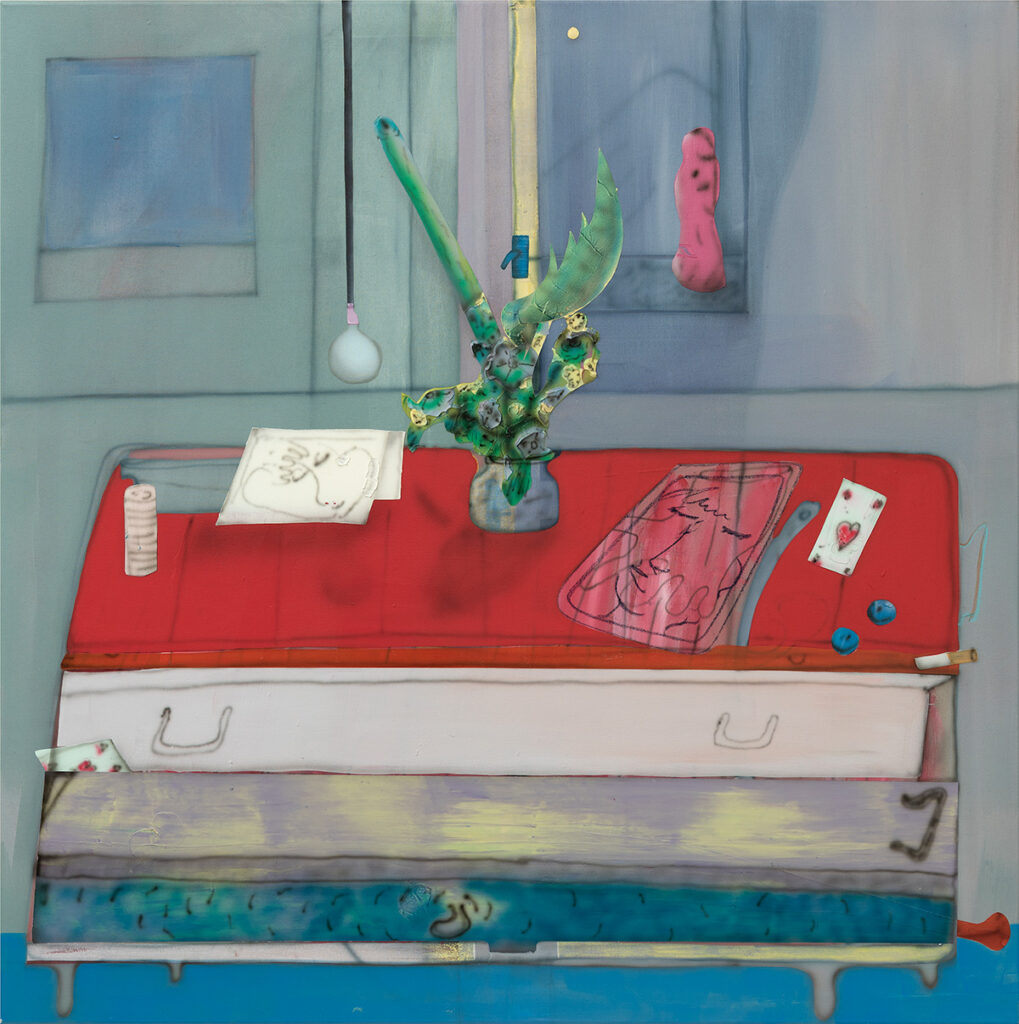
画面以近乎正视的室内陈设展开:下方是一张横向占据大半画幅的红色台面或床面,前景由数层抽屉、挡板般的水平结构叠压而成;中部竖起一组枝叶状、管状与团块状的异形物,后方则是带有画框、垂线及悬浮小物的冷灰蓝墙面。稳定的室内透视被大量不合常理的漂浮、穿插和尺度错位打断:粉红色人形软物悬于右上,球状物挂在左侧,桌面上的透明轮廓、纸片、圆珠和细长工具仿佛同时属于静物、图纸与梦境。作品因而不是再现一个可供使用的房间,而是将室内布置转化为物件彼此试探、互相干扰的心理舞台。 色彩以青灰、蓝绿构成包围性的低温背景,中央与下部的鲜红平面则突然压入视野,成为最强的重量与情绪支点。红色并未简单地带来热烈感,反而因其大面积、平整而略显闷滞的铺陈,与背景的半透明冷雾形成不安的对峙。中心异形物集中绿、黄、灰、黑等斑驳颜色,像腐蚀、淤积或多种残片被黏合后的表皮;其上伸出的绿色管体和锯齿叶片以斜向动势刺破横平竖直的室内秩序。 图中可辨认的制作语言主要来自绘画性的覆盖与叠加。墙面、框体和抽屉保留了薄层颜料的雾化过渡、擦拭痕迹及轻微渗透感,使空间边界显得软化;而纸片、透明板和小物件的轮廓又以较明确的线条、阴影或局部高光被重新钉回画面。中央团块尤其呈现出厚薄不一、颗粒化、近似拼贴的视觉效果,但其体积并不完全服从真实光源,显示它更像由绘画建构的混杂实体,而非可被稳定触摸的雕塑。 这种在平面绘画中模拟物体、又不断暴露其虚构性的方式,契合Treiber对室内、器物和图像记忆的持续处理。日常物品在此脱离功能与叙事逻辑,成为颜色、轮廓、质地和情绪的载体;空间不再是容纳人物的背景,而成为意识活动本身。作品的价值正在于它以看似轻盈甚至荒诞的物件组合,精确地调度了绘画、物性与心理空间之间无法彻底吻合的距离。
Work 06
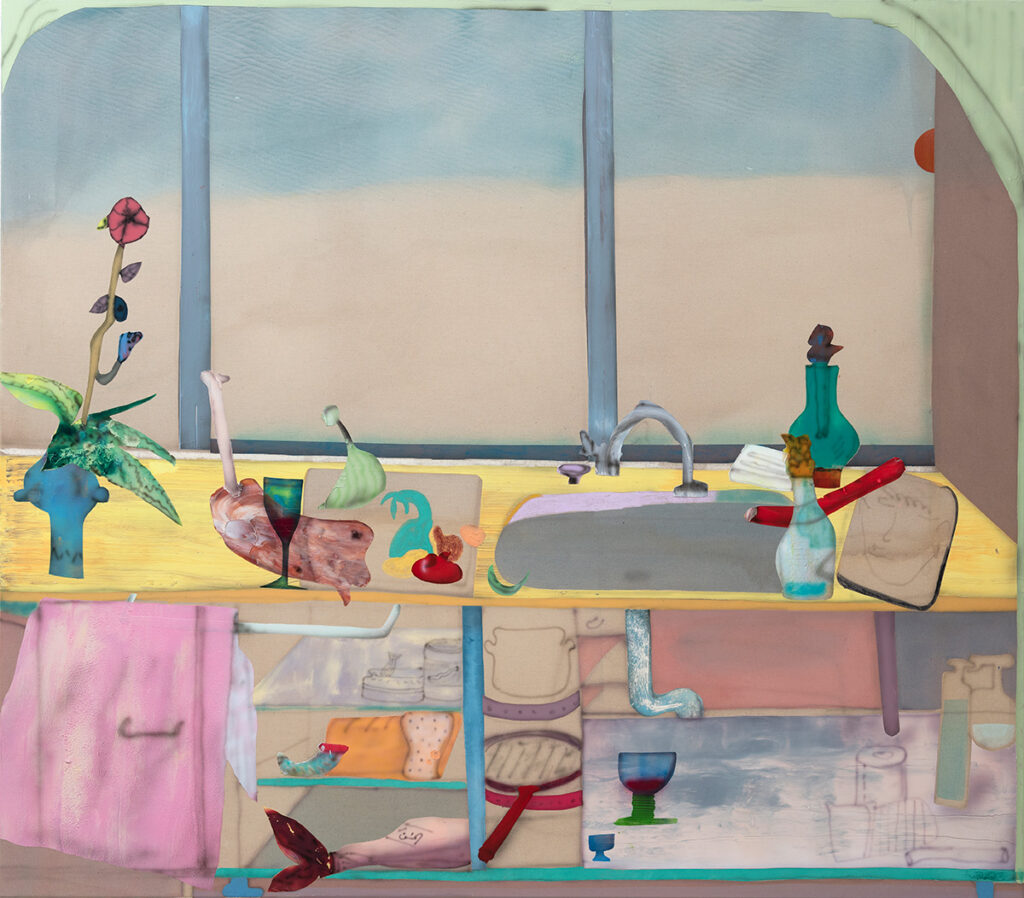
画面以正面展开的厨房操作台为主体,近乎舞台布景般被水平台面、下方储物层和后方大面积窗景切分。两条冷蓝色竖框将窗外朦胧的天光划为三个区段,使空间获得稳定而略显封闭的秩序;然而台面上过度繁殖的器物、植物与碎片化形象,又持续破坏这种秩序。左侧花枝从蓝色容器中斜向生长,中央散置着带有肉身感、叶片感或器皿感的暧昧形体,右侧水槽、弯曲龙头、瓶子、红色斜杆和倾倒的容器相互挤压。它们虽然服从静物画的陈列逻辑,却并不构成可供使用的厨房场景,而像一组尚未完成分类的视觉标本。 色彩以灰蓝、奶白、浅黄和粉紫构成低饱和的环境底色,整体显得安静、潮湿且带有过滤后的室内光感。其间,花朵的洋红、瓶身的蓝绿、杆状物的鲜红与杯盏的深蓝被压缩为局部强音;这些色块不只承担装饰作用,也将视线从左侧植物引向中央台面,再转至右侧水槽和下方层架。窗景与水槽的灰蓝色彼此呼应,使冷色结构像一层薄膜覆盖于暖黄色台面之上,令日常空间同时具有亲密性与疏离感。 表面处理明显保留了绘画媒介的渗透、罩染与擦拭感。窗外和柜体处的色层较薄,边界被柔化;植物、瓶子和肉质般的异形物则以较实的轮廓和局部阴影获得暂时性的体积。若干对象仿佛由剪贴、转印或透明叠层般的色面构成,其内部纹理并不完全服务于写实,反而暴露出图像被拼接、覆盖和重新命名的过程。下方橱柜中的鞋、织物、杯具及线描式轮廓尤其呈现半透明状态,如同记忆残影穿透了家具表面。 这类处理契合Treiber常将家庭内部、静物传统与不稳定叙事交织的方法:他不把室内视为安全而统一的生活容器,而将其转化为物件、欲望和想象彼此错位的场域。结构的规整为异物提供了可见的框架,柔和的色彩削弱了怪诞形象的攻击性,而多层、半透和近似拼贴的制作效果则使物体始终停留在“可辨认”与“不可定义”之间。作品由此重新激活了日常器物的心理密度,也让绘画空间成为不断生成联想的开放系统。
Work 07
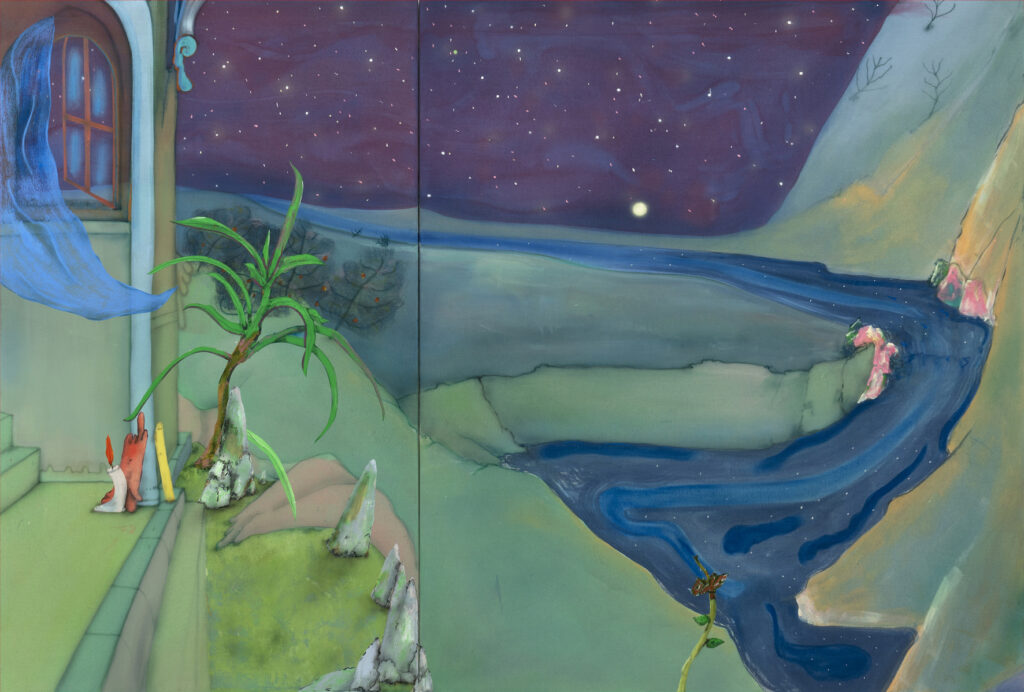
画面以中央清晰的垂直接缝分为两幅相连的画板,却并未形成对称的二分法;接缝反而像一道将室内门廊、庭园和遥远山谷勉强缝合起来的界线。左侧由窗、拱形门洞、台阶与垂落的蓝色帘幕建立近景,右侧则被向远方蜿蜒的深蓝水道和陡峭山体占据。两种空间逻辑并置:前者有建筑框架和可辨识的尺度,后者则不断滑向梦境般无明确边界的地貌。水道从中景收束后向右下方扩张,成为牵引视线的主要运动;窗洞、植物的叶片与岩石的尖峰则以竖向或斜向走势抵消其流动,使画面始终保持微妙的不稳定。 色彩建立在冷暖错置之上。紫红色夜空覆盖大面积上方区域,其间散布粉白、淡蓝和微黄的星点;下方的青绿坡地、蓝黑水面与湖蓝帘幕共同构成冷色基调。少量橙红、粉红及亮黄被压缩在窗框、前景小形体与右侧岸边的细节中,既制造局部温度,也避免景观沦为单纯的抒情夜色。月亮般的淡黄圆点位于远方水面上方,以极小体积稳定了宽阔的暗色天空。 表面处理显示出薄层覆盖、反复晕染与局部勾描并用的方式。山坡和天空的颜色并不完全均质,可见透明色层叠压后留下的浮动痕迹;水道则以较深、较饱和的蓝色层层推进,边缘既有柔化的渗散,也有接近线描的轮廓。前景岩石呈现灰白、青绿与黑色斑驳交错的肌理,植物叶片则用较明确的深色描边和鲜绿填色突出其人工性。画面中的小型人物或肢体状形象、岸边粉色簇状物,都处在介于写实识别与变形叙事之间的状态。 这种制作方式使空间不是通过严格透视被理性建构,而是由色层、轮廓和物象之间的跳跃关系生成。室内与荒野、植物与建筑、静止的舞台式布景与流动的水体彼此渗透,构成一种熟悉却无法定位的心理场所。就艺术家一贯将日常建筑、自然地貌与奇异叙事压缩于同一绘画空间的方法而言,此图像的价值正在于拒绝稳定的观看位置:观者仿佛站在窗边,却同时被卷入远方水道和夜空所开启的、带有寓言意味的未知区域。
Work 08
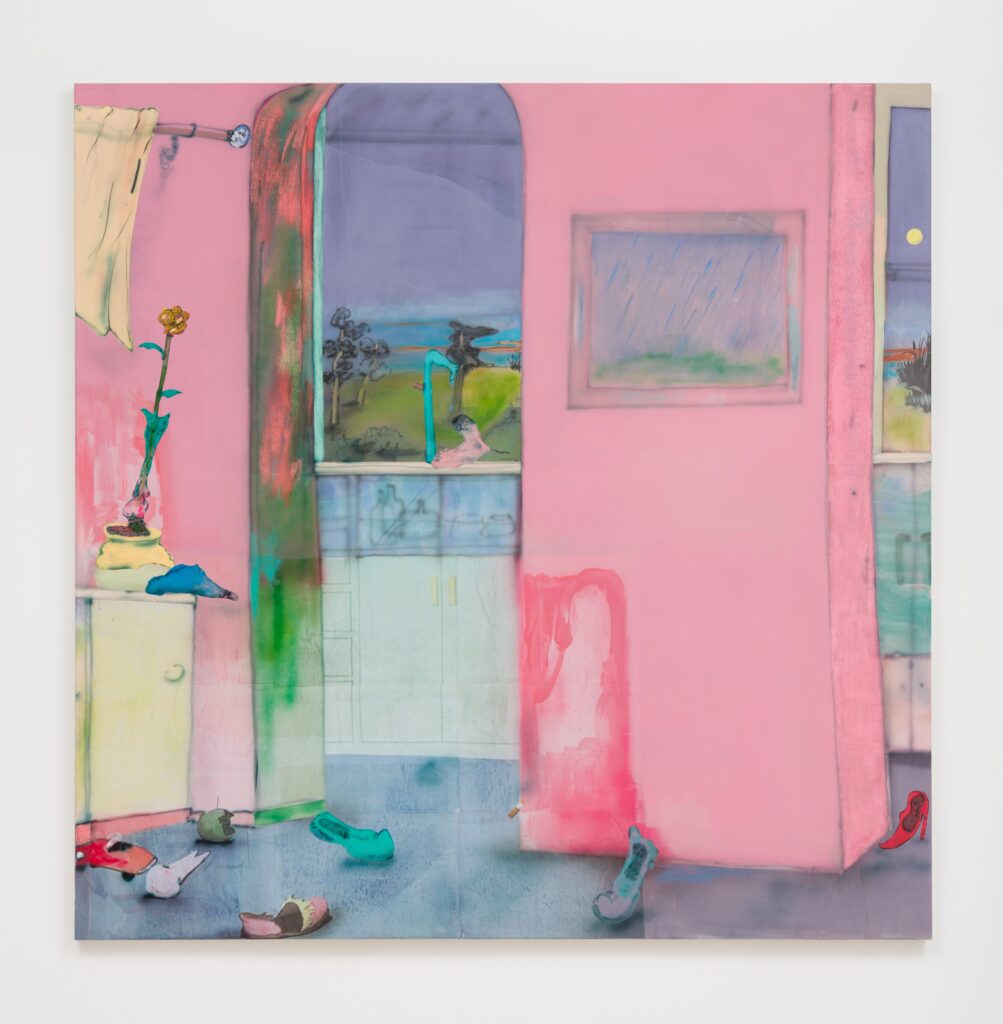
画面以一间被切割、错置的室内为基本场景:左侧是半开的浅黄窗帘、矮柜与一枝插花;中央高耸的拱形窗洞将室内与远处草地、水面般的景色连接;右侧粉红墙面上悬着一幅近乎被雾化的“画中画”,更右又露出另一扇狭窄窗景。地面散落多只鞋、袜状物和小型杂物,椅子或扶手家具仅以半透明轮廓出现。空间虽遵循室内透视,却被门框、窗框、墙柱和家具边缘反复截断;各物体的尺度、远近与实体感并不完全统一,使居所既可辨认又显得像记忆、梦境或图像残片的拼接。 粉红色占据大面积墙体,构成温暖而略带压迫感的基调;灰蓝、紫蓝的窗景和地面则不断将视线推向冷处。中央窗洞边框中红、绿、青的并置尤为强烈,像光线在陈旧表面上的反射,也像绘画主动暴露的色层关系。黄色花朵、青绿色鞋履、右下角鲜红单鞋等小面积高纯度颜色,成为室内秩序中跳跃的视觉节点。它们不承担自然主义再现,而通过不合常理的鲜艳度,强化物品的孤立与偶然性。 画面可见大面积薄涂、擦拭、喷洒般的柔化处理,局部又保留轮廓描线、滴痕、覆盖痕和近似干刷的颗粒感。窗帘、花枝、鞋子和窗外树木具有较明确的描绘性;墙面、家具及画框内部却趋于透明、渗透和失焦。由此,颜料既制造了室内物象,也不断削弱其坚实性:拱窗仿佛通向风景,实际却像一层可被穿透的色幕;地面的物件看似落在空间中,又像被贴附于画面表层。 这件作品延续了Fabian Treiber对室内、观看与绘画自身条件的关注。日常陈设并未被组织成叙事,而被当作透视、遮挡、色彩漂移和表面层次的试验单位。家具与杂物的凌乱状态,使居室不再是稳定的私人空间;透明叠层、画中画和窗中景则使真实房间、想象景观与绘画平面彼此混杂。作品的价值正在于以看似轻盈、甚至带有幽默感的物件,揭示图像空间如何在建构与瓦解之间持续摇摆。
Work 09
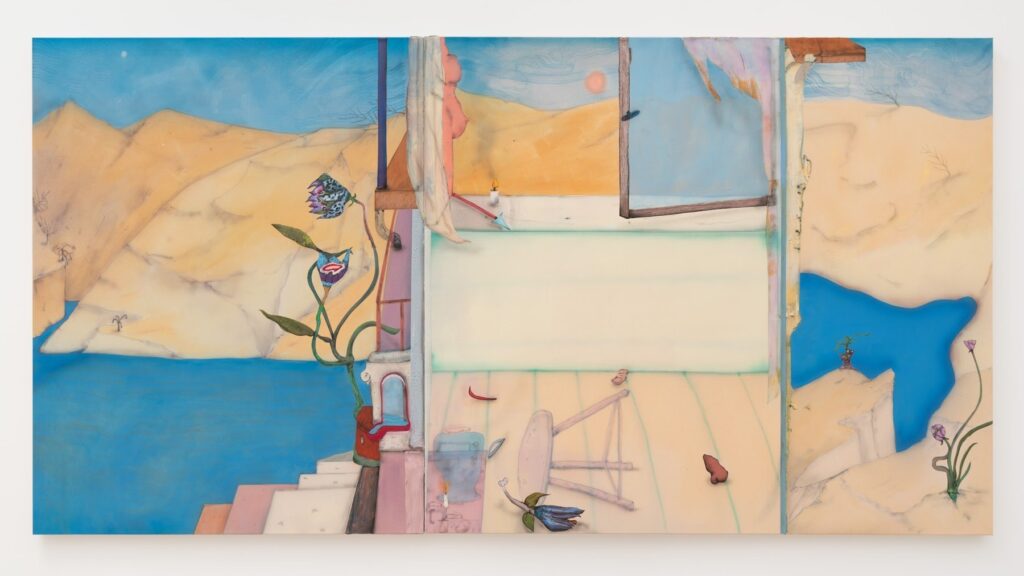
画面以横向展开的沙地、蓝色水域与室内地面构成彼此错接的场景。左侧的湖面和浅色山丘具有远景般的开阔感,中央却被一组竖直构件、台阶、帘幕和近似门窗框架的结构截断;右侧的蓝色水面又从沙丘间显现,使风景、建筑内部与舞台布景式空间无法稳定地归入同一透视系统。中央偏下的大面积浅色平面以稀疏的平行线暗示地板或平台,其上散落的器物轮廓、红色碎片与倾斜架子,进一步制造出空置、停顿而略带失序的状态。 色彩以浑浊而柔和的青蓝、沙黄、乳白和粉灰为主。蓝色既承担天空和水面的自然指涉,也因其在左右两端不连续地出现,成为切割空间的冷色力量。暖黄沙丘与肉粉色的建筑部件并未形成坚实的体积,而像半透明色层中浮出的记忆性图像;局部鲜红、紫蓝花瓣和绿色茎叶则以较高饱和度刺入低饱和背景,令画面获得类似寓言插图的异质生命感。 作品的重要张力来自绘画平面与实际凸出结构之间的协商。中央可见具有厚度的竖杆、台阶状边缘、框架和悬垂片状物,它们投下细微阴影,并以磨损、裸露、覆盖或拼接的表面中断了颜料形成的连续幻象。上方的深色矩形框并非仅仅描绘出的窗,它更像被安置在画面前方的实体骨架;其内部的蓝灰色区域因此既似窗外,也似一块被框定、尚未完成的绘画。细小植物则跨越风景、室内和构件边缘,弱化了自然物与人工物、图像与装置之间的界限。 这种处理延续了Treiber将绘画视作可被建造、遮挡和拆解的空间的方法。作品不以叙事完整性为目标,而让门框、阶梯、帘幕、花朵和残余器物共同构成一种不稳定的观看路径:观者不断在远近、内外、真实物与绘制物之间调整判断。材料性的突起与透明、轻薄的色层相互牵制,使风景不再是可进入的单一地点,而成为由视觉记忆、建筑残片和绘画行为共同搭建的临时场所。
Work 10
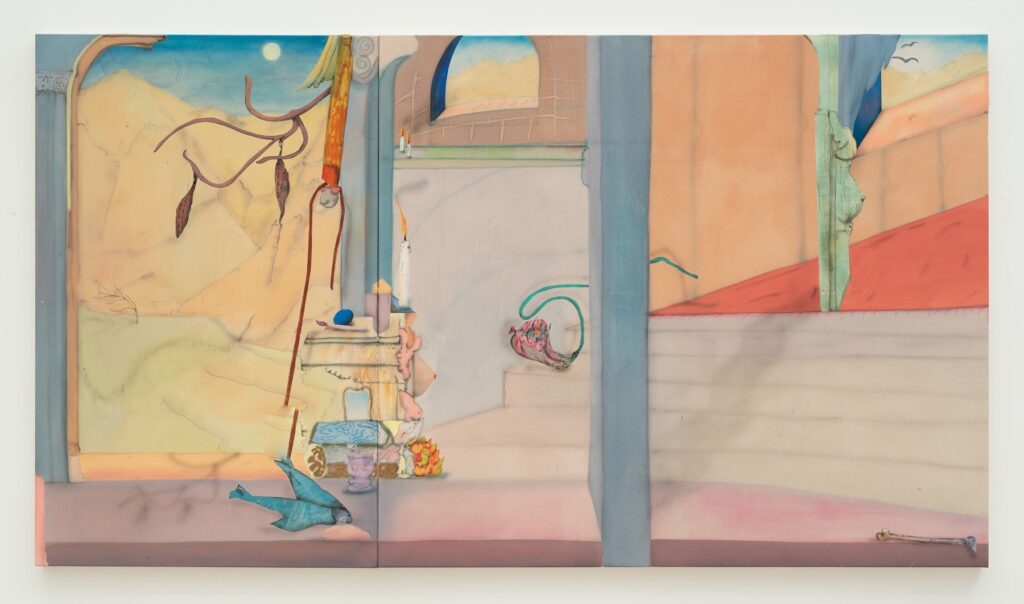
画面以横向延展的室内—室外混合空间展开,数根粗大的青灰色立柱将画面切分为若干相互连通却又彼此阻隔的区域。左侧仿佛是由拱券、山石与枝蔓构成的庭园残片;中央出现壁龛、矮台、烛火及零散器物;右侧则被大面积暖橙色墙体、红色斜坡和高窗占据。建筑并不遵循单一透视法:柱子具有近景的遮挡力量,墙面和地面却以压缩、错置的尺度向后推移,使空间既像可进入的房间,也像被拆散后重新拼接的舞台布景。 色彩以低饱和的粉橙、灰蓝、淡黄和灰紫为基调,营造出被柔光覆盖的静默气氛;局部的钴蓝、朱红、青绿和橙黄则集中在鸟形、花果、烛焰与线状枝条上,成为视觉节奏的节点。温暖墙面与冷灰柱体之间的对照,不仅划分空间,也把图像从浪漫性的景观想象拉回坚硬的建筑秩序。左部枝条的弯曲、中央绿色线条的盘旋,以及右上飞鸟的简略轮廓,使静止的构架中持续潜伏着流动感。 作品表面明显不是平滑再现式绘画。柱头、边框、壁龛、器皿及部分植物、动物形象显露出凸起的轮廓和堆叠感,平面绘制与浅浮雕般的塑形彼此交错。薄雾状的罩染、细密的线描、近似龟裂或石材纹理的刻画,与局部较厚、较实的色层并置,使墙体、织物、石膏、器物等质感处于暧昧状态。画面底部和各分区接缝也未被完全遮蔽,反而强调其被制造、拼接和陈列的对象性。 这种做法使建筑不只是背景,而成为承载记忆碎片、自然遗存与装饰性图案的容器。Treiber常将景观、室内、废墟感与人工构造交织为难以归属的心理空间;在此,精致而略显脆弱的物象被安置于宏大的柱式结构之间,形成亲密细节与纪念碑式框架的张力。材料层次、色彩降调与不稳定透视共同削弱了叙事的确定性,促使观看者在空间穿行、物件辨认和表面触觉之间反复移动。