Lien Truong | In-Depth Research
Vietnam/United States
1. Artist Profile
Lien Truong was born in Saigon, Vietnam, and immigrated to the United States with her refugee family in 1975.Her formative experiences have always been situated at the intersection of Vietnamese family values, American social education, and memories of postwar displacement: her parents“ emphasis on labor, independence, and historical awareness, combined with her training in oil painting during her youth, laid the foundation for her view of painting as tactile labor rather than mere image production.She graduated from Humboldt State University in 1999, received a Master of Fine Arts degree from Mills College in 2001, and subsequently taught for many years in the Department of Art and Art History at the University of North Carolina at Chapel Hill.Her early work centered on narratives of the individual, the family, and identity, before gradually shifting toward a critique of cross-cultural visual mechanisms;From the late 2000s through the 2010s, her repeated trips to Vietnam and participation in local art exchanges expanded her focus from personal experiences of migration to the complex interplay of colonial history, religious symbolism, images of power, and cultural translation. A significant turning point in Truong’s work came when she ceased to view ”the East“ and ”the West“ as fixed identity labels, instead regarding them as structures of perception shaped by empire, trade, faith, natural history, military affairs, and art history.She juxtaposes oil paintings, silk paintings, embroidery, textiles, pigments, and materials imbued with both the everyday and the ritual, allowing the materials themselves to carry historical significance:Silk and thread evoke labor, gender, and decorative traditions; the texture of the painting retains bodily gestures; and stitching and covering transform the canvas into a surface where memory, power, and trauma interpenetrate.Her images often place figures, animals, mythical creatures, gardens, plants, and hybrid forms within fluid and unstable spaces, using lavish, sweet, and even almost decorative colors and surfaces to subvert and expose exoticism, the desire for conquest, and the logic of assimilation.Her recent practice has further explored food, scent, land, ecology, and familial memory, reflecting a shift from a critique of cultural representation toward a focus on care, disappearance, and shared sensory experiences. Within the contexts of Asian contemporary art and Vietnamese-American art, Truong’s value lies not in simply reconciling Eastern and Western styles, but in revealing how the two are intertwined in materials, imagery, and institutions.Her work is particularly worthy of study within the field of intermedia art, as her choice of media has a clear conceptual causality: painting provides a stage for visual history; textiles and embroidery introduce time, the body, and artisanal knowledge; and the integration of layered colors and stitched structures transforms ”hybrid identity” into a formal language that is visible, tactile, and defies easy categorization.
2. Artistic Concepts
Lien Truong’s artistic practice has consistently centered on how diasporic identity is reorganized across history, the body, and materiality. Born in Saigon,and moved to the United States at the age of eighteen months. This early migratory experience—one that is difficult to fully reconstruct through personal memory—means that “home” in her work is not a fixed geographical origin, but rather a set of perceptual structures continually generated through family narratives, visual archives, the scents of food, textiles, and fragments of mythology.Rather than treating Vietnamese or Asian identity as recognizable cultural symbols, she explores how these identities have been collectively shaped by colonial trade, war, migration, racialized gazes, and American mass media.Consequently, her paintings often embed intimate family memories within transnational history, ensuring that individual trauma is not reduced to private emotion but becomes evidence of how power permeates everyday life. In her earlier work, she employed a “heterotopic” conception of space to construct her canvases as fields that mirror, displace, and intrude upon one another.Flowing brushstrokes, blank spaces resembling water’s surface or mist, and repetitive marks akin to textile patterns do not serve a single narrative but create a visual state in which boundaries dissolve.The juxtaposition of materials—silk, linen, antique kimono sash cords, metallic pigments, salt, and smoke stains—directly responds to the silk trade and the cultural exchanges, hierarchical orders, and colonial expansion underlying it.The materials are thus not merely decorative “Orientalism,” but historical mediators imbued with circulation routes and tactile memories; the suppleness, luster, and wear of the fabrics interact with the painterly brushstrokes“ covering, permeation, and erasure, rendering the composition both a landscape and a body that has been repeatedly mended. Since then, her conceptual focus has gradually shifted from macro-level cross-cultural flows to more explicit historical overlaps and female lineages.She places public history—such as war, imprisonment, military operations, and ethnic violence—on the same plane as family photographs, ancestral rites, plants, and portraits of women, refusing to confine Asian women to the roles of victims, symbols of motherhood, or silent, exotic figures.Mothers, grandmothers, and the artist herself are transformed into subjects endowed with power, the capacity for metamorphosis, and spiritual depth; red liquids, tropical fruits, and animal or mythological imagery simultaneously bring into view care, desire, pain, and intergenerational trauma.Here, ”mother” is not merely a familial role but a complex historical position that bears the pressures of colonialism, patriarchy, and migration, while passing on resilience to future generations. In the double-sided silk paintings, sheer veils allow images on both sides to shine through one another, preventing the viewer from remaining fixed in a single perspective.American everyday consumer goods, the experiences of Asian immigrants, folk rituals, and archives of violence form ghostly overlays on both sides, and the translucency of the material thus becomes an epistemological metaphor: history is never fully visible, yet it continually permeates the present.Her recent work has delved further into food, yeast, rock formations, and the imagination of ancestral spirits, revealing a shift in her focus from the legacy of conflict to restorative re-narratives.Through sensory experience and handcrafted practices, she reconnects fragmented family memories—not to return to a pure homeland, but to establish a new visual world where the diaspora can find a home amidst hybridity, loss, and inheritance.
3. Main Materials, Manufacturing Processes, and Technologies
Lien Truong’s material practice centers on the juxtaposition of painterly media with textile materials that carry histories of migration and trade.She often uses linen, canvas, or wood panels to create stable substrates capable of supporting multi-layered processes, combining them with oil paints, acrylics, fabric dyes, enamel, copper pigments, and hand-painted or printed silk;some works also incorporate antique Japanese silk from long underkits, obi sashes, 19th-century fabrics, Vietnamese dó paper, and black salt.Linen and canvas possess a fibrous quality that absorbs pigments and retains brushstrokes, making them suitable for laying out large swaths of color and for rapid, free-flowing applications of oil or acrylic paint; silk, on the other hand, is thin, soft, slightly translucent, and lustrous, allowing the image to present layers where concealment, permeation, and drift coexist on a flat surface.She chooses silk not merely as an oriental visual symbol, but as a historical material that has been produced, circulated, worn, and passed down, thereby involving the material itself in narratives of colonial trade, cultural translation, and family memory. In her practice, she superimposes paintings, hand-painted silk, printed patterns, and existing textiles onto a single support, creating a structural collision between the rigid pigment film, the soft edges of the fabric, and the varying weave textures.The slow drying time and malleability of oil paint accommodate the dense, weighty forms found in bodies, plants, and landscapes; acrylic and enamel, meanwhile, provide more direct opacity, vividness, and localized glossy surfaces.The reflectivity of copper pigments, the worn quality of antique fabrics, and the granular texture formed by black salt endow the paintings not only with color relationships but also with tactile associations that lie somewhere between skin, soil, ornamentation, and fragments.Rather than treating silk as a uniform background, she allows its patterns, drapery, and edges to serve as both breaks and connections within the composition: figures and mythical animals seem to emerge from the fabric’s history, only to be rewritten by the pigments. This synthesis of color layers thus produces a distinct spatial effect: the two-dimensional images are brought closer by the painterly gestures, yet extend inward due to the silk’s translucency, printed patterns, and layered materials; bodies, mountains, rocks, food, and textiles no longer exist within a single perspectival space, but become an “aggregate” in which one element permeates the other.This mixture of material languages corresponds to the artist’s conceptual framework: identity is not a fixed point of origin, but rather a network of relationships continually generated through war, migration, family heritage, and the transregional flow of materials.
4. A Detailed Examination and Analysis of 10 Representative Works
Work 01
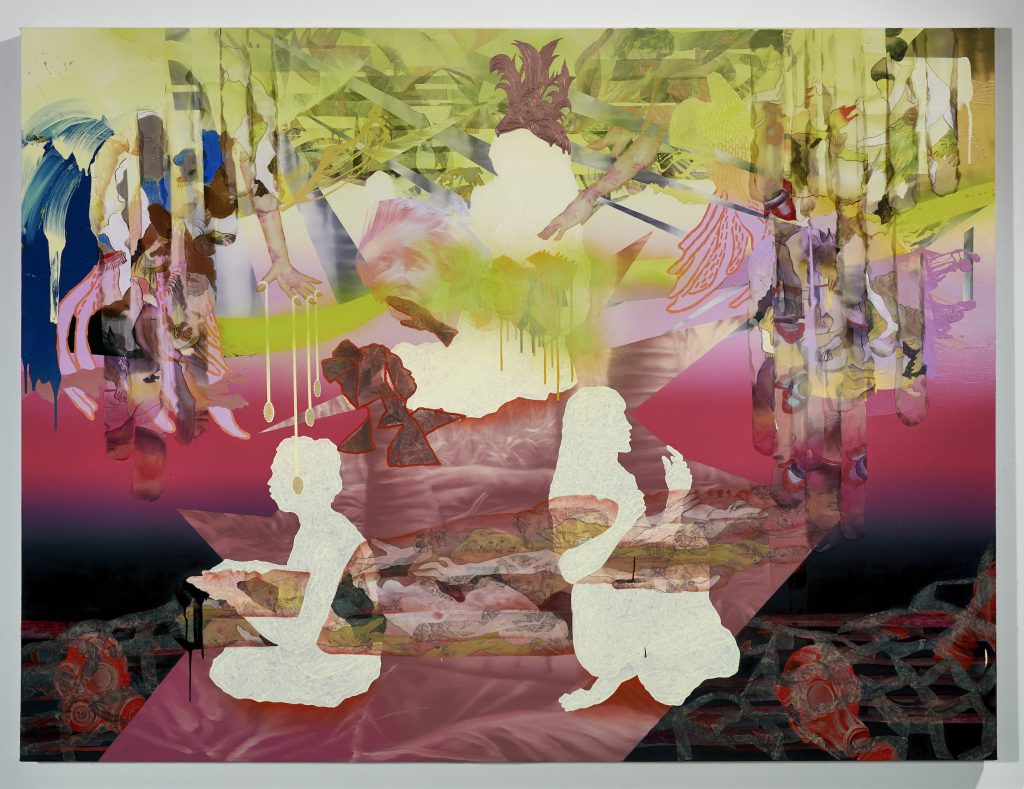
The composition is organized as a horizontally unfolding, stage-like space, with two pale beige human silhouettes in the foreground standing out most prominently: the figure on the left is seated in the lotus position, while the one on the right appears to be kneeling or in motion.Though devoid of facial features or narrative details, their rough, grainy, and blank surfaces lend them a texture reminiscent of pulp, fabric, or pigment-absorbing material.The figures resemble both empty spaces left after something has been cut out and opaque screens superimposed over intricate layers, directing the viewer’s gaze from recognizable forms toward the relationship between the body, posture, and absence. The background consists of dense, translucent layers.The upper section, with a yellowish-green hue, interweaves leaves, branches, net-like lines, stripes, and vertical forms resembling curtains; the middle transitions into diagonal blocks of pinkish-purple, grayish-brown, and bright yellow-green; while the lower section sinks into dark bands of rose red, deep purple, and near-black.Large areas of diagonally cut geometric planes—resembling stage sets, beams of light, or a sliced-open earth’s surface—overlap with botanical imagery, flowing brushstrokes, and fragments of local figuration. The composition does not establish a single perspective but creates a shallow space where multiple times coexist through overlapping, obscuring, floating, and penetrating effects. The vertical forms cascading down on both the left and right sides play a particularly significant structural role.They can be interpreted as tree trunks, hanging strips of fabric, or elongated human silhouettes; their surfaces bear overlapping traces of brown, purplish-gray, jet black, and localized patches of blue and red. Their edges are not fully defined; the bleeding and dripping of paint preserve a sense of gravity inherent in the creative process.The deep blue brushstrokes in the upper left, applied with thicker, more direct strokes, serve as visual anchors, forming a striking contrast with the thinner, almost glazed layers in the center. The locally outlined contours of palms, shoe shapes, or flower and leaf forms resemble fragments emerging from underlying memories, never fully articulated. This approach—in which painting, collage-like imagery, transparent overlays, and the negative space of silhouettes work in concert—transforms the materials from a merely decorative mixture into a mechanism for generating meaning: transparent layers preserve previous traces, covering layers create a sense of loss, and drips and erasures reveal chance events beyond control.In light of Lien Truong’s long-standing focus on experiences of migration, historical imagery, and narratives of identity, this work can be understood as a visual field that rejects linear narratives.Figures, plants, stage-like swaths of color, and fragmented images intertwine on the same surface, presenting both the individual body and cultural memory as processes that are continually being covered, rewritten, and re-identified.
Work 02
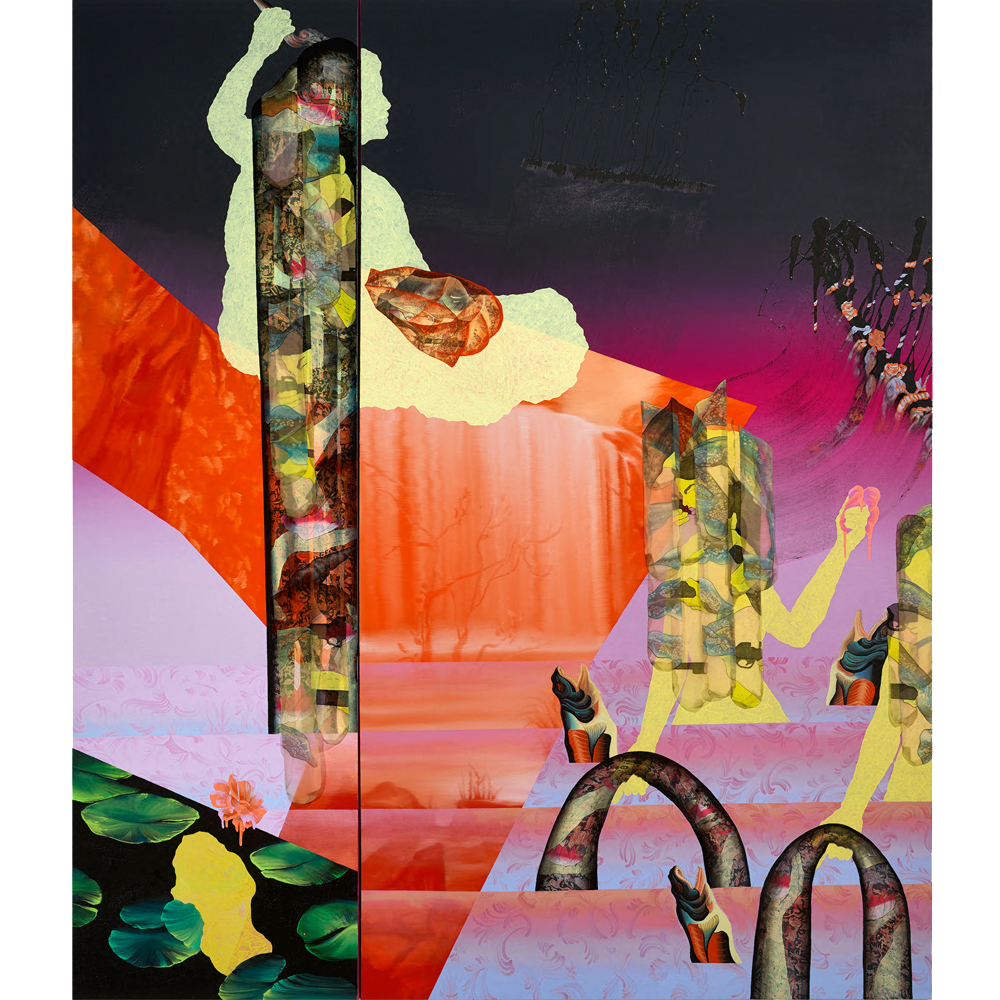
The composition is divided by a nearly vertical black central line, yet it does not create a stable symmetry: on the left, a towering human figure and the collage-like column within it dominate the scene,while the right side offers an unbalanced counterpoint consisting of a yellow figure with raised arms, severed limbs, curved tubular objects, and clusters of black brushstrokes along the edges.The figure serves both as a bodily outline and as a frame containing heterogeneous images; its face, torso, and clothing are fragmented into translucent, overlapping pieces oriented in different directions, transforming the subject into a structure temporarily stitched together from fragments of perception, memory, and matter.The large expanse of deep gray-black in the background is not a pure void, but rather resembles a curtain that compresses the depth of space, lending the orange-red sloping planes, pink-purple gradients, and fluorescent yellow human figure in the foreground a striking theatrical quality. The color scheme is structured around highly saturated warm tones. An orange diagonal band cuts in from the left, while the horizontally spreading areas of orange-red, pink, and pale purple resemble tiered steps or the folds of fabric—advancing the composition while simultaneously disrupting any potential continuous narrative between the figures.The fluorescent yellow silhouettes create a strong complementary tension with the reddish-orange background, producing a visual effect akin to a warning or a revelation; meanwhile, the dark green leaves, black arched tubes, and blue-green sections temper the overly expansive warm colors, keeping the composition in a state of instability between splendor and gloom. The visible surface treatment exhibits distinct characteristics of mixed media: printed patterns, fabric-like textures, thin layers of transfer paper, or the edges of collaged paper appear within the figures and the curved objects in the foreground, with partial transparency allowing underlying images to shimmer through. The background juxtaposes areas of flat application, smudging, bleeding, and decorative patterns;in the upper right corner, black pigment exhibits traces of dripping, accumulation, and scraping, creating a tactile contrast with the relatively smooth color blocks. The execution does not seek to seamlessly unify the materials; rather, it retains interfaces of cutting, overlaying, translucency, and uncontrolled brushstrokes, allowing the image to reveal its process of construction. In light of the artist’s longstanding focus on the Vietnamese-American experience, female subjectivity, and cross-cultural visual archives, this image can be understood as a method of rejecting the portrait of a singular identity.The body is no longer a complete, easily recognizable personal image, but rather a multilayered vessel bearing ornamentation, historical imagery, painterly gestures, and everyday materials.The amalgamation of materials is not a mere aftereffect: it is precisely the discontinuities of the collage, the clashes of color, and the suspension of space that present the subject as a being in constant negotiation, simultaneously bearing trauma and agency.
Work 03
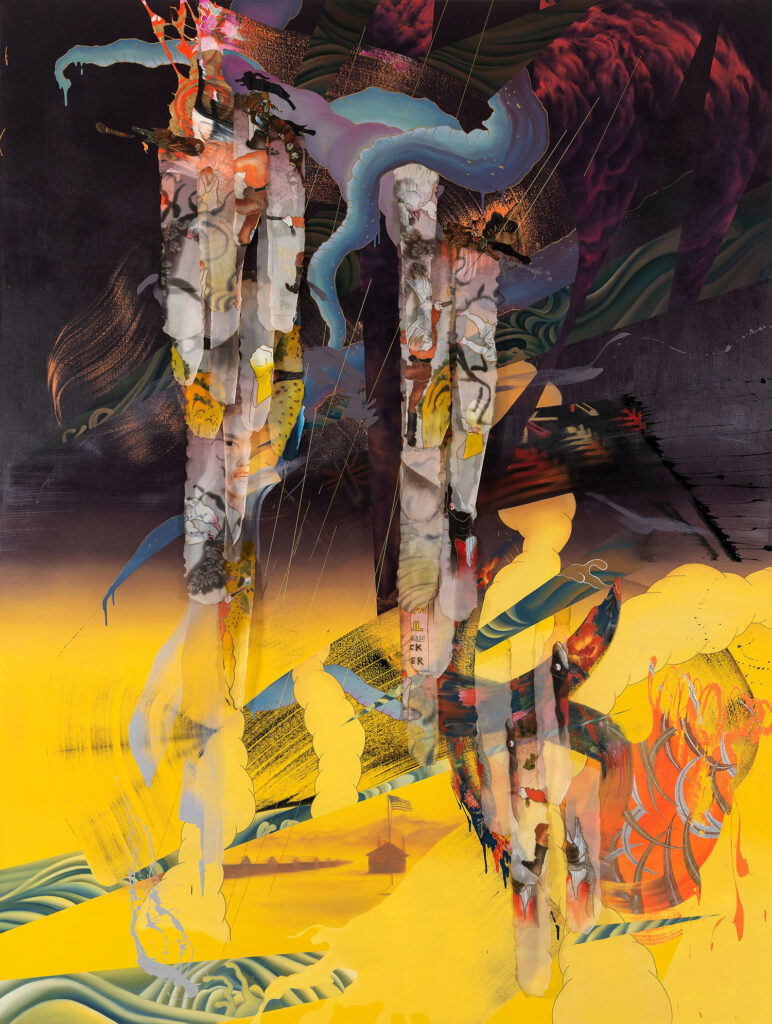
The composition is structured around three sets of vertical, humanoid-like forms: the one on the left is relatively wide, encircled in the center by a curved, blue, band-like shape, while the one on the right consists of two connected, torso-like fragments.These are not complete figures, but rather resemble columns that have been cut, covered, and repeatedly pieced together, creating a vertical tension that extends from the dense, dark area at the top of the composition down to the bright yellow zone below.The background lacks a stable perspective: undulating areas of dark purple, dark brown, and deep green overlap, while the surging reddish-purple cloud mass in the upper right and the light blue, curling outline in the upper left create uncertain spatial boundaries;the large expanse of highly saturated yellow at the bottom resembles a stage, sandy ground, or a surface illuminated by intense light, making the fragments of figures appear both suspended and sinking. The colors are organized into a stark contrast between warm and cool tones. In the dim background, blue-green curves, purple-black shadows, and orange-red granular splashes jostle against one another, while the bright yellow, orange-red, and patches of cyan in the foreground appear in a flatter, more striking manner.The yellow not only provides a visual focal point but also amplifies the oppressive feeling of the black area above. Slender golden-yellow lines cut diagonally across the entire composition—like guide wires, cracks, or rain streaks—temporarily stitching together the various sections while simultaneously emphasizing the fragmentation of the composition itself. Within the vertical, figure-like forms, one can discern fragments of portraits, animal or plant-like patterns, hand-drawn lines, fragments of text, and layers of gray-white, flesh-toned, and ochre paint.The edges between different images are not entirely smooth; they feature torn-like contours, translucent masks, and localized drips and scrape marks. This creates a composite layer of colors—resulting from the superimposition of painted, transferred, or collaged images—rather than forms established by a single brushstroke.Localized spray dots and coarse grains are juxtaposed with smooth color surfaces, further allowing visual associations with skin, paper scraps, fabric, or landscapes to shift between one another. This structure prevents the image of a “person” from being fully recognizable; it can only be interpreted through fragments, overlays, and layers that intrude upon one another.In line with Lien Truong’s ongoing focus on memory, experiences of identity, and cross-cultural historical narratives, this work can be understood as a visual approach that rejects linear storytelling: the body is no longer a unified subject but becomes a composite interface that carries private images, cultural symbols, and sensations from different times and spaces.The tactile quality of the materials, clashing colors, and fragmented composition collectively transform the act of viewing into a process of recognition, misrecognition, and reconnection.
Work 04
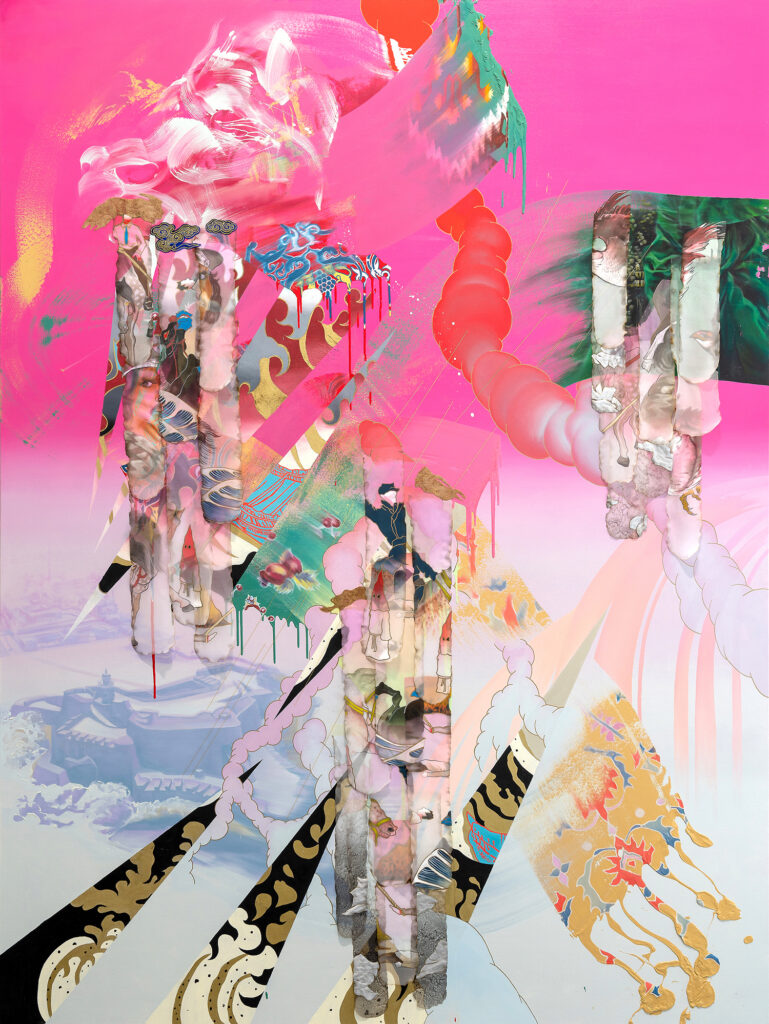
The composition is dominated by a highly saturated magenta field, resembling a stage curtain that is both flat and constantly curling inward.The composition does not rely on stable perspective but is supported by three groups of vertical, column-like fragments of human figures: on the left, a dense cluster of figures overlaps; in the center, forms extend from top to bottom; and on the right, two thicker vertical torsos contrast with the deep green horizontal background.While they evoke associations with bodies, clothing, or draped fabrics, they refuse to form complete figures due to being cut, pieced together, and obscured. A translucent gray-pink plane slanting across the upper part of the composition forcibly divides the space into two layers—foreground and background;while the diagonal band of black-and-gold patterns, the pale radial stripes, and the meandering cloud-like contours at the bottom redirect the viewer’s gaze downward, creating a sense of space that drifts rather than settles. The arrangement of colors possesses intense tension.The large expanse of pink is not a soft background but, with fluorescent-like intensity, forces white, turquoise, scarlet, gold, and jet black to collide. A chain of red, bead-like elements winds downward from the top to the middle, serving both as a distinct rhythmic pattern of color and as an energetic conduit connecting the various fragments.Decorative motifs in gold, blue, and red, along with black-and-white patterned bands, evoke visual memories of textiles, artifacts, or folk imagery; yet, by placing them amidst painterly traces of spraying, dragging, and layering, the artist prevents them from becoming a mere display of cultural symbols. The work reveals edges reminiscent of transparent overprints, image transfers, or collages, as well as brushstrokes of varying thickness, drips, smudges, and locally grainy surfaces. Some figures are rendered in thin layers, allowing skin, clothing, patterns, and shadows to show through one another;while other areas are covered by opaque layers of white, gold, green, or black that obscure the underlying layers. This creative logic renders the “body” as the result of accumulated material layers: it is not a complete outline, but rather a visual container temporarily stitched together from patterns, pigments, print-like images, and fragmented lines. In light of Lien Truong’s ongoing exploration of memory, experiences of migration, the construction of identity, and cross-cultural visual archives, this work may regard the body as a surface bearing the traces of history.The juxtaposition of decorative motifs, fragments of portraits, and abstract brushstrokes does not aim to reconstruct a fixed tradition, but rather to reveal how cultural memory is carried, overlaid, misread, and rearranged.The composition ultimately forms an unstable yet resilient language of mixed media: vivid colors provide sensory appeal, while the fragmented structure continually exposes the reality that narrative and identity cannot be integrated in a single stroke.
Work 05
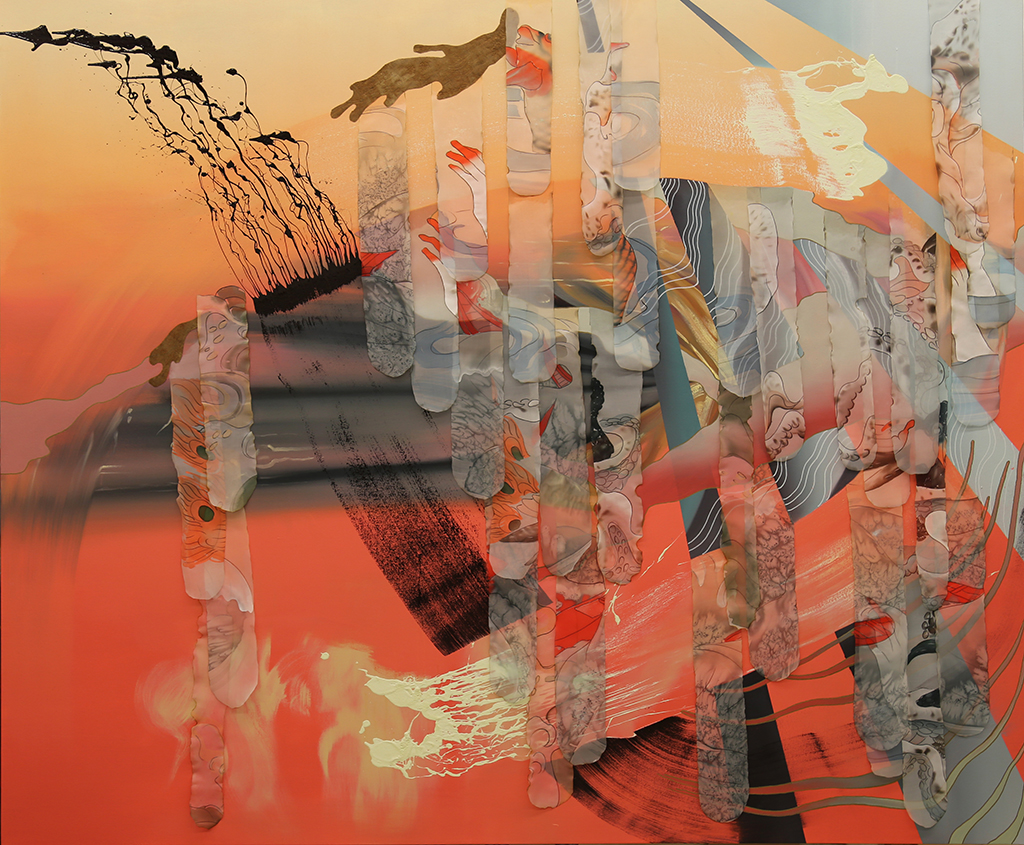
The composition establishes a strong sense of heat and pressure through its orange-red color field. The left side is relatively open, while the right is dominated by dense, vertical, semi-transparent forms, creating a structural transition from openness to congestion, and from flow to stagnation.A dark brown, animal-like silhouette sweeps horizontally across the upper part of the composition, connecting with the black splatters and slender drips in the upper left corner; these traces, imbued with a sense of speed, fall diagonally downward, ultimately converging into a band of blackish-gray brushstrokes slightly to the left of center.It resembles both a lowered horizon and the shadow left by a mechanical impact, temporarily severing the pulsating energy above from the red abyss below. The numerous narrow strips hanging on the right do not cover the surface neatly but are instead misaligned, curved, and overlapping. Their translucent shades of grayish-white, pale pink, bluish-gray, and patches of orange-red cause the underlying geometric color blocks, arcs, mesh-like patterns, and black-and-white stripes to alternately reveal and conceal themselves.The edges of the strips are irregular, with visible details in some areas—such as folds, bleed marks, line drawings, and print-like traces—suggesting that they were not simply created by flat applications of pigment, but rather resemble composite surfaces formed through techniques such as transfer, collage, overpainting, or the layering of thin coats.Transparency, therefore, is not a light decorative element, but rather creates a delay in perception: the eye must pass through multiple layers of film-like structures to discern the conflicting fragments of imagery beneath. The color relationships are established between highly saturated warm colors and cool grays and blacks.Large swaths of orange-red provide a nearly scorching background, while black splatters, smudges, and linear arcs create a sense of cutting, oppression, and directionality; translucent layers of gray-blue and off-white undermine the stability of the solid color blocks, keeping the composition poised between combustion and sedimentation, eruption and filtration.The pale yellow, splatter-like blank spaces in the lower left and upper right—like light that has been scraped out or sprayed—respond to the violence of the black brushstrokes and prevent the space from becoming completely enclosed. This method of juxtaposing abstract brushstrokes, fragments of imagery, transparent overlays, and suspended structures aligns with Lien Truong’s focus on memory, experiences of migration, bodily sensation, and the instability of historical imagery.Here, the image does not function as a narrative that can be read in a single instance, but rather appears through fragments, obscurations, and repeated permeations. The fragility of the material layers, the visible traces of the creative process, and the elusive spatial relationships collectively transform the painting into a visual archive where preservation and disruption coexist.
Work 06
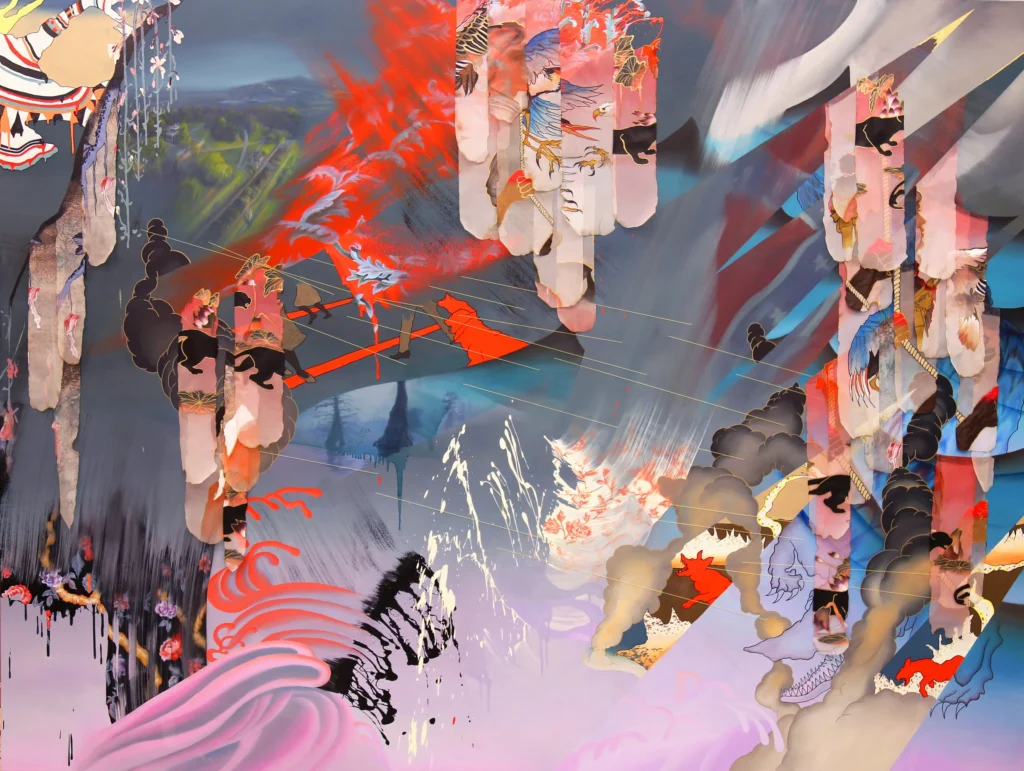
The composition, arranged in a large-scale horizontal format, creates a space where multiple layers interpenetrate one another.The deep gray-blue and blue-green background resembles a curtain that has been pulled back, wiped, and covered; the broad, crisscrossing brushstrokes on top create a sense of unstable momentum. The diagonal burst of red in the upper-left center interacts with the diagonal bands of blue, gray, and burgundy on the right, causing the visual focus to shift continuously.The array of vertically descending translucent color blocks in the composition is particularly crucial: resembling hanging pieces of cloth, skin, or fragments of cut-up images, they are set against a background of powdery white, flesh tones, and pale purple, with flowers, leaves, bird claws, ropes, animal silhouettes, and black blocks embedded within.Their irregular edges and layered relationships make the vertical structure resemble both a barrier and fragments of memories yet to solidify. Color does not serve unity or harmony; instead, highly saturated vermilion and peach-pink are deliberately juxtaposed with austere charcoal gray and indigo.Red appears in various forms—scratched, splattered, and as flat outlines—creating an alarm-like intensity while linking scattered fragments; slender golden-yellow lines traverse the composition, resembling fragile stitches, paths, or trajectories of force, establishing a temporary order amidst the jumbled layers.The milky-white drips, black brushstrokes, and curling pink-purple forms at the bottom cause the composition to gradually shift from the tense, jagged cuts at the top toward a viscous, sedimentary realm. Technically, the work features a coexistence of flat application, line drawing, glazing, scraping, dripping, and collage-like edge treatments.Some images appear with clear contour lines and decorative patterns, possessing a two-dimensional quality reminiscent of image archives or textile motifs; others are pressed into the background by broad brushstrokes, translucent overlays, and flowing paint.These technical variations reject a singular narrative perspective: figurative symbols do not form a stable narrative, nor are abstract brushstrokes purely lyrical; together, they constitute a visual scene that is obscured, exposed, and recoded. In conjunction with Lien Truong’s ongoing practice—which focuses on historical experience, migrant identity, and the construction of cultural imagery—this work can be understood as a non-linear narrative approach. Rather than recreating history through illustrative scenes, she allows natural forms, animalistic fragments, decorative motifs, and conflicting color fields to collide with one another.The layering, obscuring, and seeping of the material language thus become the concept itself: memory is not preserved in its entirety, but is constantly rewritten amidst different visual regimes, emotional projections, and traces of power.
Work 07
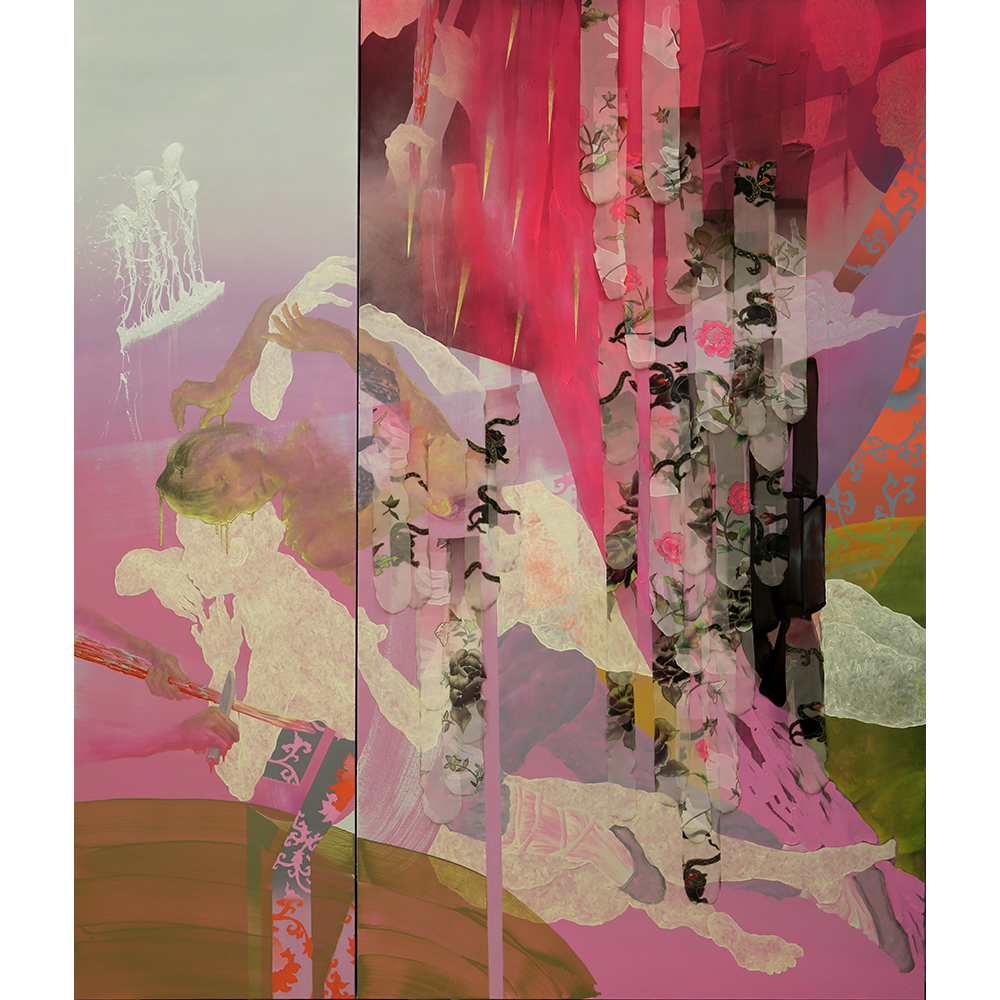
The composition consists of three vertical panels placed side by side; the narrow black dividing lines are not merely physical seams but also divide the image into interconnected visual fields that cannot be perfectly aligned.On the left, a misty background of gray-green, pale purple, and pink serves as the backdrop for a group of human silhouettes leaning forward and reaching out; the center and right are dominated by vertical forms in vivid magenta, deep red, purplish-gray, and black.The figures do not appear as complete, realistic forms but seem to be dismembered among transparent layers, botanical patterns, and blocks of color: arms, torsos, legs, and partial faces appear and disappear intermittently, creating a sense of falling while also suggesting gestures of struggle, support, or mutual dependence. The arrangement of colors reinforces this sense of instability. The large swaths of red and magenta do not merely express passion; rather, as they are constantly interrupted by grayish-purple, flesh-pink, brownish-green, and cool black, they present a complex state of stagnation, permeation, and compression.The striking orange-red scrollwork along the right edge meets areas of green and blue-purple, creating a tension between the flat, decorative quality and the fragility of the human form.Translucent vertical bands recur in the center of the composition, overlaid with black motifs such as branches, leaves, butterflies, and roses; these motifs, resembling fragments of fabric, printed transfers, or collages, create a depth reminiscent of a dim garden while also functioning as an impenetrable barrier. The surface of the work particularly emphasizes the processes of covering and revealing. Pale white, fibrous shapes—resembling thin paper, fabric, or translucent media—are torn, cut, and applied over the figures; their irregular edges retain the rough texture of handwork.Beneath these, the underlying layers of paint reveal brushstrokes, drips, and areas of flat application; vertical red strokes resemble liquid flowing downward or a hanging curtain. Layers of varying transparency transform the body from a single outline into an interface constantly rewritten by the interplay of memory, patterns, scars, and the act of viewing. This method of juxtaposing figurative bodies, decorative motifs, and collage-like structures aligns with the artist’s ongoing exploration of experiences of migration, historical trauma, the female body, and cross-cultural visual memory.Rather than fixing the narrative as recognizable events, the works employ layering, obscuring, and fragmentation to immerse the viewer in a state that cannot be fully grasped in a single glance: the body is both enveloped by pictorial traditions and tenaciously leaves traces of touch and movement within the gaps of the materials.
Work 08
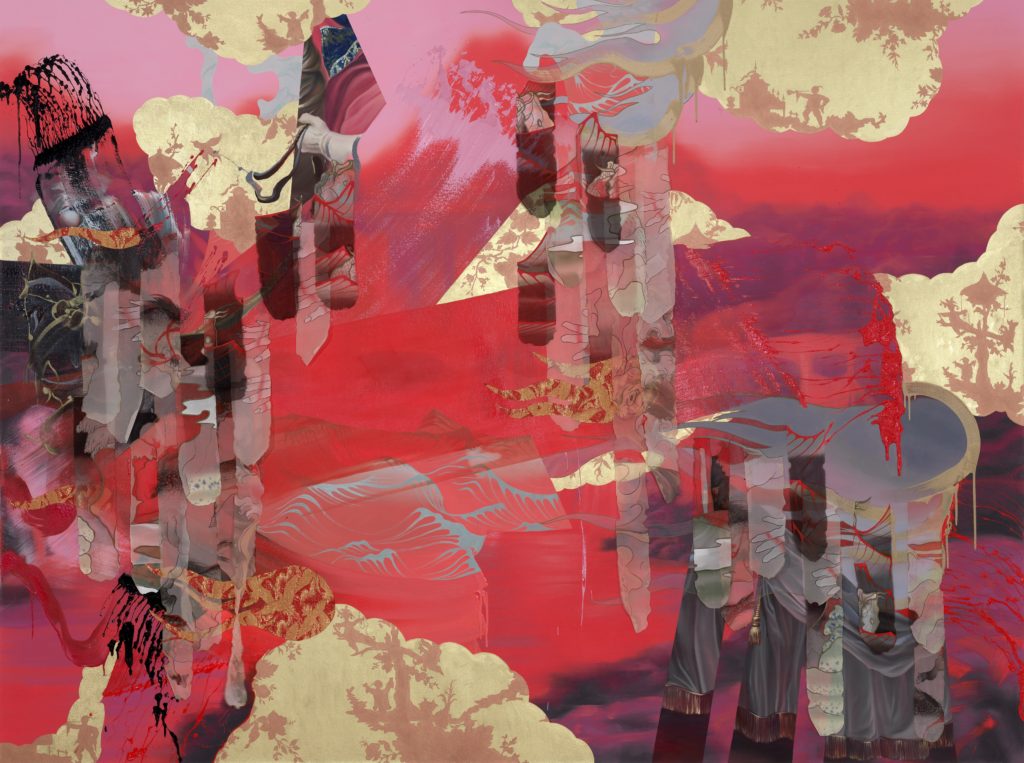
The composition centers on a horizontally spread field of highly saturated red, with shades of pink, magenta, deep purple, and dark brown intermingling in horizontal bands that resemble a distant landscape—creating a space that evokes a scene shrouded in evening glow, dust, or mist, yet refuses to pinpoint a specific location.The foreground consists of several fragmented, overlapping, and semi-transparent human body parts: cascading folds of clothing, boots, arms, the outline of a head, and decorative motifs are all misaligned with one another. The figures no longer appear as complete portraits but rather as historical fragments suspended within the composition.The black head or hat-like form on the left, together with the splashed and dripping black-and-red marks below it, forms a powerful anchor;while the gray-blue oval vessel and the red overflowing form on the right direct the viewer’s gaze toward an ambiguous image that lies somewhere between an object, a liquid, and a traumatic mark. The color structure does not rely solely on the contrast between warm and cool tones, but rather builds psychological tension through the constant modulation of red:The large, vivid expanse of red in the center is applied almost as a flat coat, covering and compressing the figures, mountain scenery, and decorative patterns; while shades of purplish-gray, bluish-gray, and black provide a sense of sedimentation in certain areas, endowing the red with multiple connotations—including splendor, alarm, bloodiness, and the aura of a stage curtain.The pale golden patterned areas scattered across the upper, peripheral, and lower parts of the composition resemble fragments of prints, textiles, or decorative wallpaper; their silhouettes of trees, figures, and pavilions carry a narrative quality, yet repeated obscurations prevent them from being read as a complete story. On the surface, the work juxtaposes smooth layers of paint, misty spray or smudged marks, fine line drawings, a patterned transfer effect, and opaque overlays. Some figures possess a transparency reminiscent of thin, layered overprints, with underlying lines and blocks of color still visible;other areas are sharply defined by hard edges, revealing a collage-like structural logic. This technical approach ensures that “covering” does not eliminate but rather serves as a method to make different temporal layers simultaneously visible: figures, landscapes, objects, and decorative images interpenetrate and simultaneously obstruct one another. Linked to the artist’s consistent focus on migration, cultural memory, the legacy of war, and the construction of identity, this imagery reads more as a deconstruction of a singular historical narrative.Traditional patterns, bodily attire, and painterly landscapes are not integrated into harmonious cultural symbols, but rather presented within intense fields of color as visual remnants that can be viewed, consumed, forgotten, and reassembled.The work’s value lies in its creation of a complex viewing position through the synthesis of color layers and fragmented images: the viewer is drawn to the allure of the imagery while remaining acutely aware of the irreparable gaps and tensions inherent within it.
Work 09
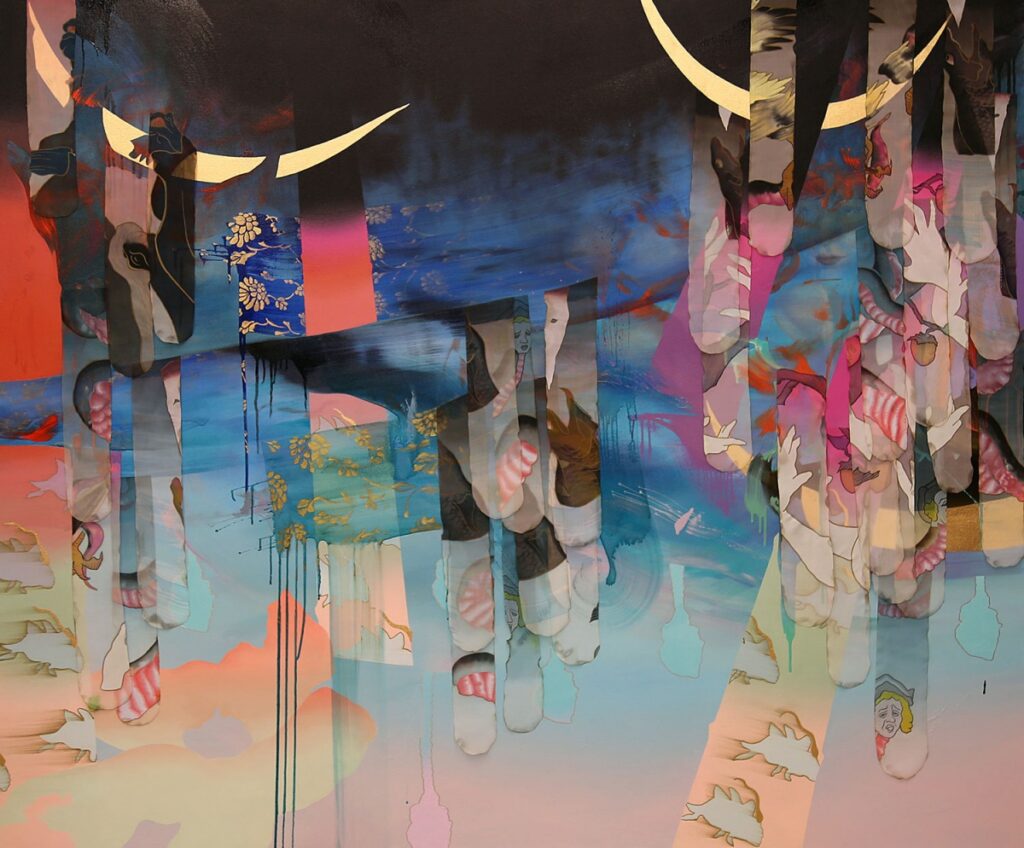
The composition features a foreground of dense vertical forms resembling a curtain, a jungle, or suspended bodies. Long, strip-like elements on either side cascade down from the top edge of the canvas, overlapping and breaking apart, compressing the central space—where deep blue, turquoise, and purplish-red intertwine—into an unstable crevice.The large, dark brown area at the top resembles a heavy canopy, through which several curved, pale yellow bands cut across—resembling both arcs of light and magnified sickle-shaped incisions.Consequently, the composition does not establish a single perspective; instead, the viewing path is constantly altered by foreground-background occlusions, transparent overlays, and localized penetrations. The colors possess intense tension: black and deep blue form a subdued and indistinct underlayer, while coral red, magenta, lake blue, and pale pink flash through the layers;局部金黄色植物纹样像装饰性残片,给冷暖冲突的画面嵌入精细而脆弱的秩序。Visible within the vertical forms are hands, feet, faces, folds of clothing, and unrecognizable body fragments; these are not depicted in their entirety but are repeatedly interrupted by translucent layers of color, black outlines, and other images. The physical body is thus no longer a stable subject but rather resembles the ghostly overlays of memory, archives, and perception across different temporal layers. On the surface, the work juxtaposes flat blocks of color, thin glazes, misty brushstrokes resembling splatter or sweeping, and dark pigments flowing downward. Drips and runs cause certain horizontal color planes to appear eroded and seeped through;clear line drawings, decorative patterns, and looser smears create a contrast in the rhythm of the technique. Certain areas retain hard-edge effects reminiscent of paper edges, cut-out outlines, or areas revealed after masking, suggesting that the artist does not seek a unified illusion of painting but rather actively exposes the process of image splicing, overlaying, and revision. This structure renders form and concept mutually dependent: fragmented bodies can only briefly emerge from the layered colors, while ornate patterns cannot dispel the oppressive sense created by the dark areas and drips.Combined with Lien Truong’s longstanding focus on Vietnamese and cross-cultural history, memory, and narratives of identity, this work can be understood as a painterly method that rejects linear narratives.By juxtaposing the decorative, the corporeal, and a sense of history, it causes the viewer to oscillate between aesthetic attraction and visual obstruction, thereby realizing that both personal experience and collective history are often perceived through fragments, obscurations, and returns.
Work 10
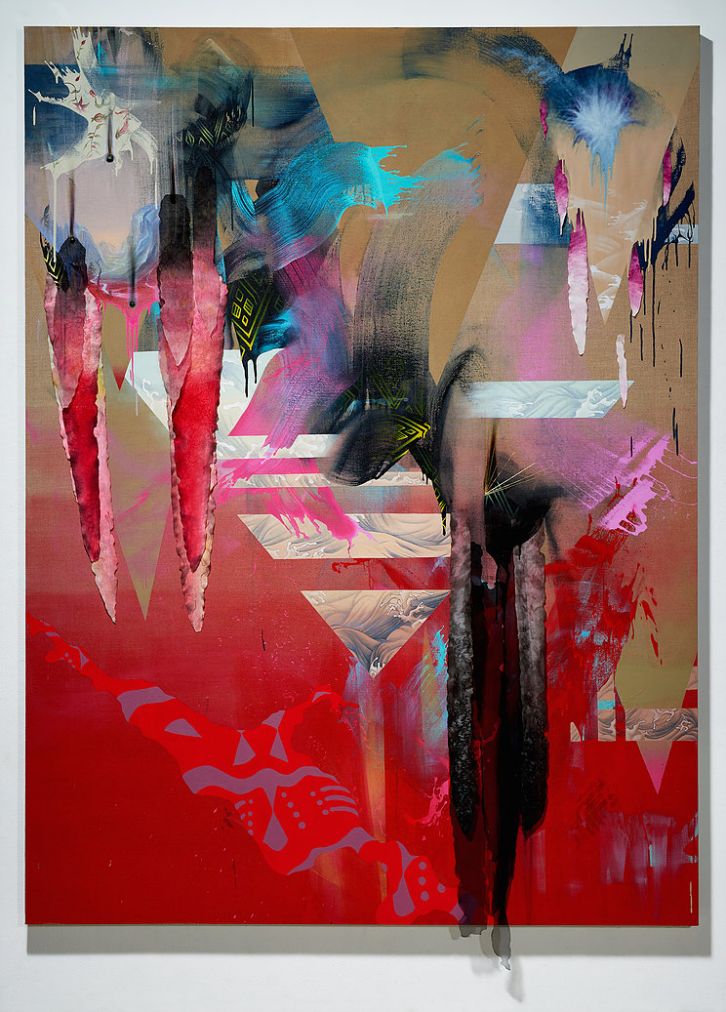
The composition unfolds across a nearly vertical rectangular plane, yet it does not establish a stable perspective.The large expanse of highly saturated red at the bottom resembles a compressed field, while the upper portion forms a murky atmospheric layer composed of earthy browns, grayish gold, and dark blue; interspersed between the two are diagonal fragments of white, silvery gray, and pale purple, creating visual paths that constantly break and shift.A deep black vertical streak slightly to the right of center is particularly significant: it drags downward from the gray-black mist at the top, crosses the red area, and spills beyond the bottom edge of the frame, resembling both a deposited ink stain and a fissure that both stitches together and tears apart multiple layers of color. The composition’s dynamism stems from several sets of opposing directions. On the left, several vertical forms interwoven with pink, dark red, and black resemble hanging membranes, plant tissue, or elongated body fragments;while in the center, cyan, magenta, and black brushstrokes sweep horizontally or diagonally, leaving behind the marks of rapid friction. The blue-and-white, explosion-like color mass in the upper right interacts with the thin, dripping black lines on the right, creating a sense of tension in that area—one of splattering, seeping, and corrosion.Consequently, the image does not refer to a single object but remains suspended between fragmented contours, fluid traces, and geometric cross-sections. Color does not merely serve a decorative purpose. Red creates an oppressive weight at the bottom, while pinkish-purple and magenta push this weight toward an emotional intensity;while cyan cuts in with a cool, bright intensity, creating brief, electric-like tremors. The earthy brown background evokes the sensation of an unpainted substrate, diminishing the flatness of the vivid colors and making each layer appear as though it has undergone obscuring, erasure, and re-revelation.Some white-gray triangles or textured light-colored fragments appear to have been formed by masking, collage, or imprinting; their fine, dense patterns, juxtaposed with the coarse brushstrokes around them, reinforce the contrast on the image’s surface between smoothness, undulation, transparency, and accumulation. The visible creative logic does not involve the uniform application of pigment, but rather—through covering, scraping, dragging, dripping, selective retention, and the superimposition of stenciled patterns—ensures that each layer retains its own distinct temporal traces.Black drips, in particular, make gravity an integral part of the composition; geometric color blocks, meanwhile, appear as artificially inserted order, temporarily interrupting the free brushstrokes, only to be swallowed up again by subsequent smudges.Combined with the artist’s ongoing focus on cross-cultural identity, experiences of migration, and historical memory, this unstable method of layering can be understood as a way of rejecting fixed narratives:The images do not offer easily recognizable stories, but rather allow bodily sensations, residues, decorative motifs, and abstract structures to collectively convey how memory is preserved, obscured, and constantly rewritten.