Fred Tomaselli|深入研究
United States
1. Artist Profile
弗雷德·托马塞利1956年生于美国加利福尼亚州圣塔莫尼卡,在南加州成长,1982年毕业于加州州立大学富勒顿分校绘画与素描专业。其早年经验深受洛杉矶地区的亚文化、迷幻视觉、主题公园式人工景观及实验艺术氛围影响,但他并未直线地进入绘画道路。20世纪80年代,他一度因质疑绘画在当代生活中的意义而转向行为与装置,这段离开画布的经历反而奠定了其后来突破绘画媒介边界的基础:对他而言,绘画不再只是颜料在平面上的再现,而可以成为容纳物质、图像、时间与感知的复杂装置。此后他重返绘画,并逐渐形成以木板为基底、拼贴和手绘为组织方式、透明树脂反复封存的标志性方法。药丸、植物性材料、草药、花鸟图像、人体局部、杂志及报刊剪影等,被精密地嵌置于画面结构之中;树脂既使实体材料获得近似琥珀包埋般的视觉深度,也制造出光洁、诱人而难以穿透的表面。 托马塞利的重要转折,在于将迷幻文化的视觉语言从即时性的感官刺激,转化为高度劳动密集、秩序严谨的图像系统。繁密图案、放射性构图、网格和蔓生式结构,使自然物、人造物与媒介图像彼此感染、增殖;明丽色彩与装饰性节奏诱导观看者沉入愉悦的视觉场域,而药物、身体碎片、新闻图像等又不断提示消费、控制、欲望与社会现实。其后对报纸版面的改写,进一步把日常新闻转化为主观心理景观,显示出他从私人幻觉向公共信息环境的延伸。在当代美国艺术史中,托马塞利连接了拼贴传统、波普艺术、迷幻艺术、装饰性绘画与后观念艺术的媒介意识。他值得综合材料艺术研究,正在于其材料从不只是奇异的“添加物”:药丸、植物、印刷图像和树脂分别承担文化符号、自然性、媒介性与封存机制,最终共同决定作品关于现实与幻象、乌托邦欲望及其破裂的观念结构。
2. Artistic Concepts
弗雷德·托马塞利的艺术观念围绕“观看如何被改变”展开。他并不把药片、致幻植物或绚丽图案简单处理为反文化符号,而是将它们视为现代人寻求脱离日常、缓解焦虑、获得愉悦与重新组织感知的物质隐喻。成长于南加州的经验,使他接触到冲浪文化、迷幻文化、流行图像与一种被娱乐、消费和媒体不断塑造的“非现实感”。因此,他的作品既承认人对超越性经验的欲望,也警惕这种欲望如何被药物、商品和视觉景观所规训。他关心的始终不是药物的生理效力,而是图像如何像药物一样,经由眼睛进入意识,暂时重置观者的时间感、尺度感和现实判断。 其早期从装置、现成物及对绘画机制的反思中发展而来,随后逐步将工作集中到木板绘画的封闭场域。药片、叶片、昆虫、人体局部、花卉、鸟类和印刷图像被精细分类、剪裁、排列,再与丙烯颜料共同封入透明树脂。这个过程具有矛盾性:原本用于服用、会枯萎、腐败或迅速过时的材料,被固化为近乎琥珀般的永久表面;它们失去原有功能,却获得了新的视觉魔力。树脂的光泽、深度与密封性制造出诱人的幻觉空间,使作品在远观时呈现为抽象的星云、曼陀罗、瀑布或装饰性纹样,近看则暴露出由药物、自然物和大众媒介残片组成的复杂系统。视觉上的迷人不是观念之外的包装,而正是作品的批判方法:观者先被秩序、色彩和光泽吸引,继而意识到这份美感内部潜伏着医疗化、消费主义、生态欲望与死亡的阴影。 托马塞利在二十世纪九十年代尤其强调身体、药理与精神漂移之间的联系。药片既可勾勒人体轮廓,也可化为颗粒、链条和星点;身体因而不再是完整主体,而像被化学物、欲望与图像穿透的容器。此后,他进一步强化自然与人工之间的混杂:真实压制叶片与印刷植物、鸟类或昆虫图像并置,分类学的理性秩序被过度繁殖的图案打乱,乐园般的景象同时显露出被占有、收藏和装饰化的自然。 约在2005年前后,他停止在作品中使用真实药片,转而更多借助绘制圆点、植物材料以及报纸版面、新闻照片和标题等媒介。这个转变并非放弃“致幻”主题,而是把感知政治从身体化学延伸到信息环境:新闻既是公共现实的记录,也是在每日阅读中塑造恐惧、愤怒和注意力的视觉药剂。他对报纸的切割、遮蔽、重绘和拼接,使具体事件进入高度形式化的构图,显示抽象并非脱离现实的纯粹语言,而能够承载瞬息万变的社会情绪。由此,他的艺术从个人经验中的意识改变,发展为对集体观看、媒介焦虑与当代现实碎片化的持续考察。
3. Main Materials, Manufacturing Processes, and Technologies
托马塞利的绘画以木板为稳定而坚硬的承载面,将药片、胶囊、植物叶片、杂志与书籍图像的剪贴、丙烯颜料及透明环氧树脂结合起来。木板能够承受树脂反复浇注后形成的重量与厚度,也使他可以在近似平整的正面上进行精密排列;这种坚实的底部结构,与药片的工业化规整形态、叶片的脉络和易碎边缘形成鲜明对照。药物具有标准化的色彩、尺度和圆形或胶囊式轮廓,适合被组织为星群、环流、网格或放射状轨迹;叶片则以不规则的外形和天然纹理打破几何秩序,使自然物不只是象征物,更成为图像节奏中的有机变数。艺术家还剪取、复制并重组鸟类、花卉、解剖图或新闻图像,将摄影再现的碎片压缩进装饰性极强的平面结构中。制作时,他先在板面上以丙烯颜料建立深色、明亮或高饱和的底层与线性框架,再依照预设的密度、方向和色彩关系逐一安置实物与纸本图像,随后以透明树脂分层封固。树脂的流动性使各层材料被包裹、固定并产生轻微的光学深度;固化后经打磨、抛光,表面获得近似玻璃、珐琅或琥珀般的亮泽。于是,原本可触、可服用、会枯萎或易被丢弃的物件被转化为不可进入的视觉标本:观看者既能辨认每一颗药片和每一片叶子,又会被密集图案、反光表皮与层层叠置的空间错觉牵引。材料语言因此同时呈现秩序与过量、愉悦与不安、科学分类与迷幻感知,支持他对身体、消费、药物文化、自然与意识改变状态之间复杂关系的思考。
4. A Detailed Examination and Analysis of 10 Representative Works
Work 01
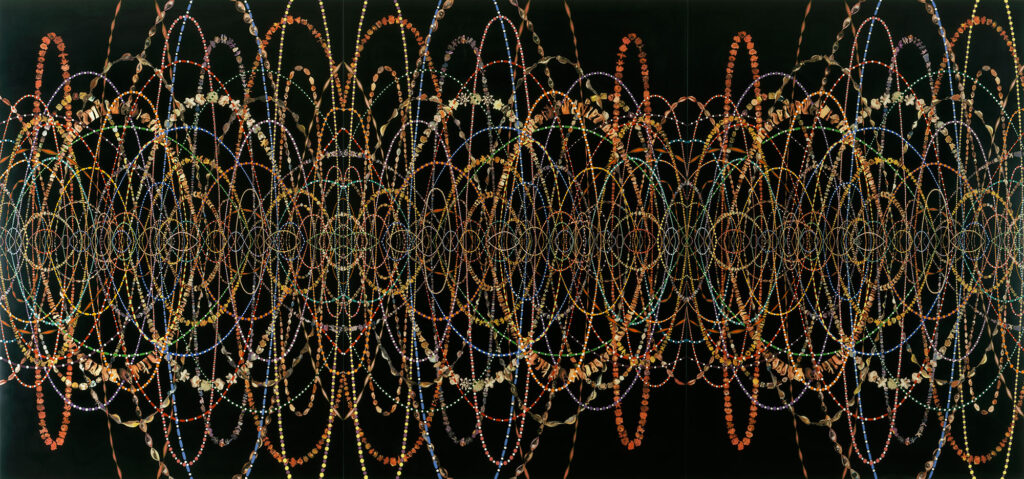
Against a deep black background, the composition features a horizontally unfolding, seemingly endless mirrored structure. In the center, a dense array of ellipses, rhombuses, intersecting arcs, and vertically linked units overlap one another, creating a visual field reminiscent of the interplay between lace, beaded netting, mandalas, and optical diagrams.The left and right sides are not simple repetitions; instead, subtle variations appear in the placement of individual flowers, leaves, granular color dots, and the trajectories of fine chains. This deviation within the order endows the image with both the stability of a decorative pattern and a sense of instability—one of growth, spread, and vibration. Color does not appear as large swaths of paint but is compressed into minute nodes scattered along linear trajectories. Red, orange, yellow, green, blue, purple, and white specks emit a strong luminosity against the black background, while warm-toned floral elements and brownish-gold leaves and seed-like forms provide a more concrete, natural texture.The black background is not merely a blank space to set off the colors; rather, it functions as a space that seems to draw all materials into its depths, causing the tiny colored dots, dried plant forms, and bead-like lines to float within a visual depth that lacks a clear sense of foreground and background. Judging by the surface effects visible in the image, the work relies on the arrangement, adhesion, and encapsulation of a vast number of microscopic units rather than on traditional brushstrokes to shape its forms. Each curve is composed of a continuous sequence of particles that are relatively uniform in color, size, and spacing; other curves are formed by the joining of leaves, flowers, or irregular fragments.Meticulous, repetitive labor transforms materials that were originally scattered, ephemeral, and subject to chance into precise geometric rhythms. Yet the natural irregularities of the materials constantly resist this geometric framework: the contours of petals, the twists of leaves, and the variations in the particles introduce subtle disturbances into the symmetrical system. This illustrates a key method in Fred Tomaselli’s art: organizing heterogeneous materials through collage, accumulation, preservation, and patterning, thereby creating a simultaneous experience of sensory pleasure and cognitive overload.The images can be viewed from a distance as grand abstract structures, yet they also demand a closer look to discern that they are composed of countless concrete elements.Decorativeness, therefore, is not merely a light, superficial effect, but rather a complex mechanism of perception: order draws the gaze in, while density and repetition cause the viewer to lose a stable focal point, ultimately compressing nature, the artificial, bodily sensation, and psychological illusion onto a single plane.
Work 02
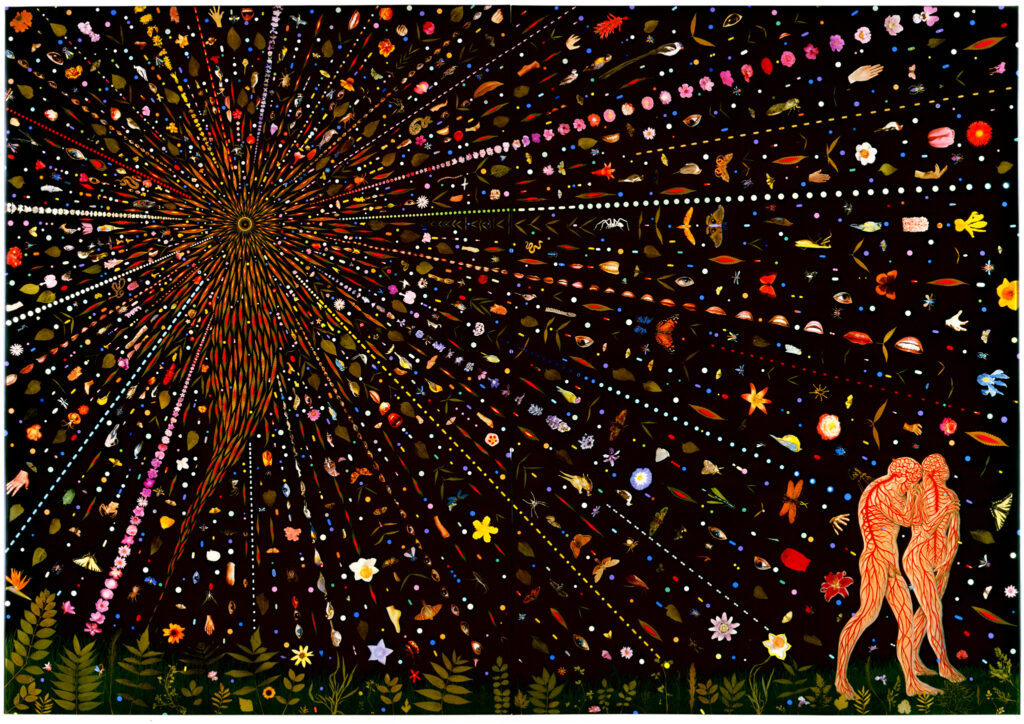
The composition unfolds against a nearly light-absorbing black background, revealing vertical and horizontal seams that divide the whole into several interconnected sections; rather than weakening the image, this division seems to place a continuous universe, garden, and bodily scenes within an interlocking visual system.The center, slightly off to the left, serves as the source of energy for the entire composition: dense lines of yellow, orange, red, green, and other colors burst outward from concentric circles, forming structures resembling vortices, pupils, celestial bodies, or energy nodes.The further downward the bundles of lines extend, the more they are elongated and converged, transforming into vertical trails with a feather-like texture, giving the intense radiating movement a simultaneous tendency to fall toward the ground and take root. The black background is not empty but is animated by a multitude of independent small images: flowers, leaves, insects, birds and beasts, eyes, lips, hands, shell-like objects, and colored dots are scattered throughout. Their scales are deliberately leveled, giving microscopic organisms, human body parts, and decorative symbols similar visual weight.Rows of dots, short dashes, and repeated images of plants or body parts form multiple diagonal, horizontal, and radiating trajectories; particularly prominent is a chain of light-colored dots spanning the canvas, resembling both a measuring scale and a musical score that weaves fragments of imagery into a rhythmic pattern.Highly saturated reds, yellows, blues, pinks, and cyan exhibit a fluorescent-like brightness against the black background; yet the colors are not haphazardly splattered but organized into streams of varying density, direction, and speed. The two human figures embracing in the lower right are rendered with orange-red outlines and dense, vascular-like linework, creating a stark contrast with the surrounding, more realistic silhouette images. While the figures maintain an intimate posture, the exposure of their internal networks makes them appear like living systems that can be observed and dissected.The grass blades and ferns spreading out in bands at the bottom provide a stable horizon; the bursts, drifts, and scatter above thus point not only toward the starry sky but are also drawn back to growth, reproduction, and sensory experience. Judging by the visual evidence, the images in the painting appear to have been individually selected, cropped, and meticulously arranged; the smooth, sharp edges create a sense of distance against the black background, reminiscent of a specimen box, a display case, or a microscopic field of view.Tomaselli is accustomed to incorporating nature, pharmacology, the body, visual illusions, and popular imagery into highly ordered compositions; here, the fragmentation of materials does not lead to collage-like chaos but, through radial, serial, and grid-like organization, is shaped into an excessively abundant yet exceptionally rigorous perceptual structure.The tension in the work stems precisely from this juxtaposition: life is dismantled into countable units of imagery, yet reconverges—through color, desire, and movement—into an expansive illusion.
Work 03
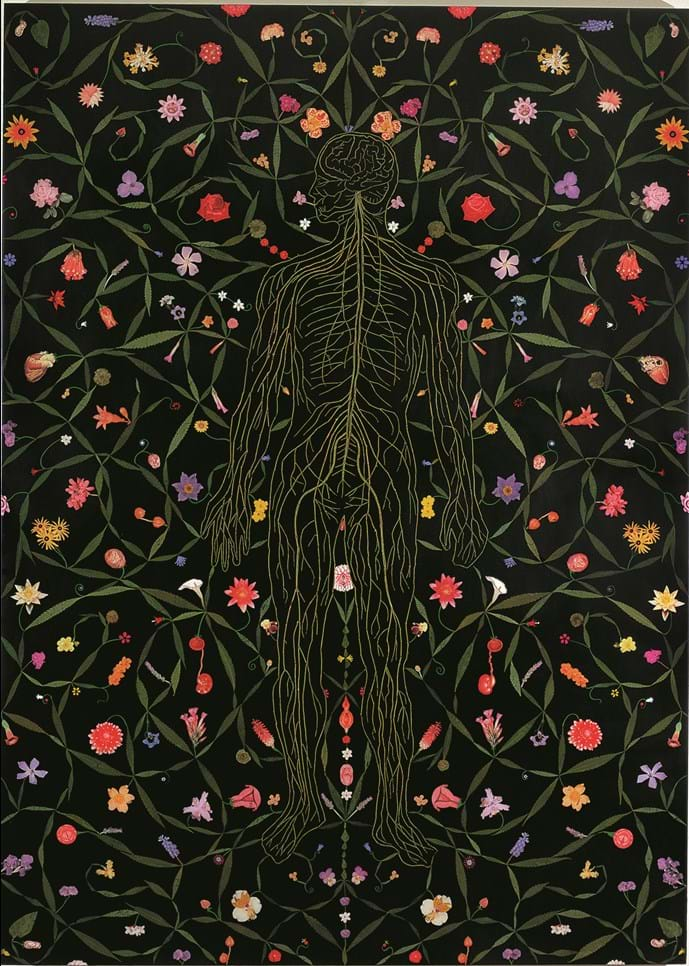
Against a nearly pitch-black background, the painting creates a deep and enclosed visual space, with a human figure standing face-on at the center. The figure lacks volumetric shading; instead, the outlines of the brain, spinal cord, nerve branches, fingers, and feet are traced with fine, pale yellow-green lines;The body resembles both the nervous system in an anatomical diagram and a plant spreading out toward its limbs. The periphery is covered with green tendrils that curve, crisscross, and coil repeatedly; these tendrils connect at the edges of the composition, forming a continuous grid reminiscent of wallpaper, fabric, or decorative botanical patterns.The vertical axis of the central figure echoes the near-bilateral symmetry of the surrounding patterns, lending the composition a ritualistic, encyclopedic, and mandala-like cohesion. The color scheme is built upon a contrast between black, deep green, and highly saturated floral hues. Black serves not merely as a background, but as a negative space that simultaneously highlights the foliage, the outline of the human figure, and the localized colors of the flowers. The leaves are predominantly a muted olive green, ensuring they do not compete with the central nerve lines for attention;Flowers in shades of red, pink, orange, purple, white, and yellow are embedded as scattered highlights within the network of vines, resembling precisely placed nodes of color. Viewed from a distance, they form a balanced, speckled rhythm; up close, each reveals distinct petal shapes, edges, and internal textures, avoiding mechanical repetition. The plant, flower, and small-fruit-like elements in the image possess a two-dimensional quality—as if cut out, printed, or individually embedded—with clear boundaries and deliberately ambiguous scales: some resemble natural specimens, while others are closer to graphic symbols.In contrast, the neural lines of the human body remain restrained, homogeneous, and highly continuous, as if they were a set of transparent internal maps. These two distinct artistic languages—elaborate, externally sourced imagery and a cool, internal depiction—transform the body into a node within a natural network, rather than a subject that dominates its environment. This organizational approach ties into the artist’s consistent focus on the relationship between perception, the accumulation of information, natural imagery, and states of consciousness. The works do not treat the plant world as a realistic backdrop; rather, through the superimposition of decorative order, anatomical structures, and dense details, they allow the viewer’s gaze to oscillate between scientific illustrations, folk motifs, and hallucinatory visual experiences.Precise symmetry and clear boundaries lend the images a sense of control, while the continuously spreading branches, leaves, and nerve endings hint at the inexhaustible complexity of living systems.
Work 04
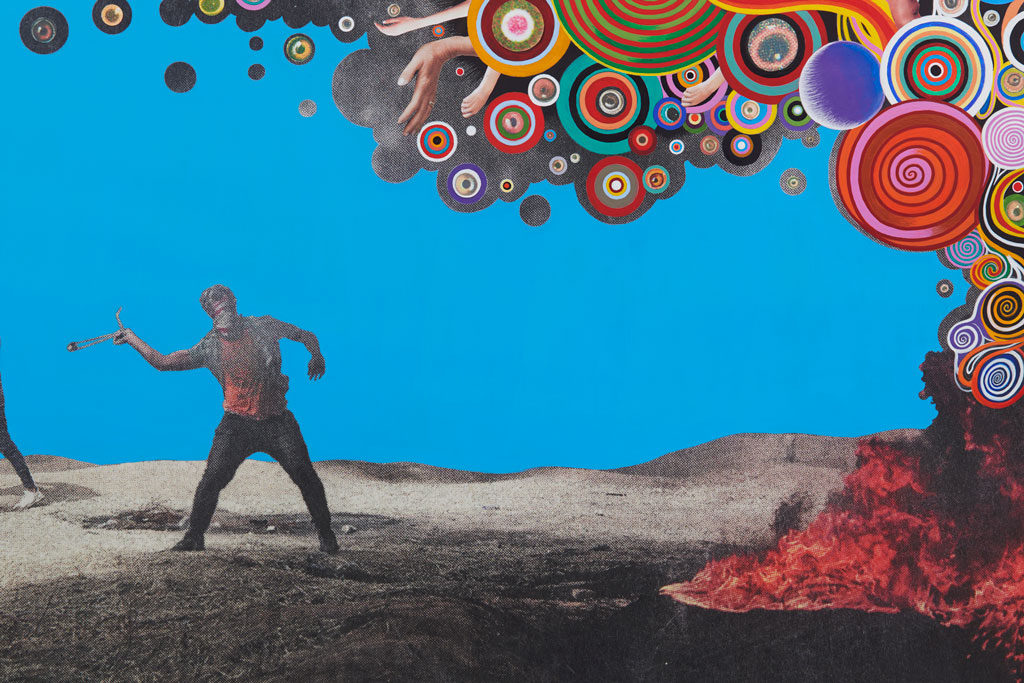
The composition features a vast background of highly saturated cyan-blue with virtually no gradation, while a desolate gray-black landscape stretches across the lower portion, creating an expansive, weightless stage.The figure in the lower left, with legs apart and leaning backward, pulls back a slingshot-like slender rod, the motion directed toward the upper right; the body is composed of a grainy black-and-white image that possesses the realism of a documentary photograph yet, due to its scaled-down proportions, becomes a silhouette inserted into a surreal scene.On the right, a rising reddish-brown mountain or eruptive landform intrudes from the edge of the frame, merging with a cluster of colorful forms densely composed of concentric circles, spiral patterns, and target-like discs.A large cluster of circular units also floats at the top of the composition, with several partially visible arms interweaving through them, endowing this “cloud formation” with multiple attributes—at once physical, decorative, and cosmic. The key to the composition lies in the extreme contrast between emptiness and fullness: a large expanse of pure blue space in the center separates the figures on the ground from the visual explosion above and to the right; meanwhile, the circular elements grow increasingly dense through variations in scale, mutual overlap, and cropped edges.The circles resemble, from above, cells, pupils, records, or pills, while also generating a hypnotic centripetal motion through bullseyes, whirlpools, and radiating stripes.Red, orange, yellow, green, purple, and black-and-white rings are juxtaposed; color is not used to reproduce nature, but rather to create oversaturated perceptual stimulation through intense complementary contrasts and jumps in luminosity. The flatness of the cyan-blue background, in turn, highlights these color blocks as if they were signals affixed to the surface. The landscapes and figures in the lower section reveal fine halftone dots, grain, or printing textures, suggesting that they may originate from image layers processed through transfer, collage, or rephotography; the circular patterns in the upper section, in contrast, convey a clearer sense of drawing, printing, or layered materials.The collision of these two surface languages places the cool, barren black-and-white reality and the high-density, psychedelic ornamentation in distinct visual and temporal realms.The figure’s throwing posture further builds a sense of causal suspense: he appears to be confronting, summoning, or releasing this unclassifiable energy. Such images can be linked to Tomaselli’s consistent method of juxtaposing found images, natural forms, bodily experiences, and anomalous perceptions.Rather than treating hallucinations as private landscapes of escape from reality, the work brings popular imagery, the order of scientific diagrams, and psychosensory overload together into a precisely organized plane. Consequently, the viewer oscillates between the bright, alluring ornamentation and a sense of latent violence and loss of control.
Work 05
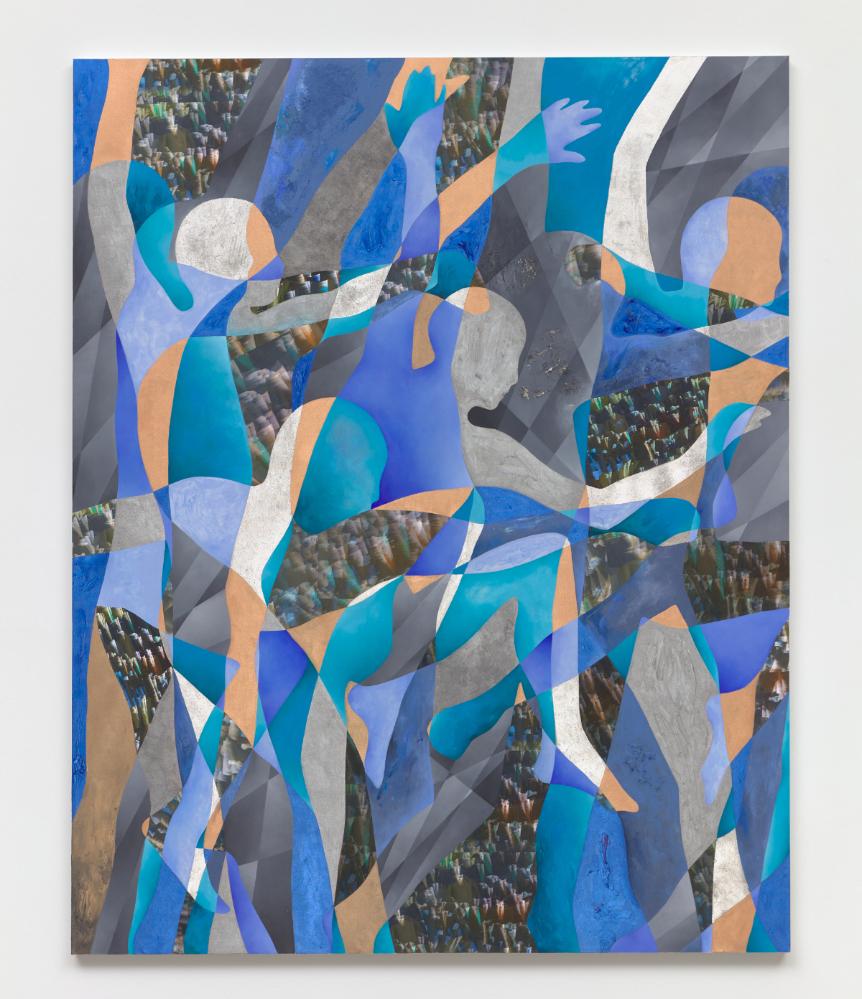
画面以竖向矩形为边界,却没有稳定的中心、地平线或单一观看方向。大面积蓝绿、深灰、银灰与肉橙色的不规则形彼此嵌压、穿插,时而可辨为手臂、手掌、躯干、头部般的轮廓,时而又退回为纯粹的弧线、斜角和色块。数个向上伸展或横向弯曲的肢体形象被切断、重叠,使画面像处于拥挤运动中的群体,也像被拆散后重新编排的人体图谱。上下左右均有强烈的出界趋势,观看因此在局部形状间不断跳转。 色彩并非以明暗塑造体积,而以冷暖和透明度的冲突建立层次。饱和的青蓝、钴蓝形成画面的情绪底色,肤橙色以小而尖锐的面积穿出,既提示人体温度,也在冷色网络中构成视觉节点。银灰与黑灰部分尤为关键:它们既像阴影,又呈现折面般的几何分割,使有机的身体曲线受到硬质结构的切割。局部灰色带有金属粉末或箔状反光的质感,随周边的哑光蓝色而显得既物质化又难以定位。 画面中若干深色区域可见密集、重复的细小图像碎片,近似经剪裁后嵌入的摄影性纹理;它们与手绘或涂布感较强的色面并置,令平整的画面内部产生不同的信息密度。蓝色部分还保留轻微的笔触、斑驳和渗化痕迹,银灰区域则显出颗粒、擦拭或压覆后的不均匀表面。由此,制作并非服务于幻觉式空间,而是让拼接、覆盖、遮蔽和切割本身成为图像生成的逻辑。 这种将身体碎片、抽象色域、摄影性细部和装饰性表面压缩于同一平面的方式,契合Tomaselli长期对感知过载、意识状态与图像材料混杂性的关注。作品没有将人体处理为完整叙事主体,而是使其成为色彩、纹理和节奏的载体;身体的可辨认性不断出现又被取消。其价值正在于把看似愉悦、明亮的综合色彩,转化为一种不稳定的视觉经验:观看者既被丰富表面吸引,也持续面对图像信息无法被一次性整合的状态。
Work 06
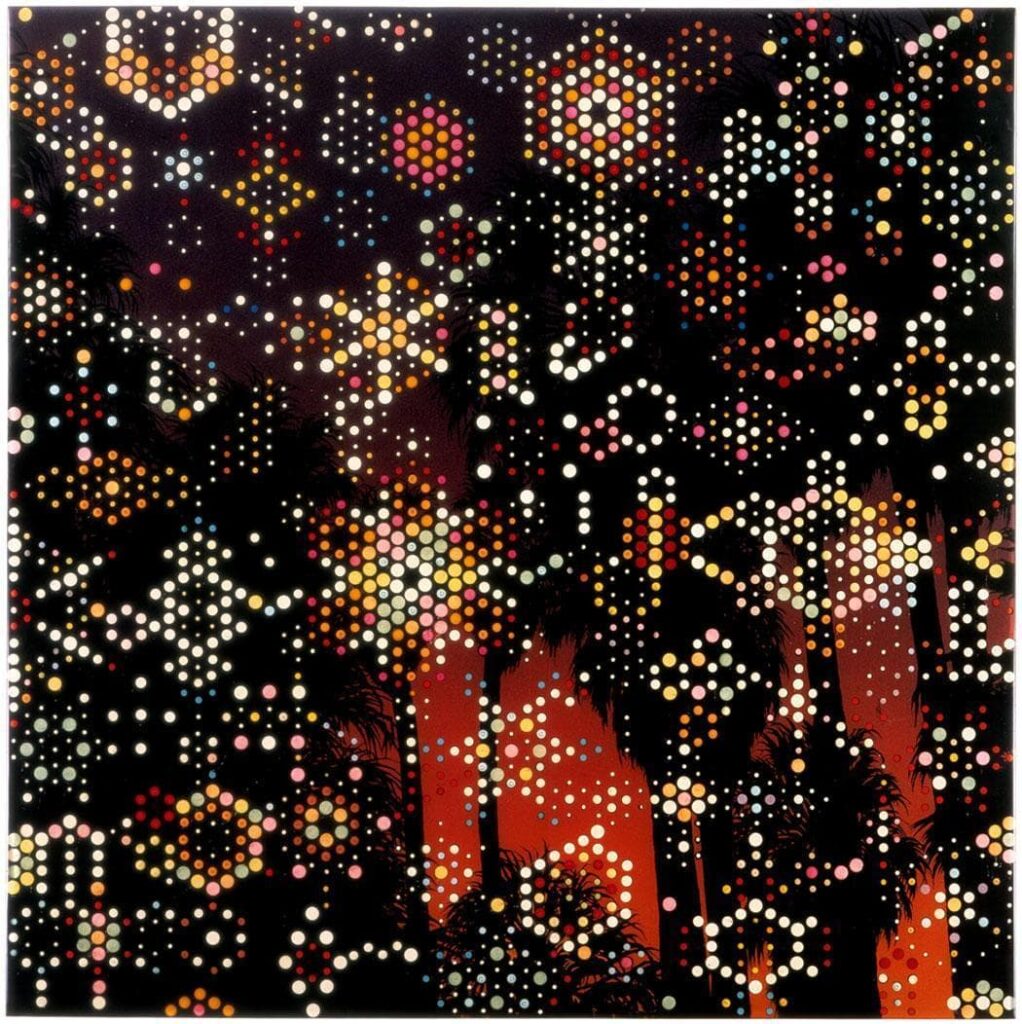
画面以近乎纯黑的密林剪影为基底,数株高耸的棕榈树从画面下缘和两侧向上伸展,树干、叶簇与枝叶的锯齿状轮廓遮蔽出不规则的暗区。背景中露出的赭红、砖红色天幕形成局部暖色空隙,使黑色并非单纯的底,而成为切割空间、制造前后层次的实体。全幅最具支配性的元素是密集圆点:乳白、淡黄、橙黄、粉红、朱红、浅蓝与灰绿色的圆形颗粒散布于黑色区域之上,并以大小、间距和聚散的变化组织成涡旋、环带、花团、网格及松散星群。它们一方面覆盖景观,另一方面又像从暗处浮现的发光信息,使风景不再服从自然透视,而转化为被编码、被激活的视觉场。 圆点并不均质。较大的浅色圆点承担节奏重音,小点则充当连接结构;有些色点由中心向外递减,形成靶心般的放射单元,有些则沿弧线或斜向路径延展,暗示流动、扩散和感知的漂移。冷色点数量较少,却在暖色密集处制造跳跃,避免整体陷入单一的热烈色调。黑、红与多色圆点之间构成明确的层级:黑色剪影提供深度和压迫感,红色背景提供大气性的温度,圆点则以近乎平面化的方式压到最前方。由此,树木既可被看作夜景中的自然形体,也仿佛是承载图案和信号的幕布。 从可见表面判断,圆点边缘清晰、色块饱满,大小虽有变化却保持高度控制,显示出耐心的逐点布置或精确转印般的工艺意识;黑色区域中仍能辨出枝叶细部,说明图像层次并非任意覆盖,而经过了前景、背景与点状结构之间的精细协调。这种将繁复微元嵌入整体构图的方法,与Tomaselli长期关注的意识状态、感官过载、自然图像和信息图式之间的交叠相呼应。作品的价值不在于再现一片可辨认的热带景观,而在于让景观同时成为装饰、幻觉、数据式分布与心理投射:观看者的视线不断在树影的具象轮廓和圆点的抽象秩序之间摆动,进而体验到一种既愉悦又不稳定的视觉沉浸。
Work 07
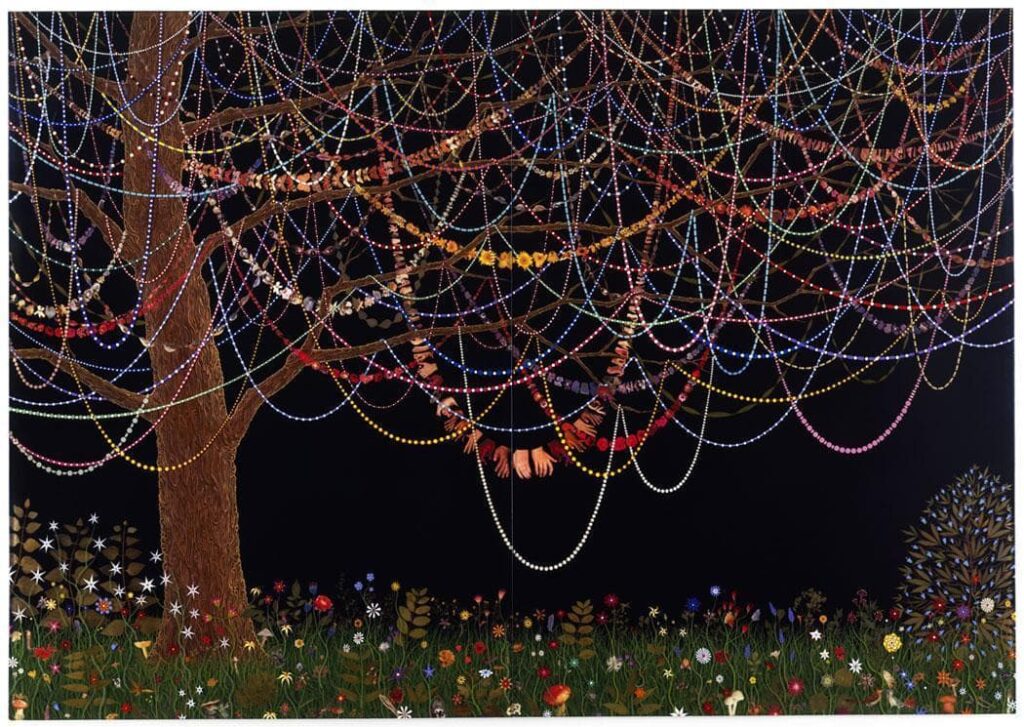
画面以近乎纯黑的背景建立深而平整的空间底板,一株粗壮树干自左下向上伸展,横向枝条覆盖画面上半部,构成清晰的骨架。树并未被处理成自然主义风景中的实体,而更像一张承载物:大量弧形垂线从枝间下坠、交错,形成密度极高的网状结构。它们类似串珠、饰链或节律化的点线,每一条均以重复颗粒组织,并通过红、粉、蓝、白、黄、绿等色彩在黑底上获得异常明亮的闪烁感。上部的繁复与下部较为开阔的黑色区域形成压力和释放的对照,使观看首先被卷入枝头的视觉噪声,继而落向底部花草丛生的地面。 树皮、枝叶、花朵、鸟形或手形般的小型图像单元,都显出被逐一描绘、剪裁或贴附后再密集编排的特征。树干内部可见细碎的纹理线,枝条上则附着许多颜色、尺度和方向不一的微小元素;它们不服从传统透视,而以近似标本陈列、装饰图案与幻觉拼贴相混合的方式铺展。下方草地由无数茎叶、菌类与星状花头堆积而成,植物轮廓精细,却同样保持平面化的并置关系。黑色负空间因此不只是夜幕,也像将所有细节压缩至同一视觉平面的背景。 色彩在这里不主要承担自然光照,而承担分类和节奏:褐色树体稳定画面,鲜艳珠串制造流动轨迹,草地中的红、蓝、白、黄小点则像从上方坠落并在地面重新萌发。精密重复的制作方式将亲密、手工和装饰性转化为近乎强迫性的视觉秩序。结合Tomaselli一贯以图像采集、物质嵌置和高密度组织来扰动感知的工作方法,这幅图像可被理解为一种关于自然、消费性饰物与心理幻视的混合系统:树既是生命象征,也是悬挂、收集和编码的结构;美丽的繁盛表面同时制造过量信息,使田园景象转化为令人驻足、迷失并反复辨认的意识场。
Work 08
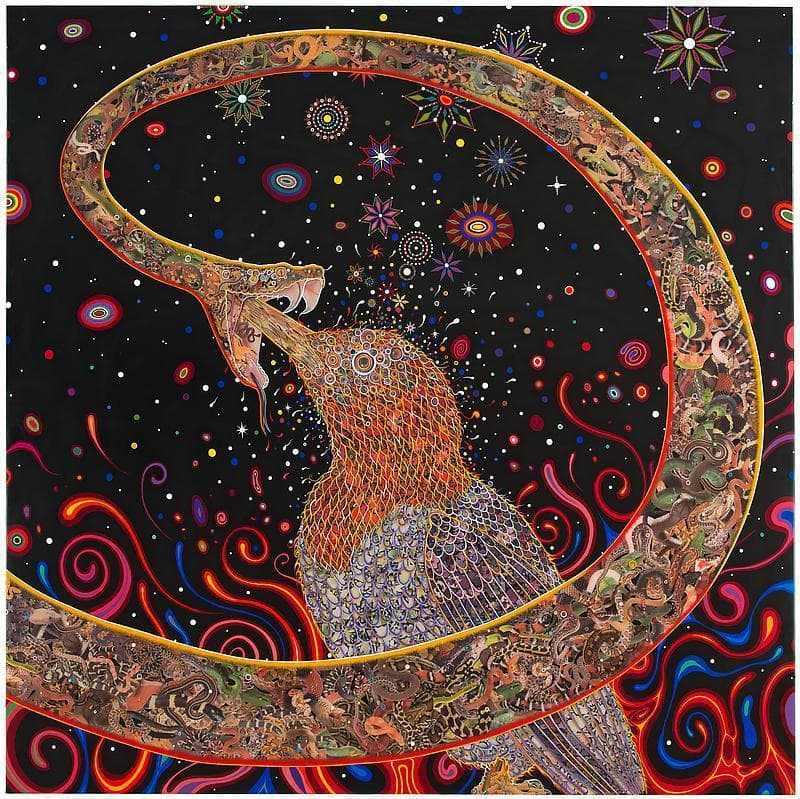
画面以黑色宇宙般的底场展开,一只侧身仰望的鸟占据中央偏下位置;其头部、胸腹与翼羽由极密的圆环、网格、鳞片状单元覆盖。鸟的长喙斜指左上,视线被引向画面上方横跨而过的巨大环带。该环带不是均质的几何线条,而像一条首尾衔接、不断盘绕的生物性边界:暖褐、灰绿、肉粉和暗红色的细碎图像填满其内部,隐约可辨兽类、蛇形肢体、叶片、眼睛及人体般的局部。它从左上进入,绕过鸟身,沿右侧下坠,再在底部横向回返,形成包围、限制与保护兼具的循环结构。 黑底中散布白、蓝、黄、红、绿等大小不一的点,既像星体,也像被放大的细胞、药丸或装饰珠粒。若干放射状星花、同心圆靶纹和涡旋线条悬浮其间;下半部尤其密集的红、蓝、紫色弯曲线,使静止的背景获得液体、神经传导或迷幻视觉般的流动感。色彩的组织并非自然主义:高纯度的荧光色被黑色压缩得异常明亮,而鸟体的橙金、银灰与环带的土色相互对照,使中心生命体从繁复环境中清晰浮现。 表面可见大量被裁切、拼嵌或逐层描绘的微小图像,以及细线勾勒的重复纹样。鸟并未以传统羽毛塑造,而是通过网状结构、环形颗粒和鳞片般模块累积体积;这令身体同时呈现生物组织、装饰图案与信息网络的属性。巨环内部的碎片与鸟身的秩序化纹理形成差异:前者近乎百科全书式地堆积,后者则被编织成可辨的形体。精密的重复劳动因此把偶然、异质的视觉材料纳入严整构图。 这类图像方法契合Fred Tomaselli一贯对感知、自然、欲望与意识状态的关注:他常将植物性、动物性、药理联想和宇宙图式并置,使观看在科学图谱、民间神话与心理幻象之间游移。此处循环的环带并非单纯装饰,而将鸟、星空和无数生命碎片锁入同一代谢系统;绚丽而近乎过量的视觉快感,也提示感知扩张背后难以穷尽的复杂性。
Work 09
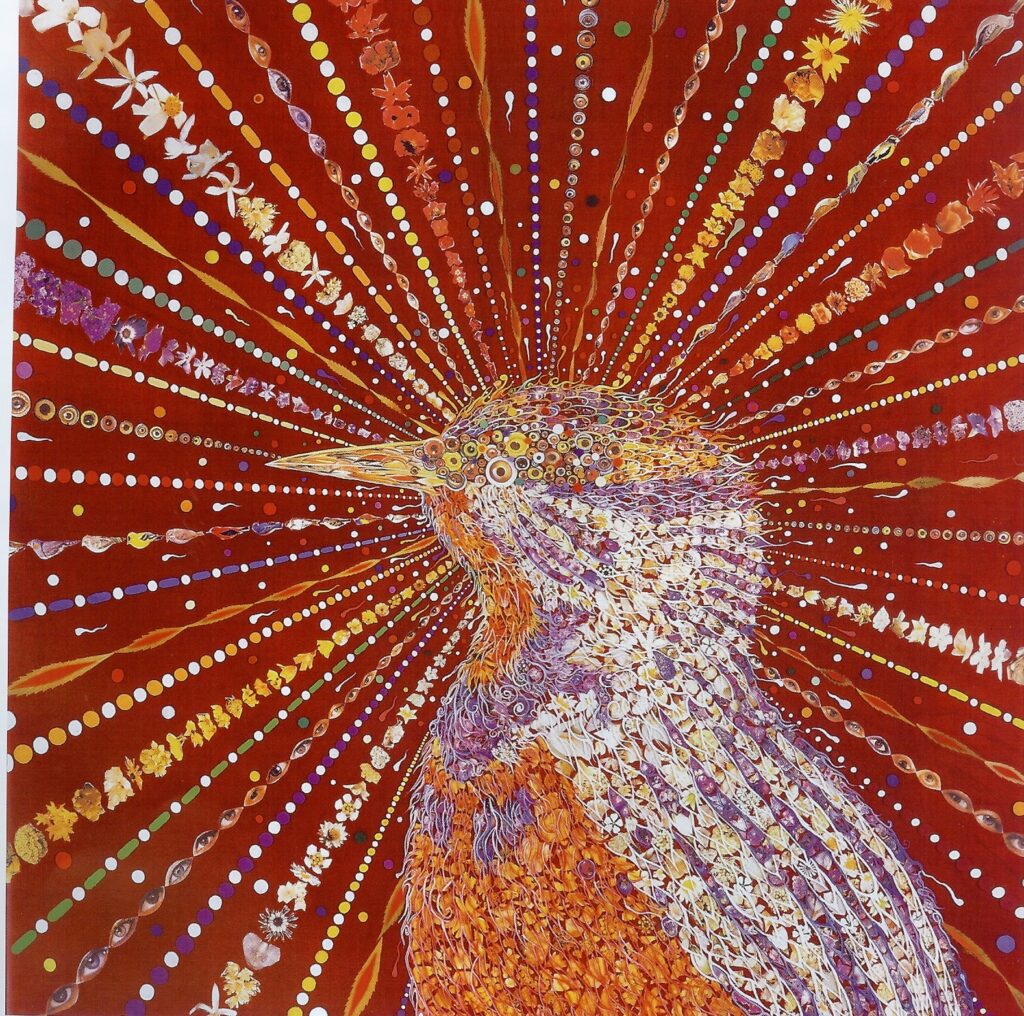
画面以浓烈、近乎单色的朱红底面展开,所有视觉元素都被一股由中心向四周喷射的放射性力量统摄。画幅中部偏下形成一个密集的涡旋核心:细小圆环、花朵、眼睛形图像、线状卷须与颗粒彼此挤压、缠结,继而向下延展为一道厚重的垂直形体。它既像被拉长的能量流,也隐约具有躯体、羽翼或瀑布的轮廓;上半部的射线则使这一形体仿佛处在持续爆发的感知场中。 色彩结构并非自然主义,而是由红、黄、橙、紫、白、绿等高饱和色点构成的节律系统。红色背景提供稳定而炽热的平面场,黄色和橙色线条强化向外迸射的速度,紫、白两色在中央与下方密集区域形成冷暖交错的纤维感。大量重复的圆点、椭圆眼形、花瓣和胶囊般的单元,被串接为平行、弧形或放射状轨道;它们一面标记透视般的方向,另一面又因尺寸与间距的微妙变化而制造脉冲、振动和视觉眩晕。 图像表面可见明显的拼贴性:花朵、晶体状碎片、眼睛及装饰性纹样保留了各自不同的边缘、明暗和摄影式质感,与手绘或勾勒的曲线交织。中央下垂部分尤其呈现层层覆盖的制作逻辑:小图像被密集嵌入,白色线网再从其间穿行,如同将离散的图像碎屑缝合成一块有机组织。若表面存在透明封存层,其平整、饱满的视觉效果会进一步压低拼贴材料原有的物理差异,使手工痕迹与现成图像共同凝结为一个紧致皮肤。 这种由微小现成图像反复累积、再以秩序化构图导向总体幻觉的方法,契合Tomaselli长期将日常视觉材料转化为意识经验图谱的实践。作品并不把花、眼与颗粒组织为可供辨认的叙事,而是令它们在装饰、药理般的分类感与宇宙性爆发之间摆动。材料的异质性因此不是杂乱的来源,反而成为制造精神性强度的条件:观看者越试图辨认局部,越被整体的放射节奏吸入。
Work 10
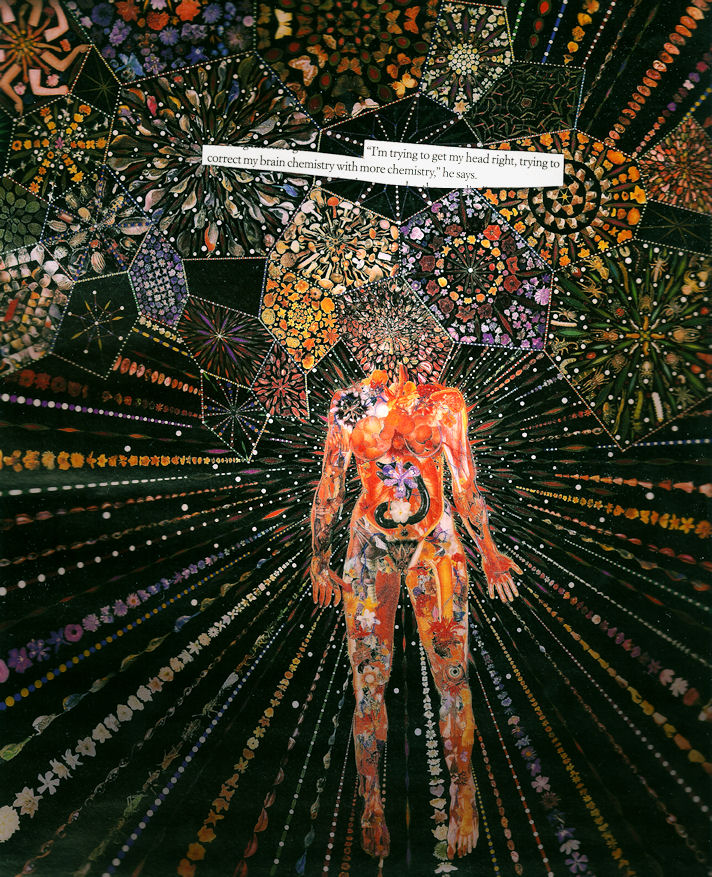
画面以黑色底面建立近乎无边界的深空,中央一具正面站立的人体成为绝对视觉轴心。身体没有头部,颈部位置被强烈的红橙色光团覆盖,像灼热、失焦的能量核心;胸腔、腹部与双腿则被花朵、枝叶、器官式图像及斑驳色块填满,使肉身同时呈现为解剖图、植物标本和拼贴容器。人物周围放射出大量由圆点、花瓣、叶片、小型图案组成的线束,既像神经讯号、星图轨迹,也像宗教图像中的圣光,将身体推入一种向外爆发的感知场。 上半部的空间由不规则的多边形区块拼接而成。每一块内部均密集铺陈不同尺度的植物性纹样、花簇、颗粒和几何网格,白色点线连接区块边缘,形成类似晶体切面、神经网络或地图边界的结构。横置其间的英文引语以剪贴纸条的形式打断纹样连续性,其关于以“更多化学物质”调整脑部状态的内容,为画面的绚丽与焦虑提供了直接的观念张力:身体并非稳定整体,而是被药物、欲望、信息与视觉刺激持续重组的系统。 色彩的安排强化了这一矛盾。黑底压低环境亮度,使紫、橙、粉、黄、草绿等高饱和色如荧光般浮现;人体的暖色集中于躯干,周边则以冷暖交杂的微型色点不断扩散。局部图像的边缘、细小圆点和排列整齐的植物元素显示出高度控制的手工秩序;表面似被透明层统一覆盖,令剪贴、绘制与收集性图像获得同一平滑而封存的质感。Fred Tomaselli惯于将自然材料、药物文化、幻觉经验与精密图案结构并置;此图像尤其表明,他并不把“化学”处理为单纯的社会批判对象,而是将其转化为一种观看机制:过量的装饰、分类与重复,既制造感官狂喜,也暴露主体在自我调节中愈发碎片化的现实。