
Doris Salcedo|In-depth research
Colombia
1. Artist Profile
Dorothy Salcedo was born in Bogotá, Colombia, in 1958. She graduated from the University of Architecture of Jorge Tadeo Lozaño in 1980 and returned to Colombia in 1984 after receiving her master's degree from the University of New York. Her growth and creative work were always immersed in the long-standing political violence, disappearances, displacement, and social fractures of Colombia; however, she refused to reduce art to a mere illustration of events or a reenactment of suffering. Through her long-term research and listening to the narratives of victims and their families, she transformed the experiences of the authorities“ history into forms that were not accessible to the public through artifacts, spatial oppression, or the slow process of viewing. From the late 1980s to the 1990s, she first developed a sculptural language centered on everyday furniture. The objects that had previously served as the framework for family life and the body's dimensions, such as beds, tables, chairs, wardrobes, and door panels, were cut, spliced, embedded in concrete, or combined with materials such as fabric and bone fragments, losing their functional purpose and becoming testimony to the absence and relationships in violence-interrupted spaces and relationships. In the late 1980s and early 1990s, she first developed a sculptural language with a focus on everyday furniture. The beds, tables, chairs, wardrobes, door panels, and other objects that had previously served as the framework for family life and the body's dimensions were cut, spliced, and embedded in concrete or combined with materials such as fabric and bone fragments, losing their functional purpose and becoming testimonies to the absence of those who were trapped in the material world. In the 2000s onwards, Salcedo expanded this ”material evidence" sculpture to architecture and public spaces. In Shibboleth, she transformed the safety of the audience walking on the ground by changing the floor cracks, making the colonizing, racial, and class-based exclusion perceptible in the physical space; in Plegaria Muda, she intertwined the burial, recovery, and silent prayer by pairing table bodies and grass from the holes; in Fragmentos, she melted captured weapons into walkable ground. Her importance in the history of contemporary art lies in her close integration of the material aspects of postmodernism, the field consciousness of installation art, and the Latin American ethical issues regarding memory of violence. For the study of integrated material art, she is particularly worthy of in-depth study: her works demonstrate how the tactile qualities of materials, the labor time of craftsmanship, the imbalance of structural organization, the restraint of color, and the silence of space can together form an art language that does not consume trauma but compels the viewer to bear the responsibility of memory.
2. Artistic Concepts
Salcedo’s artistic practice has always revolved around a fundamental question: how can sculpture re-establish the sense of presence in those lives that cannot be fully narrated when violence kills individuals, makes them missing, or forces them into silence? She does not present her works as illustrations of events, nor does she create a shock to the viewer by fabricating a victim image; she is concerned with the “absence” left behind by violence. Growing up and working in Colombia, she has continuously faced the problems of armed conflict, political murder, and the disappearance of those who cannot be fully narrated. And listening to the long-term stories of survivors and relatives of victims, she has avoided abstracting the trauma into grand historical concepts. Her works are often triggered by specific testimonies, yet they do not tell a complete story to anyone; they aim to preserve the silence of those who are irreplaceable and cannot be possessed by others. Early to the 1990s, she focused primarily on household furniture such as chairs, wardrobes, and bed frames. The furniture originally served the function of resting, eating, storing, and gathering family members together; therefore, it naturally pointed to the order of private life; when it was cut, squeezed, displaced, sealed with concrete, steel reinforcement, or wood, the familiar scale remained, yet it lost its ability to be used. The formal closure and weightlessness made “home” from a sanctuary into a place of violence. She particularly valued the seams, holes, wear and filled voids: these details not only avoided figurative narratives but also made the viewer feel a kind of physical suffocation when approaching the object. Footwear, clothing, hair, fibers, and other material traces are also not intended to replicate the remains, but rather to suggest a body that has left the scene through a residual state. After entering large installations and public spaces, her concept expanded from the rupture within the family to the boundaries, colonial heritage, and global exclusion. In “Shibboleth,” the ground cracks change the viewer’s walking route, making isolation no longer just a social issue to be discussed, but a spatial reality that must be crossed and looked at but cannot be completely controlled. Subsequently, she emphasized that mourning should not be a monument to the past but rather a continuous structure that functions in the present. In “Plegaria Muda,” the wooden tables stacked with mud and grass sprouts from the gaps; the softness, beauty, and corruption of death are placed within the same structure. In “A flor de piel,” a large rose petal is sewn into a flat surface resembling a shroud; the softness, beauty, and corruption of the flower are achieved through hand sewing. In “Fragmentos,” melted weapons are made into ground for people to walk on; he transforms the destructive metal into a public base that carries memories. Thus, Salcedo’s art does not offer a simple image of reconciliation; rather, by producing slow, arduous, and almost reparative processes, it allows mourning, responsibility, and unfinished justice to persist in the viewer’s physical experience.
3. Main Materials, Manufacturing Processes, and Technologies
Salcedo’s material selection always starts from the tangible, lived-in, and most easily accessible material of everyday life: old wooden furniture, clothes, shoes, hair, thread, concrete, steel bars, mud, grass leaves, and water. Wood has a temperature, texture, and wear that are left behind after prolonged use; furniture originally functions to provide physical rest, family reunion, and storage of life’s traces; she therefore does not treat them as finished products, but as fragile evidence left behind after violent entry into private space. In contrast, cement, stone, and steel bars are hard, cold, and impenetrable, with a feeling of architecture, sealing, oppression, and institutional power. She often cuts, assembles, and reassembles wooden tables, wardrobes, and bed frames, or fills concrete with the void that should have contained the body, then pierces and clamps the structure with steel bars. The warm brown of wood and the grey-ish, cold luster of concrete form a conflict of tactile and chromatic sensations: familiar domestic objects are solidified, aggravated, and lose their functionality; the viewer thus first perceives not a narrative image but the emptiness left behind after the deprivation of physical location. Her processing does not pursue a mechanical degree of completion; instead, through slow, repetitive, and highly time-consuming manual operations, she transforms the production itself into a time of mourning. She forces the mismatched wooden tables together, stitching them together with human hair and silk on the surface; the slender, easily broken linear materials both resemble the needles of a healing wound and the fragile evidence of wounds that cannot truly heal. For shoes and clothing, she often covers the mismatched wooden tables with translucent film-like materials, embedding them in the wall or compressing them between components to make the objects recognizable yet inaccessible. The petal-shaped material is then stitched together into large, flexible covers: its original fragrance, comfort, and commemorative qualities are transformed into a disturbing, fragile surface of vulnerability. The mud and grass leaves emerge from the double-layered tabletop, permeating the structure with a weak but persistent growth that counteracts the closed, heavy structures of furniture, concrete, and so on. Therefore, her technical core is not merely collage or installation; it involves infusing, embedding, stitching, covering, concealing, piercing, and spatial cutting in ways that allow materials to be in an incompatible relationship with one another. The work rejects the direct reproduction of violent events, but instead makes the weight, cracks, blocking, seams, and remnants constitute a “wounded material language.” It denies the unmediated visualization of the victims, but instead allows the weightlessness, the fragmented spatial scale, and the inability to reconstruct the material structure to persist, thus turning personal grief into a silent witness to political violence, missing, and collective memory.
4. A Detailed Examination and Analysis of 10 Representative Works
Work 01
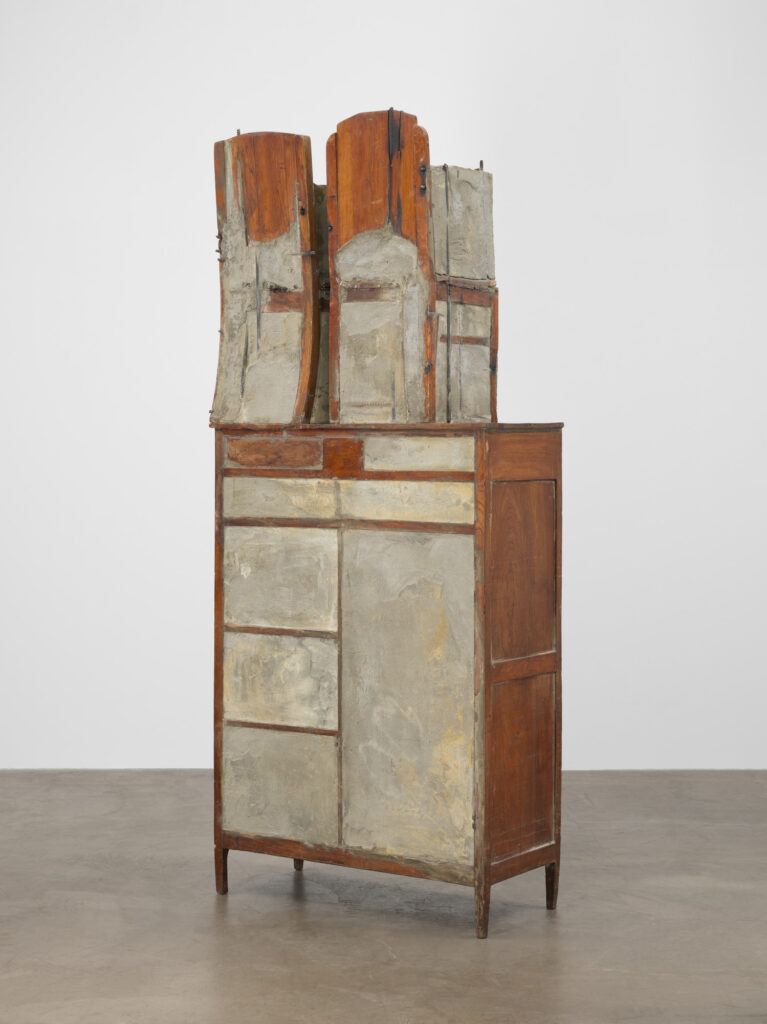
The object in the image is based on a vertical, old-fashioned wooden cabinet, with a narrow vertical dimension almost at the height of a human being. The bottom still reveals the door, drawer compartments, side panels, and four slender legs; however, the structure intended to provide storage, opening and internal space was largely sealed with grey-white hard padding. The upper part has several high and low wooden panels that extend upward, like doors that are squeezed shut or fragments that cannot be closed; between the two higher panels, narrow and deep black fissures remain; the narrow and deep black gaps between the two central panels make the whole appear almost like a body that has been forcibly sewn together but still continues to tear. The colors are extremely restrained: the dark brown and ochre wood retains the warmth and intimacy of everyday furniture; the grey-white, ochre-colored padding, however, brings a cold, hard, sedimented, and blood-like feeling. The wood texture remains clear in some areas, but is covered with rough mortar, interrupted by cracks, particles, and edge loss; several nails, metal parts, and exposed seams have not been repaired, indicating that the production was not intended to restore the furniture’s integrity but rather to impose the actions of strengthening, sealing, and squeezing as a legible visual language. The original rectangular order of the cabinet remains intact, but is disrupted by asymmetrical sealing and the uneven contours of the top. In particular, the door panels sealed at the bottom turn the “interior” from an accessible space into an untouchable weight; the furniture’s function is eliminated, and the memory of everyday use is preserved. The materials here are not decorative collage: the wood assumes the associations of a dwelling, body scale, and private life; the hardened gray substance, in turn, by its weight, blocking properties, and irreversible nature, presses these associations into a silent but persistent manifestation. Doris Salcedo has long been working through the absence, trauma, and obscured experiences of life in everyday objects. In this image, the work does not reconstruct events through narrative imagery; rather, by sealing off structures, damaged surfaces, and difficult-to-open gaps, it makes visible how violence enters the scale of the home and how memories are solidified into material resistance, gaining a low but persistent manifestation.
Work 02
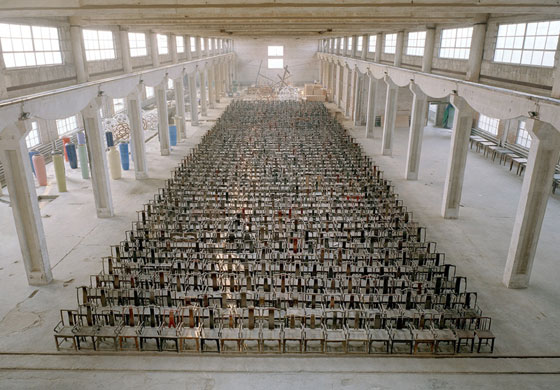
The image presents a long, industrial space that has not yet been completed or is left as a rough state. High windows, concrete beams, exposed floors, and vanishing perspectives in the distance together form a stark, almost institutionalized container. The work occupies the center of the hall, composed of a dense array of wooden chairs; they are arranged in alternating rows of extremely wide horizontal borders, forming a strong, ladder-like structure. The chairs are intended for use in everyday life as furniture for serving, waiting, chatting, and gathering; here, however, they lose their scale of being used individually. The backs, legs, and crossbars of the chairs are repeatedly interchanged, forming surfaces that approximate a grid, fence, or compressed architectural framework. The front row of chairs is still recognizable; the further back you go, the denser the dark brown particles become, creating a strong, ladder-like mass of volume. The chairs are essentially everyday furniture designed to serve the purpose of sitting, waiting, chatting, and gathering; here, however, they have lost their scale of being used individually. The backs, legs, and crossbars are arranged in alternating rows, forming surfaces that are almost grid-like, fence-like, or compressed architectural frameworks. The front row of chairs is still recognizable; the further back you go, the denser the dark brown particles become, creating a strong, ladder-like mass of volume. The chairs are essentially everyday furniture designed to serve the purpose of sitting, waiting, chatting, and gathering; here, however, they have lost their scale of being used individually. The backs, legs, and crossbars are arranged in alternating rows, forming surfaces that are almost grid-like, fence-like, or compressed architectural frameworks. The front row of chairs is still recognizable; the further back you go, the denser the dark brown particles become, creating a strong, ladder-like mass of volume. The chairs are essentially everyday furniture designed to serve the purpose of sitting, waiting, chatting, and gathering; here, however, they have lost their scale of being used individually. The backs, legs, and crossbars are arranged in alternating rows, forming surfaces that are almost grid-like, fence-like, or compressed architectural frameworks. The front row of chairs is still recognizable; the further back you go, the denser the dark brown particles become, creating a strong, ladder-like mass of volume. The chairs are essentially everyday furniture designed to serve the purpose of sitting, waiting, chatting, and gathering; here, however, they have lost their scale of being used individually. The backs, legs, and crossbars are arranged in alternating rows, forming surfaces that are almost grid-like, fence-like, or compressed architectural frameworks. The front row of chairs is still recognizable; the further back you go, the denser the dark brown particles become, creating a strong, ladder-like mass of volume.
Work 03
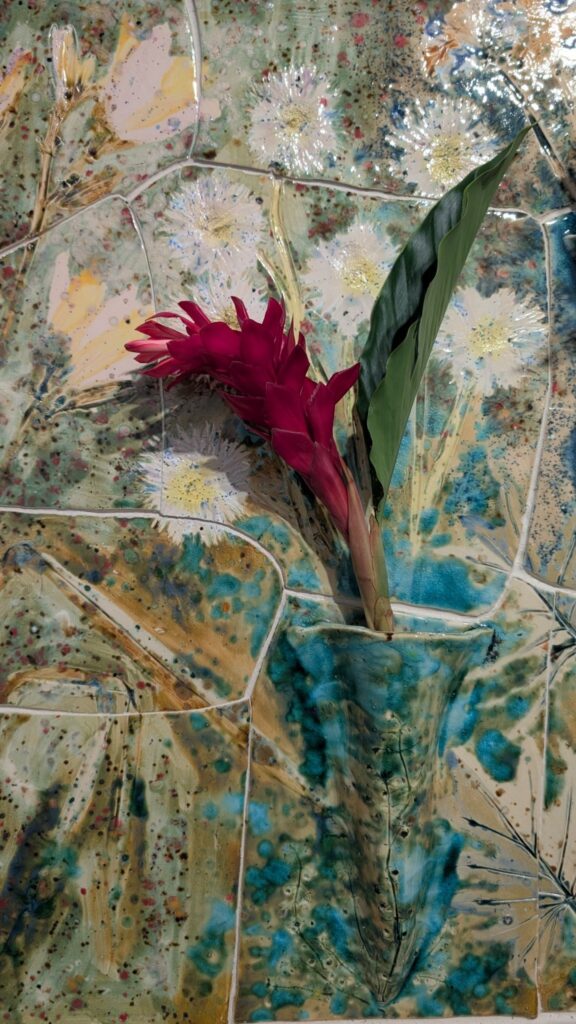
The image is a deep red flower and its green leaves, the visual core of the composition. The stem grows obliquely upward from a shallow container at the bottom, and the flowers that unfold from the left side of the container and the long leaves extending from the right side form asymmetrical tensions. The background is not neutral, but a whole field of cut-up floral patterns: milky-white, pale green, ochre and blue-blue intermingle, interspersed with brown-red and deep-green spots, forming a vague visual of a worn wallpaper, glazed panel or textile-pressed fabric. The saturated deep red of the center flower therefore stands out particularly, without creating a clear celebratory sense. Instead, it appears as a fleeting sign of life amidst a murky and damaged environment. The surface is composed of a large number of irregular fragments, the cracks are clearly marked by shallow-colored seams; although the fragments have been reassembled, they cannot be restored to a smooth, continuous plane. The seams form a web of obstruction and confinement around the flowers, also integrating the container, background patterns and plant images into a fragmented structure. Visible are high-gloss reflections, glazed-like luster, dense pore points, flowing color marks and granular deposits, suggesting that the surface underwent firing, glazing, dyeing, printing or other handling processes that solidified the image into material. The floral patterns are not merely drawn: some contours appear to be pressed in or retained under a translucent layer, thereby carrying the depth of being sealed, impregnated and worn. The structural fractures and chromatic complexity form key relationships. Originally soft, everyday floral ornaments are cut into fragments; the green-stained stains and brown-spotted patches weaken the decorative pattern’s pleasantness; real plants intervene with their vivid, moist and voluminous forms, and the plants pressed into the background, flattened and solidified, form a contrast to the flowers that are pressed flat and solidified in the background. The container acts as both a vase supporting life and a fragile receptacle for broken fragments. This approach to placing everyday objects, traumatic fractures and meticulous repair in juxtaposition, echoes Salcedo’s long-standing artistic practice of how private life can bear collective violence, loss and mourning. The work does not identify any direct narrative events; instead, meaning is generated by the damage state of the materials, the difficult to smooth seams and the fragility of the plants’ survival. The importance of this work lies in the fact that it does not transform the broken into pure beautification; rather, the repairs themselves retain the wounds’ shape, making the viewer a fleeting observer of the absence, memory and the slow recognition of care work.
Work 04
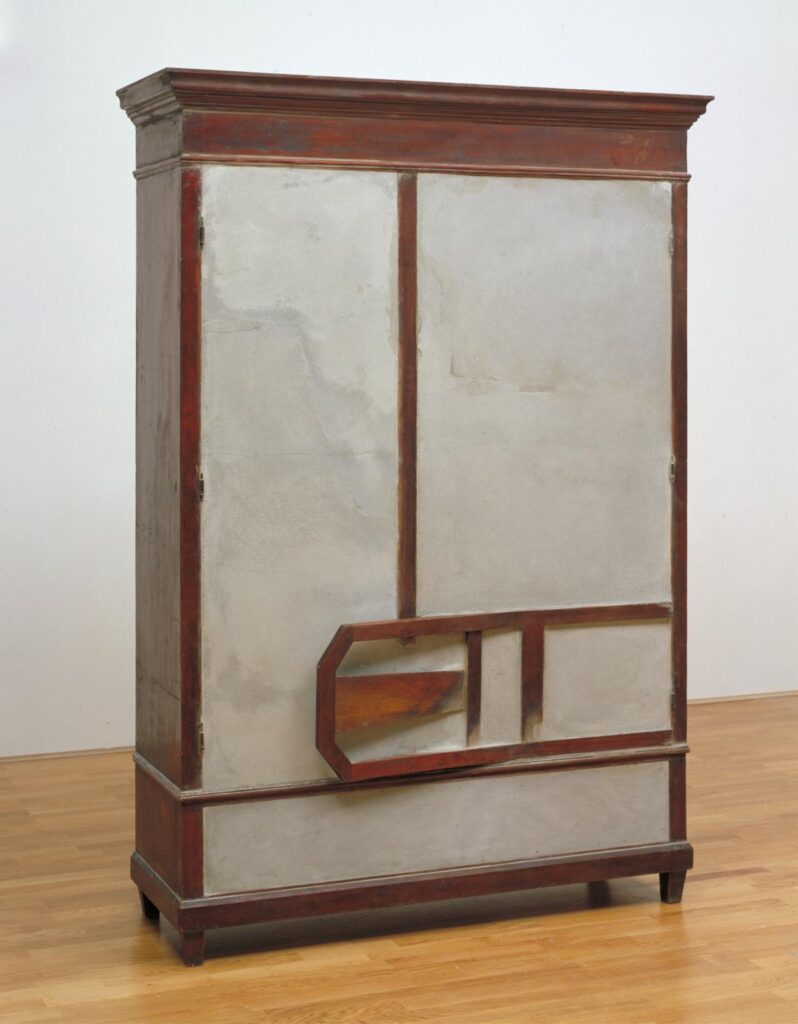
This work occupies a space in the form of a high, narrow, old-style cabinet. The front of the cabinet approximates the architectural facade: heavy top rails, base, vertical frames, and two large areas of light-colored panels form a stable, closed rectangular order. The cabinet door is not fully closed in the normal way; instead, it is detached from its original vertical structure and hangs horizontally in front of the cabinet; its left-side fold forms a prominent obstacle to the elements intended to open and close the cabinet and to provide concealment and protection; the component that was used to open, close, and conceal has therefore become a structure that obstructs the body’s line of sight and action. The entire work thus has a distinct sense of imbalance: the upper part maintains the furniture’s stately symmetry, but the lower part is interrupted by a dislocation that is difficult to restore. The colors are compressed between dark red brown wood, gray-brown shadows, and a murky milky white. The remaining deep red lacquer on the wooden frame no longer has decorative warmth; instead, it is like a sediment of old traces. The large areas of light-colored panels lose their transparency or reflectivity, revealing mottled, foggy, and slightly cracked states. They are both glass that is obscured by the cabinet and thin films or padding attached to the frame’s interior side. The viewer cannot penetrate the cabinet; the basic function of the furniture—the “internal containment”—is cancelled by the visual opacity. The key to the production lies not in shaping the external image, but in preserving and enhancing the inherent temporality of the object. The details, such as the rounded corners, the painted layers, the exposed hinges, and the misaligned door frames, do not make the structural damage appear as dramatic explosions, but rather as the persistent consequences of pressure left behind over time. The horizontal placement of the cabinet door still maintains the original wooden components, connections, and panel organization; therefore, it is not an added sculptural component, but rather a remnant of the furniture’s inherent relationship to function that was rewritten after the initial design. The precise dovetail-style frame still displays the original utilitarian rationality; the partial twist and blocking are increasingly imperceptible as the pressure of time remains. This treatment corresponds to Doris Salcedo’s ongoing concern with the absence, trauma, and the ethical weight of everyday objects. The work does not directly reproduce violent events, but allows an object related to family life, intimate storage, and safe living to be discarded. The closed panels refuse to reveal the interior; the misaligned doors again turn into obstacles that obstruct entry and exit; the silence of the materials, the dullness of the colors, and the structural disorder together transform the invisible losses into perceptible spatial experiences. The viewer is not confronted with the nostalgia of the furniture; rather, the order is a rupture that cannot be repaired beneath the surface.
Work 05
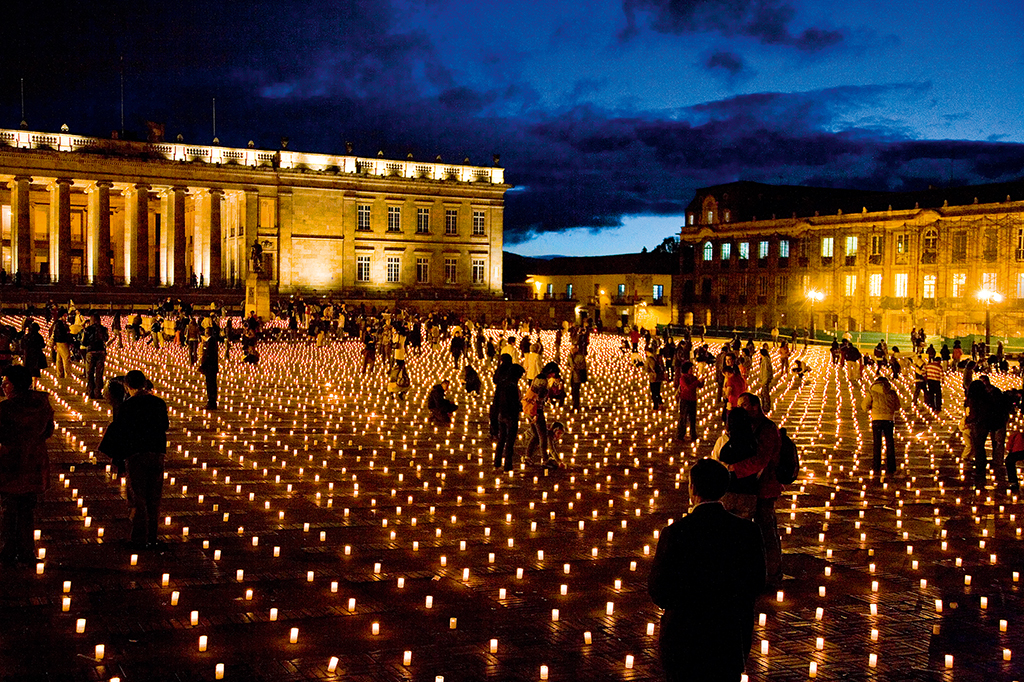
The square in the nightfall is covered with thousands of small, low, warm candles. The open stone pavement, originally used as a symbol of urban power and history, has been transformed into a grid of light that is almost borderless. The image is surrounded by grand classical and Republican buildings on both sides: the colonnade on the left, the facade on the right, and the dark outline of the buildings in the distance, all forming a stable, solemn and institutionally-meaning spatial framework. In contrast, the ground beneath the candles is not arranged in a strictly mechanical way; they are spread roughly along brick seams or parallel lines, and in some places they are loosened or broken due to the placement, burning, and human walking. This structure, which accumulates from tiny units, forms a whole that no longer merely commemorates a monument; it is a public space occupied and continuously lit by temporary occupants and passers-by. The strong contrast between the colors of the night sky, the dark shadows of people, and the warm glow of fire creates visual weight for each weak light. The white or semi-transparent shell of the candle holds the flame within tiny vertical volumes, making the light not a diffuse illumination but rather a series of individual highlights marked and preserved by accumulation. The materials here exhibit a distinct fragility and temporality: the candle will melt, the flame will flicker or extinguish, and the thin, paper-like containers are easily affected by wind, moisture, and foot traffic. It is these uncontrollable surface conditions that make the work’s order not equivalent to a monumental permanence. The people in the image bend, stand, and walk, changing the scale of the viewing and demonstrating that the installation requires continuous placement, maintenance, and communal participation; bodily action becomes part of the structure’s establishment. Combining Salcedo’s consistent approach to touching upon violent histories through everyday objects, spatial trauma, and public mourning, this image can be understood as a minimalist, repetitive material action that confronts attempts at forgetting and abstract statistical representation. She does not replace the deceased with oversized images, but instead juxtaposes the irreplaceable micro-light in a public square: the vulnerability of the individual is preserved, and the collective scale is revealed through accumulation. The solidity of the architecture represented by the monument, the brief candlelight on the ground, and the slow labor of the participants are mutually constraining, making the memorial not merely a viewing object but rather a moral relationship practiced in a public space.
Work 06
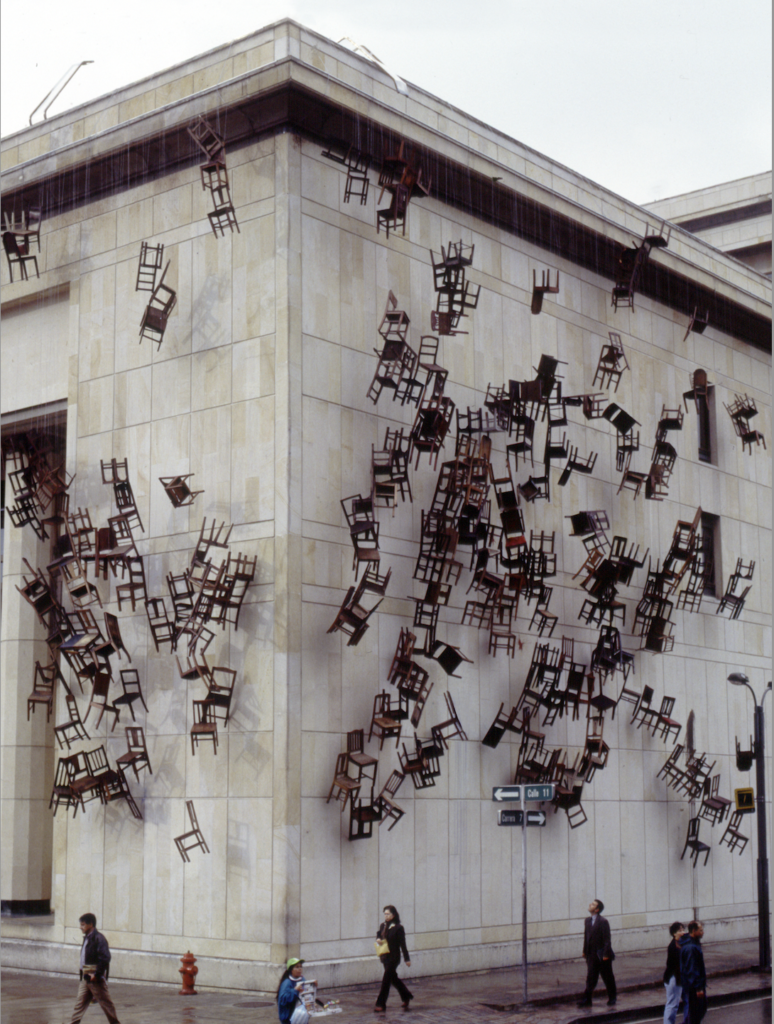
The image is taken from a street corner in a light-colored stone building, with the perspective slightly tilted upward, making the wall appear as a vast interface of vertical surfaces. A large number of dark brown to near-black wooden chairs are detached from their everyday indoor scale, suspended, perched, or piled on top of the high walls; they appear sporadically from below the eaves, suspended in a continuous aggregation towards the center, then dispersed into a disorganized remnant near the ground level. The direction of the chairs is completely disordered: some are upright, others are tilted backward, some are turned upside down, the legs of the chairs intersect into a chaotic and sharp linear grid. The order established by the original arrangement of neatly laid stone tiles, horizontal eaves, and vertical corners is disrupted by the furniture that is constantly skewed and tilted. The light-gray walls assume a near-calm, administrative function; the dark-colored wooden chairs resemble shadows deposited on the surface; rainwater and moisture further depress the colors, making the wood appear aged and dull after being subjected to wear and tear. The chairs are not presented as a complete ensemble, but rather as visible elements that are attached to the wall in a manner that draws near, fixes, or supports them; the partial overlapping and hanging of the dark-colored wood chairs creates a state of instability between falling and solidification. Wood furniture is usually intended for carrying heavy objects and for sitting down; here, however, the horizontal ground is lost, seating is not available, and the backs and seats instead become fragile skeletal structures that are suspended towards all directions. The repetitive units of handmade furniture no longer point to specific domestic situations; instead, they form a group of traces that cannot be counted quickly or identified individually. The visible shadows of the chairs on the wall create a second layer of image: the real objects, the shadows, and the seams of the stone join together, creating an installation that is both weightless and seemingly poised to move at any moment. The pedestrians in the street, the street signs, the fire hydrants, and the lamp posts retain the normal scale of the real city; this precisely highlights the dysfunction of the wall-based events. The artist does not present characters directly in narrative form, but instead replaces the bodies with objects left behind and transferred from everyday life. In the artist’s consistent approach to violence, missing persons, mourning, and social memory, this handling of furniture outside the public building may be intended to push the container of private life into the institutional space: the chairs suggest the position once occupied by the absent ones, and because of the piling, hanging, and weightlessness, they refuse to provide a reassuring memorial. The oldness of the materials, the imbalance of the structure, and the cold, hard order of the architecture together create a state of unrectified memory, lingering on the surface of the city in a continuously visible state of blockage.
Work 07
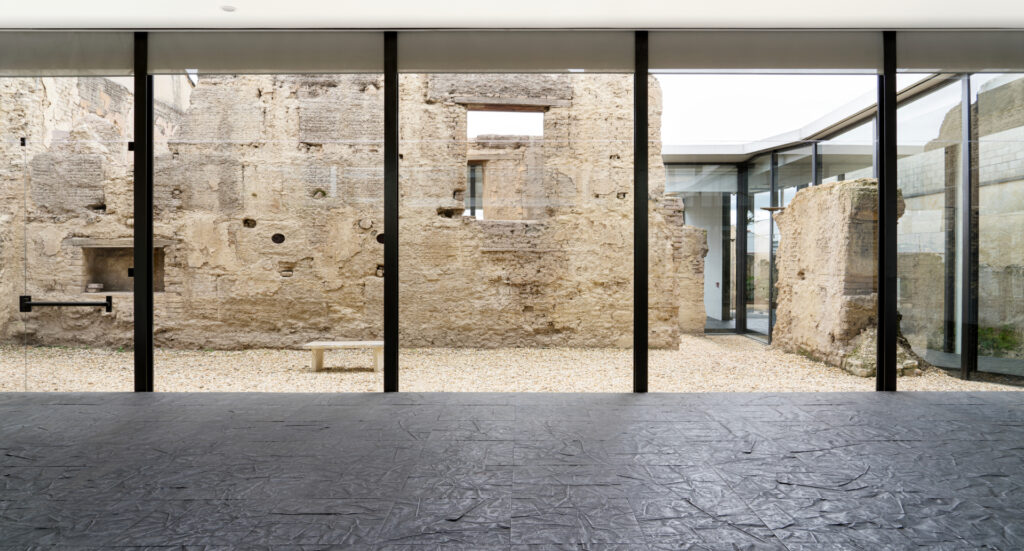
The image is viewed from a high-altitude, transparent glass interface: the viewer stands on a dark grey ground in the interior, separated by a glass partition that divides the interior into two parts. The foreground ground occupies almost half of the image, with a strong horizontal extension; the background, consisting of light-colored rubble stones, forms a transition; the rough, thick stone walls, on the other hand, constitute a visual focus through irregular fragments, holes and window openings. The glass should have provided transparent viewing conditions, but its reflection, horizontal seams and black structural columns simultaneously suggest the presence of a barrier. The space is therefore not directly open, but a historical site protected, cut and delayed in arrival. Color is strictly compressed into a low saturation range: the walls consist of gray-yellow, brown-earth tones, revealing the time layers of weathering, peeling and repair accumulated over time; the rubble stones enhance the dryness of the foreground; the interior ground is a cold gray to near black, contrasting with the warm and fragile wall surfaces. Especially the ground is not flat and seamless; the surface reveals dense folds, cracks, pressure marks and interlocked textures; the boundaries of the square blocks are still discernible, but weakened by surface irregularities. This state of order in coexistence with the damage makes the ground resemble a layer of skin pressed down but still unable to completely smooth out. From the visual evidence, the way the walls were made or preserved emphasizes the raw weight of the materials: rammed earth, masonry, filling and erosion left different densities of particles, cracks and gaps. In contrast, the foreground ground is clearly manmade and has been treated with a surface that accentuates the dryness of the architecture. The glass’s smoothness and the metal frame’s straight lines, as well as the collapse of the ruins wall, constitute a tension between contemporary architectural techniques and historical remnants. This treatment corresponds to Doris Salcedo’s consistent working method: she often avoids reproducing violence in straightforward narratives, but by using furniture, architecture, everyday materials or the anomalous state of the ruins wall, she brings the absence, trauma and unspeakable social memories to material form. The most crucial aspect here is not the ruins as a backdrop for display, but the viewer’s body placed between the cold, hard, wrinkled ground and the inaccessible walls. The silence of the materials, the pressure sensation of the surface and the distance caused by the glass constitute a visual tension between the contemporary architectural techniques and the historical remains. This treatment fits in with Doris Salcedo’s consistent working method: she often avoids reproducing violence in straightforward narratives, but by using furniture, architecture, everyday materials or the anomalous state of the ruins wall, she brings the absence, trauma and unspeakable social memories to material form. The most crucial aspect here is not the ruins as a backdrop for display, but the viewer’s body placed between the cold, hard, wrinkled ground and the inaccessible walls. The silence of the materials, the pressure sensation of the surface and the distance caused by the glass constitute a visual tension between contemporary architectural techniques and historical remnants. This treatment fits in with Doris Salcedo’s consistent working method: she often avoids reproducing violence in straightforward narratives, but by using furniture, architecture, everyday materials or the anomalous state of the ruins wall, she brings the absence, trauma and unspeakable social memories to material form. The most crucial aspect here is not the ruins as a backdrop for display, but the viewer’s body placed between the cold, hard, wrinkled ground and the inaccessible walls. The silence of the materials, the pressure sensation of the surface and the distance caused by the glass constitute a visual tension between contemporary architectural techniques and historical remnants. This treatment fits in with Doris Salcedo’s consistent working method: she often avoids reproducing violence in straightforward narratives, but by using furniture, architecture, everyday materials or the anomalous state of the ruins wall, she brings the absence, trauma and unspeakable social memories to material form.
Work 08
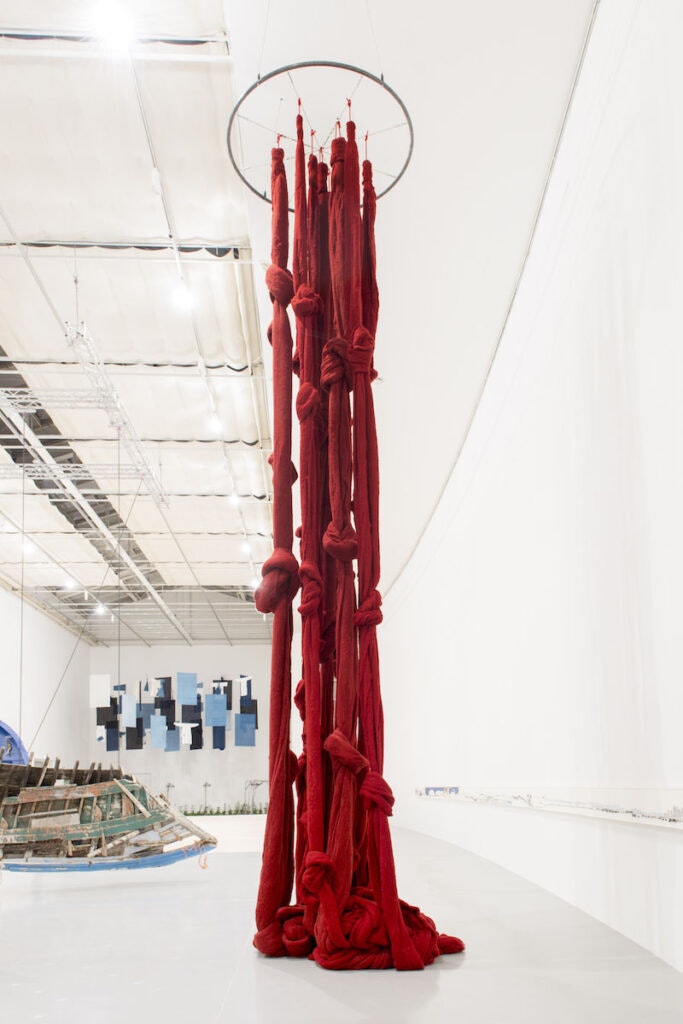
The image consists of a vertical core composed of a bundle of deep red fibers suspended from above. At the top, a slender metallic ring can be seen; dozens of thin, slender, flexible strips of material hang from the ring, extending and twisting towards the ground, eventually accumulating into heavy, irregular masses. The ring provides an almost geometric, restrained boundary; however, the fibers below shift, twist and expand; the orderly arrangement of the hanging becomes progressively entangled and compressed; the uniform suspension order gradually transforms into a body-like structure of entanglement under the influence of gravity. The work thus possesses a clear process of structure from control to loss of control, from suspension to fall. The red color is the only highly saturated color in the image. It is strikingly vivid in the context of the white hall and the gray-white ground; it makes the soft materials simultaneously appear warm, heavy and warning. The color is not treated as a uniform, flat coating: the texture of the fiber surface, the layers of wrapping and the light that shadows them create a deep red that is not only visible as a trace left by the handling technique but also causes localized blocking, tightening and volume increase; the linear rhythm of the drooping is thus repeatedly interrupted. The material clearly retains its properties of softness, flexibility and ease of adhesion to gravity. They are not sculpted into stable sculptural forms; they are presented as suspended, bound, wrapped and stacked materials. The small suspension lines almost disappear from the surface of the ring above, allowing the viewer to first perceive the weight of the thick fibers at the bottom; the accumulation on the ground, in turn, reveals that the material cannot be completely retracted upward. The cold hardness of the metal ring and the softness of the fibers create a contrast with the clean space of the hall; this creates a tension in the work between the few constituent elements. Placed within the artistic path of Doris Salcedo’s long-standing interest in the absence, trauma, repressed memory and material witness, this image can be understood as a means of expression that avoids direct narrative. It does not reproduce figures or events; instead, through the state of the materials suspended, bound, wrapped and dropped, it mobilizes the viewer’s perception of the body, load and the things that are difficult to disentangle. The material is not a decorative textile language; it becomes a structural medium that carries time, labor and fragility; the bright red is not just a visual emphasis; it transforms the silent hanging objects into an almost wound-like intensity.
Work 09
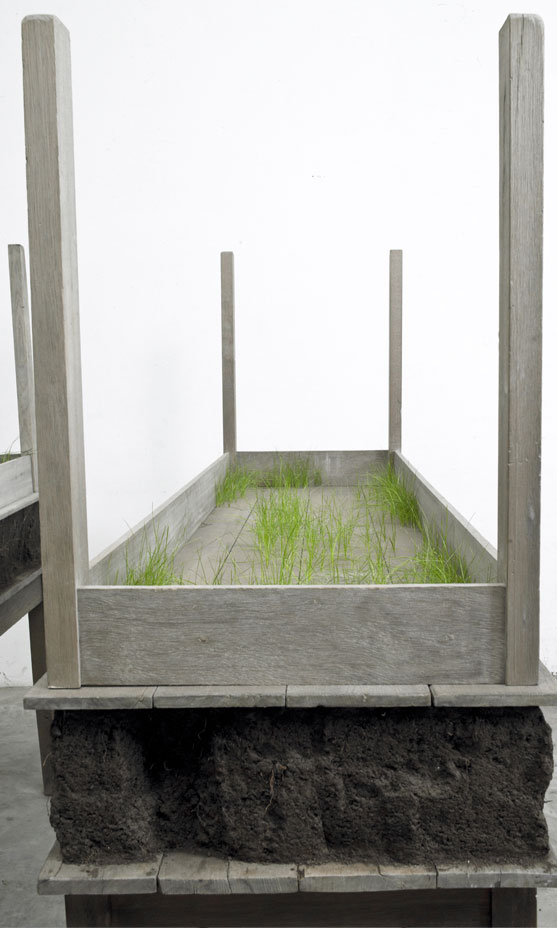
The work presents a vertical installation made of grey-brown wood elements, mud, and fine, weak grass shoots. The main structure resembles furniture frames that have been turned upside down or reassembled: four clearly defined upright columns frame a narrow interior space, with horizontal panels forming low, sloping interfaces that obstruct the view and the body from entering; the bottom is sandwiched between a large block of dark, coarse soil. The interior of the wooden structure reveals a flat, grey surface on the bottom, on which sporadic green grass leaves sprout. The spatiality of the work thus presents a dual orientation: on the top, it resembles an empty, unusable container; on the other hand, it seems to carry layers of compacted, sealed soil. The overall color is strictly confined to grey, brown, black, and green. The weathered grey wood eliminates the warmth and decorative qualities often found in everyday furniture, giving it a muted, dry, almost architectural appearance; the black soil absorbs light, creating a visual weight; the green of the grass, though extremely weak, is particularly striking due to the low saturation of the surrounding hues. The work does not constitute a clear symbol of vitality; instead, it is a sign of time that occurs continuously and cannot be completely erased by human intervention. The wood surface retains its vertical graining, seams, edge wear, and partial unevenness, indicating that it was not treated into sterile, minimalist forms. The soil block has not been completely regulated either: its collapse, knots, and granular texture give it a realistic sense of weight and humidity. The grass emerges from the narrow gaps in the plane and edges, suggesting that its growth conditions are fragile and subject to frame control. The linear lines of the wood panel, the loose texture of the soil, and the resilience of the plants all contradict the natural material’s status as a purely minimalist form. The wood surface retains vertical graining, seams, edge wear, and partial unevenness, showing that it is not treated into sterile, minimalist forms. The soil block has not been completely regulated either: its collapse, knots, and granular texture give it a realistic sense of weight and humidity. The grass emerges from the narrow gaps in the plane and edges, suggesting that its growth conditions are both fragile and subject to frame control. The straight lines of the wood panel, the loose texture of the soil, and the resilience of the plants all counter each other: the craftful support, enclosure, and imposition create a physical layer that is no longer a landscape but rather a testimony to time that has been accumulated and sealed away. The value of this treatment is in the restrained material language, allowing the absent, repressed memories and tenacious, tiny remnants to be given a form that can be contemplated.
Work 10
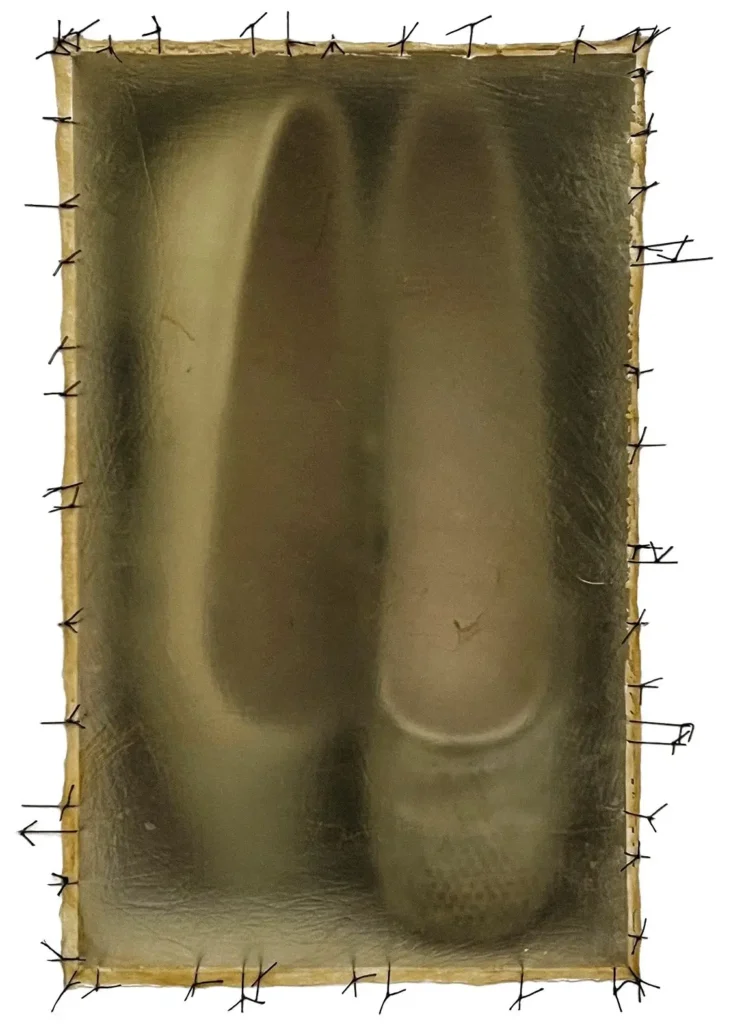
The image is composed of a horizontal, roughly leather-like or thick fabric brown-gray surface, with irregular light yellow edges preserved around the perimeter and stitched together in a dense, exposed manner by numerous black lines. The border was intended to function as a binding of the image, but due to the varying lengths of the stitches, the disorderly arrangement and the many protruding headlines, it presents a tension that is almost like a makeshift fix or a wound stitching. The center is not drawn as a figure; rather, the material is pressed, pulled, or covered, resulting in a longitudinal concave-convex pattern: the upper part is narrowed, the middle section is slightly outward, and the lower part forms a rounded, blunt outline. It is both reminiscent of a shrouded body scale and at the same time refuses to become a recognizable figure; the body is almost pressed into the skin, leaving only incomplete evidence of presence in the shadows, raised areas, and edge folds. The colors are strictly controlled between dark brown, gray green, ochre, and black. The brighter yellow brown in the center is not warm and decorative; instead, it appears like a layer of worn, aged skin under the pressure of surrounding dark areas. The light gradually fades along the concave edges, making the body almost like a delicate embroidery, yet at the same time refusing to become a recognizable figure; the form is almost pressed into the skin, leaving only shadows, raised areas, and edge folds to bear the incomplete presence. The tightly controlled use of dark brown, gray green, ochre, and black. The brighter yellow brown in the center is not warm and decorative; instead, it appears like a layer of worn, aged skin under the pressure of surrounding dark areas. The light gradually fades along the concave edges, giving the body almost like a delicate embroidery, yet at the same time refusing to become a recognizable figure; the form is almost pressed into the skin, leaving only shadows, raised areas, and edge folds to bear the incomplete presence. The tightly controlled use of dark brown, gray green, ochre, and black. The brighter yellow brown in the center is not warm and decorative; instead, it appears like a layer of worn, aged skin under the pressure of surrounding dark areas. The light gradually fades along the concave edges, making the body almost like a delicate embroidery, yet at the same time refusing to become a recognizable figure; the form is almost pressed into the skin, leaving only shadows, raised areas, and edge folds to bear the incomplete presence. The tightly controlled use of dark brown, gray green, ochre, and black. The brighter yellow brown in the center is not warm and decorative; instead, it appears like a layer of worn, aged skin under the pressure of surrounding dark areas. The light gradually fades along the concave edges, making the body almost like a delicate embroidery, yet at the same time refusing to become a recognizable figure; the form is almost pressed into the skin, leaving only shadows, raised areas, and edge folds to bear the incomplete presence. The tightly controlled use of dark brown, gray green, ochre, and black. The brighter yellow brown in the center is not warm and decorative; instead, it appears like a layer of worn, aged skin under the pressure of surrounding dark areas. The light gradually fades along the concave edges, making the body almost like a delicate embroidery, yet at the same time refusing to become a recognizable figure; the form is almost pressed into the skin, leaving only shadows, raised areas, and edge folds to bear the incomplete presence.